Saturday, April 27, 2013

R L Allan & Sons' The Holy Bible (KJV)


Allan Oxford Longprimer Ref Ed. (KJV) 2009.  1264 pages, plus concordance and full-color maps.  Octavo.  Highland Goatskin.
Available in three colors: Black, Brown, and Dark Blue.
Also available in Black French Morocco.

Stay calm, dear readers.  Before many of you go fleeing into the shadows like exorcised demons at the sight of a Bible on this blog, I'd like to include a quick reminder about the book's very long history in the Western Esoteric Tradition.  Its ubiquity, and questionable interpretations, should not overshadow its importance, for it is without question one of the most influential books in all of Western magic and a keystone of the Western Esoteric Tradition.  It is the talismanic book par excellence.  The Book of Psalms in particular is an ancient magical formulary, as David Rankin expertly points out his his book The Book of Gold - the Magic and Spells of the Book of Psalms.  I also urge my readers to check out David Chaim Smith's book, The Kabbalistic Mirror of Genesis: Commentary on Geneis 1-3 for a deeper exploration of Kabbalistic meaning in the Book of Genesis.

All magical traditions in Europe (and many beyond) were in some way impacted by Christianity, even the Sami shamans of the remote boreal forests of northern Scandinavia did not escape the influence (and tyranny) of Christianity.  This fact cannot be avoided, regardless of ones distaste for Christianity's theology and its followers.  Many of its tenets, beliefs, and symbolism are written into the very DNA of the Western Esoteric Tradition.

It should also be noted that for the last thousand years the vast majority of European magicians, sorcerers, conjurers and cunning folk where Christian.  The same holds true in America.  Alchemists,  root-workers, pow-wows, and mystics have been overwhelmingly Christian since the days of the Puritans.  In Grimoires - A History of Magic Books, author Owen Davies writes, "American treasure seekers seem to have relied mostly on the Bible and the psalms rather than magical conjurations,...".   Regarding the Bible, Davies also states:
Some books were also used as protective talismans.  The most obvious example is the Bible, which people placed under their pillow to protect them from witches and evil spirits, or touched when swearing oaths.  It was also used in popular divination. By placing a key at certain passages in the Bible, binding and then suspending it, the divine power enshrined in the 'good book' would make it turn in response to the name of a thief.  The Bible was obviously not a grimoire, but the power of the words, stories, psalms, and prayers it contained, as well as its holiness as an object, made it the most widely used magical resource across the social and cultural spectrum over the past thousand years. ... in the Christian world, the Bible has always been thought a necessary companion of the grimoire, and both were required to make magic.

It is for these reasons that I feel the Bible is an essential book in any esoteric library.

The book also happens to feature one of my favorite protagonists in a prominent role.


Unlike most of my reviews, I will not be commenting on the written content of the Bible.  That shouldn't be difficult to find elsewhere.  Instead I intend to help my readers navigate through the ocean of Bibles available on the market and choose a quality edition that is right for them.  I do not approach this from a belief standpoint, but rather one of functionality.

There are countless Bibles on the market, so deciding on which one is right for you can be a daunting task. The options are virtually endless.  However, there were a few traits and features I was looking for which aided me in narrowing down my choices.  These are as follows:

  • Fine binding and quality construction (preferably leather).
  • English language for ease of use. (Unfamiliar languages can be useful too.  More on this later)
  • A traditional translation, yet not too removed from modern English.  The King James Version is the best fit for me. 
  • Not too small - not too large.  I didn't want to squint to read fine print.  I also wanted something that didn't require a lectern.  
  • A traditional look and feel


After a considerable amount of research I decided the Bible best suited to my needs was the Allan Oxford Longprimer Ref Ed. (KJV).  It met all of the criteria above.  But don't just take my word for it: It is also a favorite among many Bible enthusiasts.  One of my favorite reviews comes from this gentleman below.  Book lovers come in all varieties.  I admire his obsessive enthusiasm -- it's almost infectious.  One wasn't enough; he had to get all three colors and a stack of variations:


Like the gentleman in the video review above, it is not uncommon for people to own multiple copies/editions of the Bible.  In some cases it can prove useful to have a copy printed in a language one is unfamiliar with, such as the Latin Vulgate Bible (if one doesn't know Latin).  Finding one is easy, as the Bible is the most widely translated book in the world.  Why own a copy one can't understand?  The reason for this is simple: when one reads passages in an unfamiliar language it amounts to a "barbarous tongue" to one's ear and bypasses normal logic circuits of the brain.  Meaning is experienced abstractly through auditory channels, much like listening to instrumental music, rather than via normal verbal cognition.  Passages are felt rather than understood, at least on a rational level.  Speaking in alien tongues is also an effective tool for putting the reader into a totally different 'head-space' outside the norm.  For example, I have bi-lingual Bible printed in Pennsylvania Dutch, an obscure dialect of German, for just this purpose.  I am totally unfamiliar with this dialect, yet when I read passages I feel as if I am invoking a distinct magical aesthetic that is highly appropriate for some workings.


The R L Allan Longprimer is bound in full Highland goatskin with a limp binding.  This is a traditional style for Bibles, making them very flexible, easy to carry, and use.  The limp binding is extremely pliant and soft.  One can even roll the book up and bend it into all sorts of configurations without harming the binding.  This is a practice Bible aficionados amusingly call "Bible yoga".

Normally a photo like this would make me cringe, but the limp binding
of the R L Allan Longprimer is intended for this sort of "Bible yoga".
The Highland goatskin has a luxurious, heavily gained texture, and has a full 1/2 inch overlapping yapp.  The yapp is the part of the book's cover that extends beyond the text block on top, bottom, and side.  With a limp binding the yapp can bend around on the sides of the text block to help protect it.  The title is gilt stamped on the cover and spine.  The spine also includes five bands.


A close-up of the book's yapp.


The inside covers are accented with two gilt lines.  Cover page and end page are navy blue with a linen texture and are reinforced with leather to add strength to the binding.  Other indications of quality are readily apparent.  The publisher states,
This Bible has the distinctive 'overcasting' feature which used to be standard on quality binding. Basically you will find a extra line of stitching about 1/8 of an inch from the middle stitch, usually in Genesis and Revelation. This feature adds to durability and a feature of old school craftsmanship.


Head and tail bands are white.  Page edges are colored red and gold gilt.  This creates a lavish effect, as the page edges change color depending on how they are held to the light.  Three royal blue silk bookmarks are included to mark multiple passages.  I find this extremely handy.


As with most Bibles, the pages are thinner than most books, hence the paper phrase "Bible thin".  This is a necessity due to the page-length of Bibles.  However, the R L Allan Longprimer has far better pages than most.  They are solid without feeling like "onion skin" and have minimal ghosting.  Text is clear and sharp in 10 point bold, divided into dual columns, and includes center column references.


The book includes presentation pages for family history such as births, marriages, and deaths.  This is a common inclusion in Bibles, as many become family heirlooms.  The book concludes with a full concordance, full color maps, and over thirty lined pages for personal notes.


Overall the R L Allan Longprimer Bible is an impressive and handsome book.  Its solid construction and practical design make it a great choice for both Christians AND magicians.  When open it will lay completely flat, freeing one's hands for other ritual tools.  It is an essential companion to most traditional grimoires and a primary talismanic tool in many charming traditions.


Sunday, March 31, 2013

Volubilis Ex Chaosium by S. Ben Qayin


Dark Harvest Publishing 2012.  133 pages.  Octavo.  Black and white illustrations.

Available in two editions:

Chaosium Edition: Trade hardcover limited to 478 hand-numbered copies.
Deluxe Priesthood of Irem Edition: Full goat skin, limited to 37 signed copies. Sold out at publisher.

Volubilis Ex Chaosium is the most recent edition to an ever-growing library of occult works inspired by the writings of legendary American horror writer H.P. Lovecraft.  For nearly forty years occult writers have used Lovecraft's works as a foundation for esoteric exploration.  One of the earlier examples is Anthony Raven's The Occult Lovecraft, published in 1975 (a slim booklet limited to 990 numbered copies).  The author makes note of occult references throughout HPL's fiction and explores the depth of HPL's knowledge was on the subject.  This was followed by the infamous 'Simon' Necronomicon in 1977 and another so-called Necronomicon edited by George Hay shortly after in 1978.

 Since then there has a been a near-constant stream of occult Lovecraftiana.  The works of Kenneth Grant draw heavily from the cosmic horror of HPL, often comparing HPL's trans-dimensional alien gods to grim qliphotic entities.  More recent additions to the ever-growing corpus include Liber Yog-Sothoth by John J. Coughlin, Cthulhu Cult by Venger Satanis, and a number of others.  These books range from delightfully creative to utter nonsense.  There are even, not one, but TWO, different Lovecraft inspired tarot decks available.

A number of these writers (though not all) believe HPL's stories are not entirely fiction and that his works contain a hidden and very ancient magical current.  This notion is particularly popular among Chaos Magic practitioners who often find HPL's colorful pantheon of gods and monsters irresistible, as it lends a gleefully eldritch veneer to their workings.  In fact, in my experience, it is one of the most popular paradigms utilized by chaotes.  However, the concept can be somewhat problematic considering HPL did not believe in magic or the supernatural, as can be seen clearly in this quote from one of his letters,
“All I say is that I think it is damned unlikely that anything like a central cosmic will, a spirit world, or an eternal survival of personality exist. They are the most preposterous and unjustified of all the guesses which can be made about the universe, and I am not enough of a hair-splitter to pretend that I don't regard them as arrant and negligible moonshine. In theory I am an agnostic, but pending the appearance of radical evidence I must be classed, practically and provisionally, as an atheist.” -- H.P. Lovecraft
Even so, there is of course the possibility that HPL was an unwitting accomplice.  Many of HPL's best works were directly inspired by dreams.  Thus it is theorized the contents and themes of some of his stories may have been the product of transmissions sent by alien intelligences and received unconsciously, making some of his works (particularly those considered part of the Cthulhu Mythos) to be considered received texts.  According to the introduction of Volubilis Ex Chaosium, author S. Ben Qayin shares this view.

There have been a number of very good cases made to support this theory.  To my knowledge, the best arguments supporting the hypothesis are given by David Geall in his essays, "A half-choked meep of cosmic fear: Is there esoteric symbolism in H.P. Lovecraft's The Dream-Quest of Unknown Kadath?" and "In a Mirror, Darkly: A comparison between the Lovecraftian Mythos and African-Atlantic mystery religions" published in The Journal for the Academic Study of Magic volumes 3 & 4 respectively.  The former essay is especially convincing.  Geall reveals a number of astounding qabalistic synchronicities found within HPL's "The Dream-Quest of Unknown Kadath".  It's well worth the read.

Yet HPL maintained he knew very little about the occult.  When asked about specific occult details in his stories and what he knew about black magic, HPL stated,
"As for Black Magic--I fear I'm not any such expert as you suppose!  In fiction I prefer original horrors to flat transcripts from folklore, and my knowledge of actual medieval formulae and practices is really abominably fragmentary."
On the surface his stories support this.  HPL borrowed terms (at times erroneously) from the works A.E. Waite and Eliphas Levi, what he called "rather dry and pompous treatises", with poor understanding of their meaning and usage.  In perhaps his most overly occult tale, "The Horror at Red Hook", it is obvious that HPL simply chose esoteric words and phrases he felt would make good literary props.  In a letter to fellow horror writer Clark Ashon Smith he mentions that he decorated the tale with incantations found in the 9th edition of Encyclopedia Britannica under the entry "magic".  Of course believers theorize HPL's errors are simply a "blind" or that he didn't fully understand the arcane information presented to him via dream.

Now, on to the book....


Volubilis Ex Chaosium (meaning, whirling or spinning out of a place of chaos) begins with a brief foreword by Dr. Robert Ing followed by an introduction by S. Ben Qayin.  It is here that the author makes his case for his belief that HPL was a prophet and unsuspecting mouthpiece for the Great Old Ones.  The author writes, "When conceiving this text, it seemed apparent that since Lovecraft had been the unwilling victim & medium receiving these nightmare messages from The Old Ones, that they are the ones to be contacted and worked with."  He continues by comparing HPL's dream contact as analogous to Golden Dawn founder Samuel MacGregor Mathers' experience with the "Secret Chiefs".   Quite frankly, I felt this was the most fascinating part of the whole book.  His analysis is intriguing, and he supplied a number of interesting facts to support his stance. I wish the author had expounded more on this in greater detail.

The rest of the book is devoted to the construction of magical tools and rites designed by the author  (not HPL) for contacting specific entities from the Cthulhu Mythos.  These sections stuck me as rather uninspired.  For example, in the section regarding magical tools, S. Ben Qayin remains disappointingly conventional by falling back on default implements of ceremonial magic; ones we are all familiar with: wand, cup, mirror, crystal ball, black candles, incense, etc.  When compared to the other-worldliness of HPL's creations, traditional magical tools seem tragically ill-suited and trite.  The godlike entities that populate the Cthulhu Mythos are so utterly alien and unlike anything in Classical mythology (or demonology for that matter) that one would think they would require an entirely different set of tools and practices from what most Western occultist are accustomed to.  In fact they do, and it's right there in the stories.

Throughout all HPL's stories he makes it abundantly clear that the means to contact The Great Old Ones is though a state of altered consciousness, whether achieved ritualistically or artificially.  It is certainly not through repackaged goetia, unless one is going solely by the misappropriated Encyclopedia Britannica phrases used in "The Horror at Red Hook".  For example, in the story "From Beyond" the protagonist creates a machine that affects the pineal gland of the brain, much like DMT, making other dimensions and their inhabitants visible.  I'm not suggesting the author invent a fictitious device, but why not utilize something already in existence, like Brion Gysin's 'Dream Machine', to help create a trance state?  This isn't complicated: you can even download a Dream Machine app for your iPhone HERE.

HPL also hints at using entheogens to alter one's perception and access the trans-dimensional realms of the Old Ones.  Blogger Chris Bennett makes a convincing arguement, in his article "H.P. Lovecraft and the Origins of 4:20" that HPL's "mirage-plant" is actually marijuana.  Read it HERE.   Other tales suggesting chemical assistance to transcend into the unknown include "Hypnos", "Ex Oblivione", and "Celephais".

In the story "The Dreams in the Witch House", contact is made through mind-altering exploration of occult geometry including non-Euclidean calculus and quantum physics.  Author S. Ben Qayin does include elements of geometry, but it is limited to the ubiquitous magic circle and Triangle of Arte.  One would think that when trying contact multi-dimensional beings one would be better served meditating on a geometric form like a hyper-cube, a.k.a. a tesseract.  It should be mentioned the author does include one element that is directly from HPL, a trapezohedron from the tale "The Haunter of the Dark" and recommends that it be used as a scying device and portal; beyond this, little instruction is given.

Furthermore, in "The Call of Cthulhu", the namesake of the Cthulhu Mythos, barbarous cults achieve altered states of consciousness, or trance states, through ecstatic dance, drumming, and through "nameless rites and human sacrifices".  In "The Dunwich Horror" Wizard Whateley offers up his own daughter to be impregnated by Yog-Sothoth.  These are extreme acts of cultural transgression that are known to trigger altered states of consciousness.  While I'm certainly not insinuating the author recommend ritualized murder or cannibalism, it must be said that lighting black candles, waving a wand around, and reading chants that sound like Metallica lyrics seems incredibly pedestrian by comparison.  The works of HPL suggest that a certain degree of boundary-crossing and trance is needed, a subject the author mostly avoids.  Granted, a few rites require one to make a small cut on one's arm, but this is as 'edgy' Volubilis Ex Chaosium gets.

Image by Chaosium Inc.
The rest of the rituals are simple evocations with directions about how to arrange the props.  The book does not strike me as being very serious.  More than a few sections seemed rather tongue-in-cheek, such as stating a specific size/height requirement for black candles. (???)  The book would likely prove more useful for those who engage in Lovecraftian 'live-action role-playing' and perhaps should have come with its own d20.  In fact, this may very well be the book's intent.  The standard 'Chaosium Edition' may be a clue.  Chaosium is also the name of the game company that makes the role-playing game Call of Cthulhu.  Either this book was intended for "gamers" as a prop or the author (or publisher) chose a very unfortunate name for the standard edition.  As such, it is difficult to take it seriously.


None of the entities' attributes, symbolism, or background are explored in depth, leaving me wondering why I would want to call up any of them in the first place.  In the 'Evocation of Shub-Niggurath' S. Ben Qayin states, "She is evoked to help one see their present circumstances and the possible 'paths' at hand.  She cannot advise the Magician on which course to take, only show him the possible routes."  Now, please take a moment to look at an artist's depiction of Shub-Niggurath (see pic below).  Am I to believe Shub-Niggurath 'The Black Goat of the Woods with a Thousand Young' is to be used as a guidance counselor?  Really?  Lovecraft clearly portrays Shub-Niggurath as a proto-fertility goddess (using gender very loosely here), but not in a good way.  It is more akin to the fertility of flies on a corpse.  The author makes no mention of this -- a significant oversight.  I see no reason one would want to implore the unclean blessing of Shub-Niggurath unless one is looking to birth abominations.

Image by Zarano

The author lists a number of "sacred days" that should be observed, listing Imbolc (Feb 12th), May-Eve (April 30th), Good Friday, and Samhain/Halloween (Oct 31st).  However, he gives absolutely no reason why.  Nor does he explain where these dates are found within HPL's work.  Why not equinoxes and solstices?  HPL specifically mentions Yuletide (winter solstice) as a sacred night in the tale "The Festival", yet the author completely omits this.

"It was the Yuletide, that men call Christmas though they know in their hearts it is older than Bethlehem and Babylon, older than Memphis and mankind. It was the Yuletide, and I had come at last to the ancient sea town where my people had dwelt and kept festival in the elder time when festival was forbidden; where also they had commanded their sons to keep festival once every century, that the memory of primal secrets might not be forgotten." -- H. P. Lovecraft  "The Festival"

Volubilis Ex Chaosium is a brief work.  The author managed to stretch out the book's page number by including a number of full-page chapter titles, one-sided pages, and very large text size.  Technically the book has 133 pages, but it likely has less than 100 pages of actual content.  Pages containing incantations are difficult to read.  The author, or perhaps publisher, made the perplexing and unfortunate decision to include an underlay of symbols beneath the text (presumably some invented form of 'Alko' script).  It adds a creative flair, but is not very practical.  When reciting in low-light (candle-light or moonlight, as the author suggests) it becomes a garbled mess.  Or maybe it's just my old eyes.


The Priesthood of Irem edition is bound in full green goatskin.  The shade of green is perfect; a hue that Lovecraft himself would probably call a leprous green.  Acquiring specific colors of leather can be a difficult task, so congrats to the binder (Mr. Coughlin at Waning Moon, I suspect) for his deftness in securing such befitting materials.  The leather feels quite nice, being smooth and supple.  The cover is blind-stamped with a triangular device, the same configuration of triangles recommended for evocation within the text.  The spine contains four raised bands and topped with white & green head/tail bands.  This edition has solid black endpapers which are nice.  However, I prefer the black moire endpapers of the standard edition which have an appropriately worm-like pattern.  The Priesthood of Irem edition includes and a black silk ribbon bookmark.  Here again I prefer the standard 'Chaosium Edition', as its bookmark has 'Alko' script in gold running its length -- a nice touch.  The only drawback is that it is laid in and not attached to the book itself.


Pages are of above-average quality paper and pure white.  The book includes four, black & white, glossy full-page illustrations by Lucas Pandolfelli that greatly enhance the text. Regrettably their titles are not given.  Some of the book's graphics, particularly the chapter title pages, are of questionable quality and appear slightly pixelated.  Higher resolution images should have been used.  This appears to be a common problem with many small presses.


Another common problem in the small press, and even among large publishers, is over-reliance on SpellCheck.  Dark Harvest Publishing is no exception.  I noticed a number of glaringly obvious typos.  For example, the word "altar", meaning a sacred table or pedestal, is spelled "alter" with an "e" -- a totally different meaning --  throughout the entire book.   Naturally this is an error that SpellCheck will not catch, nor did the editor apparently.  Another example of poor editing can be found in the section devoted to incense.  Here the passage, "Nyarlathotep: Frankincense, Blood, Sage, Cinnamon, Sandalwood." is printed twice consecutively on page 123.


A note on the section devoted to incense: No explanation is given explaining why certain scents are applicable to various entities.  Nor does the author explain how he arrived at his correspondences.  The reader has no idea whether he found them in HPL's tales (he didn't), divined them, or just pulled them out of the air.  I can only assume the author is using a vaguely elemental structure when assigning incense.  I found this more than a bit odd, as the author specifically states, "Old Ones added by authors who worked within Lovecraft's structure or 'Yog-Sothery', such as August Derleth, Frank Belknap Long and others, will not be included or worked with here."

The author's theory is that these authors were not "chosen" as Lovecraft was, relegating their Cthulhu Mythos tales to apocryphal texts.  Yet it was Lovecraft's protege August Derleth, not HPL, who first proposed the elemental theory behind HPL's creations.  Noted Lovecraft scholar S.T. Joshi points out the elemental theory's logical errors in Icons of Horror and the Supernatural stating, "he [Derleth] maintained that Nyarlathotep was an earth elemental.  This is already problematical, especially as Cthulhu is said to have come from the stars and is imprisoned under water making it unlikely that that is his natural element."  Yet S. Ben Qayin follows the elemental model by assigning the watery scents: "Cedar, Willow, Bark, Water Lilly, Dried Seaweed" to Cthulhu.  Perhaps he feels it is permissible to use other author's theories, just not their gods.


It is my opinion that Volubilis Ex Chaosium was published prematurely.  It is far too brief to present any kind of workable system.  It has the beginnings of a very interesting book but lacks depth and any kind of thorough analysis, either of HPL's work, or of the author's Lovecraft-based system.  It amounts to nothing more than qliph notes.  It follows the same tired template found in dozens of other recent occult titles that are equally disappointing.  There seems to be a notion among some of today's occult writers that they can create their own magical system by simply swapping out a few god names, inventing a series of correspondences, and replacing traditional formulae with their own poetry, all while keeping the underlying format and mechanics the same.  It is a theatrical overlay; the magical equivalent of adding food coloring, a practice I feel is creatively and intellectually lazy.

As for Lovecraftian magic, HPL set the bar very high.  If contemporary occult writers are serious about using his bleak cosmic model for more than just stage lighting, or exotic window-dressing to give stale rituals spice, then they desperately need to look beyond conventional Western magical practices and traditions.  The last thing the occult publishing world needs is yet another regurgitation of Agrippa, Barrett, Levi, et al. with green tentacles added for drama.


Even so, S. Ben Qayin has potential.  In the book he alludes to plans for publishing future books devoted to individual gods of the Cthulhu Mythos.  The first will be The Book of Smokeless Fire followed by Nyarlathotep: Spirit of the Desert.  One hopes that he will not make the same mistakes and instead provide longer works with adequate analysis, well-reasoned insight, and original ideas.  If not, they will amount to nothing more than further volumes of fan-fiction.


Thursday, February 21, 2013

The Leaper Between by Andrew D. Chumbley


Three Hands Press  2012.  66 pages.  Duodecimo (Twelvemo).  Black and white toad device on title page, otherwise no illustrations.

Available in three editions:

Trade paperbound: unlimited
Deluxe hardcover: limited to 231 copies.  Sold out at publisher.
Special hardcover: full goat skin, limited to 77 copies.  Sold out at publisher.

Three Hands Press has printed yet another clever chapter from the corpus of Andrew D. Chumbley.  Recent publications of Chumbley's work always leave me with mixed feelings of exhilaration and melancholy.  On the one hand I find his keen observations and oftentimes oneiric prose utterly enchanting; however, the experience is always bittersweet, as I'm continually reminded of the great loss Chumbley's untimely passing has been for the occult world, particularly those interested in witchcraft.  We are all very fortunate that he was remarkably prolific during his brief time on this plane, with still a few more unpublished works planned for the future.

The Leaper Between: An Historical Study of the Toad-Bone Amulet; Its Forms, Functions, and Praxis in Popular Magic is Chumbley's treatise on the age-old 'toad-bone' rite.  It first appeared in an abridged form in The Cauldron back in 2001.  It is presented here in its unabridged form.


This is the second book to be released concerning the toad-bone rite in less than a year; the other being Nigel Pennick's The Toadman.  See my review here of Pennick's work for more details on the toad-bone rite itself.  Fortunately each book approaches the subject in a different way.  There is a small overlap of information, but readers can still greatly benefit by reading both studies.  Pennick's The Toadman is far more focused on history and the alchemical symbolism of the toad, especially as portrayed through artwork.  In contrast, Chumbley's research is far more localized, often drawing upon the lore of specific rural regions of southern England.  Like The Toadman, The Leaper Between provides a wealth of historical background information and cites many examples of how the toad-bone rite was used throughout history.  Chumbley does an impressive job illuminating the tradition, especially considering brevity of the work (only 66 pages).


The Leaper Between goes beyond ritualistic methods and procedures of the toad-bone rite itself by also providing a thoughtful and intuitive meditation of the nature, symbolism, and mystical function of toads within a larger magical context.  In essence, Chumbley is asking, What can they teach us?  I find it fascinating, and more than a little ironic, that toads (and frogs) are used by scientists today as prognosticators or 'early warning' devices for environmental damage.  Amphibians are the proverbial 'canary in a coalmine', as their permeable skin makes them highly susceptible to toxins within the environment.  Just as our cunning-folk ancestors divined animal signs for clues and answers concerning their world, modern scientists conduct their own batrachian auguries for much the same purpose.


The Leaper Between is a slim book, opening to reveal sage-colored endpapers.  The endpapers appear to be made of what could be hand-made paper -- they certainly have that look and texture -- lending it a pleasantly simple and rustic feel.  Three Hands Press always uses quality paper, and this volume is no exception.  Pages are bone-white; a nice tone, not to stark, not too cream.  Red ribbon bookmark.  The Special edition is bound in full black goat with a very fine pebbled texture.  Cover is stamped in silver with an amazingly creative toad-shaped device designed by James Dunk titled, 'Waters of the Moon' (also on title page).  The design is cleverly constructed out of a mixture of what appears to be Arabic and Chumbley's own magical alphabet.  Note Chumbley's 'Ninth Holy Letter' (according to Azoëtia) hidden within each shoulder of the toad, looking somewhat like the Hebrew letter 'shin' (click the cover photo above to enlarge and see detail).  Shin is also the symbol for Three Hands Press.  It's an interesting little cipher for readers to figure out.  The book concludes with an impressive bibliography.  A handsome little book befitting one of the most talented witches of our age.


Friday, January 25, 2013

WINNER: 2012 Esoteric Book of the Year


*A note on how books are judged.

Books will be judged by the following criteria: binding, materials, design, talismanic intent & method of consecration (if applicable), layout, and editorial rigor.  Unlike last year, this year I have decided to pick from books actually released in 2012 rather than books with a 2012 copyright date.  This is because many books tend to encounter publishing delays.  This is especially common in esoteric publishing for a number or reasons.  For example, a 2011 book may not actually be available until 2012 in some cases.  Books will not be judged by their content.  This may sound strange, but I feel it is unfair and pointless to compare or make value judgments on different magical paths or traditions (like comparing apples to oranges). While I do my best, I am not qualified to judge and assess every single magical system the world has to offer; I very much doubt such a person exists.  Therefore, books will be judged by their craftsmanship,  creativity, and beauty only.  So without further ado Balkan's Arcane Bindings (BAB) is proud to announce its pick for the English language 2012 Esoteric Book of the Year.


The BAB 'Golden Talisman Award' for '2012 Esoteric Book of the Year' goes to....


The Society of Esoteric Endeavor & Treadwell's Books edition of Devils & Spirits by Anon.

When it comes to contemporary publications, I consider this book to be one of the crowning jewels of the entire Balkan collection.  Devils & Spirits absolutely epitomizes the concept of a magical grimoire.  It exudes an aura of hoary mystery, uncommon luxury, and implicit danger.  This is not some re-imagined compendium of spells, nor it is a post-modern attempt at redefining sorcery -- this is a text with historical merit.  Devils and Spirits is a reprint of 17th century spells, charms, and practices as recorded in two anonymous texts; one a grimoire of conjurations, and the other a discourse on the nature of devils and spirits.  Each originally appeared in the appendix of the 1665 edition of Reginald Scot's Discoverie of Witchcraft.    This edition includes an introduction by Christina Oakley-Harrington, proprietor of Treadwell's Books of London.

What makes this edition particularly important is that it was created through a collaboration between one of the finest esoteric publishers of our day (TSoEE) and a popular occult bookstore, Treadwell's Books of London.  This, in my opinion, gives Devils and Spirits unique historical significance.  The book is, in essence, an emblematic specimen of the fine occult publishing world at the dawn of the 21st century.  Limited to only 14 copies.

Devils and Spirits is bound in full Spanish leather displaying wonderful natural striations.  Hand tooled border and includes numerous gilt devices.  Decorative, two-tone, gilt-stamped title.  Marbled boards.  Comes with matching marbled paper bookmark.  Printed in two colors (black and red).  Includes felt-lined, lidded, slipcase with marbled lip.  Slipcase lid bound in matching leather.  The craftsmanship is astounding.  Bookbinding at its finest.  Congratulations!


In second place, the BAB 'Silver Talisman Award' goes to...


The Society of Esoteric Endeavor's Experimentum compiled by Frederick Hockely with translation and transcript by Dan Harms.

Yet another exciting release from The Society of Esoteric Endeavor.  Experimentum is made to look as close to the original manuscript as possible.  The pages are full-color giclée facsimiles of the original handwritten pages.  The quality is so good and deceptively realistic that a casual observer may mistake it for an original manuscript.  Dan Harms provides a translation of the text (the handwritten script can be difficult to read at times), a brief essay on the history of the text, provides thorough notes on the text, and includes a bibliography.

The book is half-bound in supple, blue, sheepskin with tooled accents.  Marbled boards are treated with beeswax, making the book water resistant and lending it a soft sheen.  Experimentum comes with a slipcase standard; however, an optional lidded slipcase and/or chemise can be custom ordered.  The chemise is blue cloth, blocked in gilt, and lined with blue suede.  Flaps on each side can be lifted to reveal tipped-in plates.  One is a fascinating full-page image from the book.  It is fully restored with screen-printed metallic inks (gold, silver & copper) to reveal how the original must have looked before the fine detail was obliterated by time.  The lidded slipcase has matching marbled paper on three sides.  The separate lid includes a leather label blocked in gilt.  The chemise and lidded case provide exceptional protection for the book.  Expermentum is limited to 100 copies.


In third place, the BAB 'Bronze Talisman Award' goes to...


Primal Craft's The Scorpion God: Forbidden Wisdom of Belial by Mark Alan Smith (Venom Edition).

I continue to be impressed with the work of Mark Alan Smith and his talented bookbinders.  His previous work, The Red King, won last year's Silver Talisman Award.  His dedication to his chosen path comes through clearly in is writing.  Mr. Smith's books are not simple manuals detailing his unique witchcraft current; they are an essential physical component and direct manifestation of his practice.  The books in the 'Trident of Witchcraft' series give the reader the impression that they are almost conscious.  Some talismanic books serve as homes for resident spirits, or 'bottle' for the genie.  In Mr. Smith's case, his books are the actual flesh.

Third volume in the 'Trident of Witchcraft' series, The Scorpion God is a hefty tribute to Belial.  Unlike the first two books (The Queen of Hell and The Red King published by Ixaxaar), The Scorpion God is published by Primal Craft, the author's own publishing house.  Size and format match the first two volumes for an attractive uniform set.  It is bound in a beautiful shade of full olive goat (close to the hue of very old vellum) and bears the gold seal of the scorpion.  A delight to touch.  Gilt edges and ribbon bookmark.  Evocative and dramatic interior artwork by Namtaru Creations.  Each copy (73 total) is consecrated, signed, and sigilized by the author using ink that was ritually infused with his own blood.  A truly talismanic work, one that the author claims will never be reprinted.


2012 Honorable Mentions:

  • Theatrum Chemicum Britanicum compiled by Alias Ashmole (Vellum Edition), published by Ouroboros Press.
  • Veneficium: Magic Witchcraft and the Poison Path by Daniel Schulke (Deluxe Edition), published by Three Hands Press 
  • The Psalter of Cain by Various (Deluxe Edition), published by Xoanon Ltd.
  • The Toadman: Lore and Legend, Rites and Ceremonies of Toadmanry and Related Traditional Magical Practices by Nigel Pennick, published by The Society of Esoteric Endeavour.
  • The Sacrificial Universe by David Chaim Smith (Deluxe Edition), published by Fulgur Ltd.
  • Mandragora by Various (Cthonia Fine Bound Edition), published by Scarlet Imprint.


2012 was a very exciting year for esoteric publishing.  A great number of wonderful texts saw publication, making this year's judging extremely difficult.  However, one publisher really stands out:  Ben Fernee of The Society of Esoteric Endeavour really had a spectacular year with a number of showstoppers, much like Scarlet Imprint did in 2011.  Mr. Fernee has really taken esoteric publishing to a new level (or one not seen in centuries) by offering optional lidded slipcases and chemises with his most recent publications, a feature rarely seen in the publishing world these days regardless of genre.  Many thanks, Mr. Fernee.

2012 saw the publication of a number of nicely bound and inspired magical texts and insightful essay collections; the The Book of Azazel by E.A. Koetting (Special Reserve Edition) from the new publishing house Nephilim Press and Scarlet Imprint's At the Crossroads (Compassed Edition) come to mind. The year also saw the release of a few books destined to become modern classics, such as Daniel Schulke's Veneficium: Magic Witchcraft and the Poison Path from Three Hands Press (the Deluxe Edition bound in snakeskin and Shantung silk is particularly beautiful -- see pic) and Liber Falxifer II: The Book of Anamlaqayin by N.A-A.218 and published by Ixaxaar.


While we didn't experience a Mayan apocalypse, we did see a significant number of classic magical texts that were discovered, reprinted, and saved from obscurity.  The 2012 Silver Talisman award recipient, Experimentum, is a perfect example.  2012 also saw the publication of another important classic work, Theatrum Chemicum Britanicum, thanks to Ouroboros Press.  Their sturdy vellum and leather editions will ensure this work sticks around for a few more centuries.  A dear friend remarked that the stunning white vellum edition (complete with white ribbon closures) looked like a wedding registry book (see pic).  Amused, I responded, "It is... a chymical wedding".  If I were to judge books by their esoteric content, Theatrum Chemicum Britanicum would likely take this year's gold.  There's a reason why Sir Isaac Newton owned a copy.  It is a masterpiece.


Lastly, another very noteworthy reprinted manuscript that may have flown under the radar of many of my readers in 2012 is Der Freund in der Noth - Or - The Friend In Need: An Annotated Translation of an Early Pennsylvania Folk-Healing Manual by Johann Georg Hohman, translated (for the first time in English) and annotated by Patrick J. Donmoyer.  It is published by The Pennsylvania German Cultural Heritage Center.  This is an extremely obscure and primary source work relating to the American folk-magic tradition know as Pow-wow, a.k.a. Braucherei.  It is now available for the first time since 1813.  Previously unknown or forgotten charms and practices can now be accessed and utilized by modern practitioners, further enriching the tradition.  It is a sturdy, albeit humble, book (much like the tradition).  The Friend is Need includes an impressive amount of scholarly research, facsimiles of the original text (with English translation on the opposite page), and commentary by Mr. Donmoyer who has a particularly keen understanding of this fascinating tradition.


As we look forward into 2013, there are already a number of highly anticipated books on the horizon:
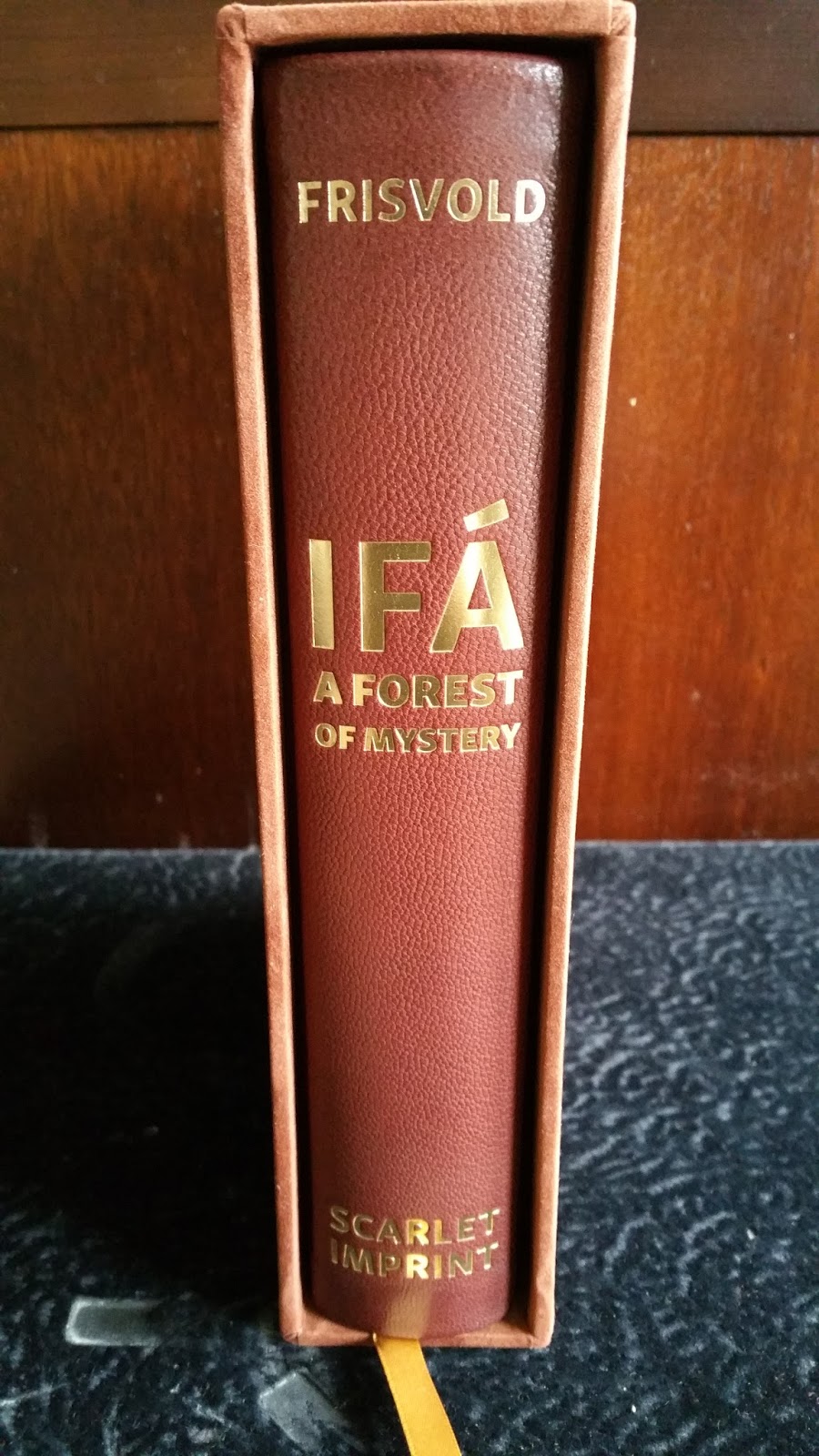
  • The 'Mor Edition' of Exu and the Quimbanda of Night and Fire by Nicholaj de Mattos Frisvold (Scarlet Imprint) should arrive any day.  This massive goatskin tome is bound to make a deep and lasting impression within some circles.
  • Ixaxaar has plans to release a pair of diabolic texts penned by Johannes Nefastos, The Catechism of Lucifer and FOSFOROS.  
  • Three Hands Press shall release the long-awaited ARCANUM BESTIARUM by Robert Fitzgerlad.  This will include 55 original woodcut illustrations by Liv Rainey-Smith.  I am a great admirer of her work.
  • Salamander & Sons is rumored to release a new limited work in the Golden Dawn tradition within the near future.  
  • Also be on the lookout for The Book of St. Cyprian by Humberto Maggi from Nephilim Press.  
  • And of course we mustn't forget the 2013 Esoteric Book Conference scheduled for next September.  

Have a great year, dear readers.

Sincerely,

B. Balkan


Tuesday, November 13, 2012

Status update

Dear readers,

I apologize for the delay in posting my next book review.  Unfortunately, I have had to deal with a number of serious medical issues within my immediate family recently.

I thank you for your continued patience.  My hope is to post my next review within the next few weeks.

A sneak peak at my next review:

Next up...  A review of the 'Deluxe Edition' of Andrew Chumbley's The Leaper Between.


Sincerely,

B. Balkan


Sunday, September 30, 2012

A Brief Overview of Today's Esoteric Journals

After devoting so much attention to fine bindings I thought I would change things up this month and dedicate an article to another noteworthy and dynamic segment of esoteric publishing; namely, Esoteric Journals.  Recently there has been a surge of new publications devoted to a wide array of occult topics ranging from: spiritual paths (both traditional and modern), exploration of  esoteric themes through art, and serious academic study of Western magic and its impact on culture.  While journals devoted to Witchcraft or Hermeticism are certainly nothing new, what sets many new journals apart from their predecessors is their high quality (VERY deluxe in some cases) and elevated academic standards.  The latter stems from new-found interest within academia that has raised the bar for today's esoteric journals.  Cheaply produced 'zines' and spiral-bound booklets of past decades have matured into sturdy textbooks filled with insightful peer-reviewed studies and often include beautiful and magically charged artwork.  For these reasons current esoteric journals deserve significant attention.

Just like their predecessors of past decades, many current journals still contain raw and powerful essays describing personal experiences and individual practices; however, they also typically contain a healthy amount of academic research.  Most of this has been made possible because of the internet.  This is not to say that earlier journals (say, from the 70s to mid 90s) didn't attempt scholarly articles, rather, most authors simply didn't have access to crucial materials.  As a result, gaps in knowledge were frequently filled with educated speculation at best, or biased and fanciful fabrications at worst.  Thankfully things have changed.  Today one can research remote archives from the comfort of one's own living room.  Libraries of rare and previously unknown documents detailing forgotten practices are now available in digital format, and only a click away for the curious.  This has allowed researchers to make incredible discoveries and has allowed them to separate fact from fiction.

There is no doubt that personal observations, subjective interpretations, and relative experiences can often be instructive and inspirational to readers, but only to a point.  The same is true with scholarly research; one can know the facts behind a certain tradition or practice, but frequently the meaning behind it is lost, or is purely speculative. This is why editors of many current esoteric journals have chosen to go with a balanced approach utilizing both subjective experiences and a fair amount academic rigor: not too fanciful, nor too dry.  In short, a middle-ground that most of us can comprehend and one in which we can all relate.

So what are the titles of these publications?  I have included a list (below) of current esoteric journals along with a brief description of each.  This list is by no means complete, and I apologize to those I have inevitably overlooked.  Some of the following titles are venerable publications that should be well known within the occult community; some have only recently printed their debut issue; others are still forthcoming.


  • Journal for the Academic Study of Magic (JSM)   This is an excellent journal, and one of my personal favorites due to its wide range to topics.  Publication has been sporadic, but is worth the wait.  JSM's 'journals' are more like books.  Most issues are over 300 pages.  
         From a publisher:
"A multidisciplinary, peer-reviewed print publication, covering all areas of magic, witchcraft, paganism etc; all geographical regions and all historical periods."  


  • SiLKMiLK MagiZain      SiLKMiLK is a highly creative journal/magazine covering topics ranging from alchemy, chaos magic, witchcraft, art, and beyond.  Issues have become increasingly deluxe, including audio/video CD/DVDs.  SiLKMiLK is a surreal treat for artists and futurist magicians.


  • QLIPHOTH Esoteric Publication   QLIPHOTH is an impressive newcomer.  The premiere (and most current) issue has already sold out.  It includes a 50 min audio CD of ritual music (wonderful stuff).  The journal includes essays, poetry, and artwork from notables: Orryelle Defenestrate-Bascule, Nicholaj De Mattos Frisvold, S. Ben Qayin, and Kyle Fite, among others.  As the title implies, QLIPHOTH deals with the darker side of magic, therefore some may want to proceed with caution. 


  • Hermetic Virtues    Hermtic Virtues is an online-only publication with issues available in .pdf format and has been published quarterly since 2007.  The journal's primary focus is Hermeticism with particular emphasis on the exploration and study of magic within the Golden Dawn tradition.  Frequent and notable authors include Chic and Tabatha Cicero, Aaron Leitch, Nick Farrell, and Darcy Kuntz.  
         From the publisher:
"We hope that, over time, it will become a repository for hermetic knowledge and research. It is designed to be a place where people of good will from all orders, groups, places and backgrounds can communicate to freely share what they have discovered in the course of their exploration for the greater good of all and the expansion of our intellectual and spiritual horizons."

  • ESOTERICA     ESOTERICA is published by the University of Michigan Press and is,
 "A peer-reviewed academic journal devoted to the transdisciplinary study of Western esotericism: Western esoteric traditions including alchemy, astrology, Gnosticism, gnosis, magic, mysticism, Rosicrucianism, and secret societies, and their ramifications in art history, history, literature, and politics."  
ESOTERICA has been published on an annual basis since 1999 in an online-only format.  Past articles are archived on their website and can be viewed for free, though you may want to consider a donation.  More recently, instead of their usual online format, they have chosen to publish essays in book form (generally over 300 pages).  Esotericism, Art, and Imagination was published in 2008. The most recent book, Esotericism, Religion, and Nature was published in 2010. These books offer remarkable insight into oft-overlooked areas of Western magic. I eagerly await their next release. 


  • The Cauldron     This is an indisputable classic. Where would the Witchcraft/Pagan community be today without The Cauldron?  In far poorer shape I'd wager. Their newly revamped website states, 
"The Cauldron, edited by Michael Howard, is a non-profit-making, independent, privately published magazine featuring serious and in-depth articles on Traditional Witchcraft, Wicca, Ancient and Modern Paganism, Magic and Folklore. It has been published quarterly in February, May, August and November since 1976."   
The Cauldron  has been a prime resource for witchcraft studies for over a generation and continues to provide brilliant articles written by the tradition's leading voices.


  • CLAVIS: Journal of the Art Magical    I'm extremely excited about this new collaborative effort between Three Hands Press and Ouroboros Press.  The debut issue is due any day now.  This highly anticipated journal promises to be an exquisite publication.  It will be available in softcover and hardback.  
        From the publisher:
 "CLAVIS is a journal of the advanced occult disciplines, produced by esoteric publishers Ouroboros Press and Three Hands Press. Born of the desire to serve an increasingly sophisticated esoteric community, its pages wed the dual arenas of scholar and practitioner, our aim to serve as a magical resource for years to come. In accord with the Emblem of our work, the journal provides unique access to magical strata and currents of esoteric thought not found elsewhere. Our pages feature Magical Theory and Practice, Hermetic Studies, Comparative and Esoteric Religion, History of Magic, Folklore and newly-emergent fields of syncretic occult praxis."      


  • Abraxas: International Journal of Esoteric Studies     Abraxas is published on a roughly annual basis with issued #3 due this autumn.  After only two issues Abraxas has proven to be one of the most deluxe esoteric journals in print (particularly the limited hardcover edition).  It is printed in an extremely large format (large quarto) with over 200 glossy and full-color pages.  Abraxas is more expensive than most journals; but let me assure you, its scholarly articles and breathtaking artwork are worth every penny.  
From the publisher:  
"Abraxas aims to represent the best of the international esoteric scene in a high quality printed format. As a bi-annual journal, it seeks to offer relevant and thought-provoking features: ranging from essays that are scholarly and engaging, to images and sounds that challenge and inspire. Our print run is limited, and every issue employs lavish colour and exotic papers – providing for the reader a rare sensory sorcery. Indeed, it is our intent that Abraxas should embody that magical, creative nexus which feeds both mind and soul. And in a world fraught with troubles, our approach is refreshingly non-partisan and inclusive… join us!"    
Yes, join them.


  • Starfire: Journal of the New Aeon     Starfire dates back to 1986.  This large and high-quality journal is published every few years, and is available in both softcover and hardback.  In 2011 Starfire published ECPYROSIS: The Best of Starfire Vol. 1, making long out-of-print articles and essays (1986-1994) available once again.  Starfire is primarily geared towards those working in the Thelemic/Typhonian currents.


  • The Gnostic: A Journal of Gnosticism, Western Esotericism, and Spirituality    I was happy to hear that The Gnostic has plans to continue.  The Gnostic #5 has recently been published.  Each issue is unique.  I thoroughly enjoyed Lance Owen's essay about Jung's Red Book in issue #3.  In my opinion, The Red Book could be one of the most illuminating grimiores in modern history.  Issue 5 includes,
"Interviews with Gary Lachman on Hermes Trismegistus, Patrick Harpur on the soul, and Nicholas Baker-Brian on the Manichaeans. Sean Martin on David Lindsay's A Voyage to Arcturus, Jeffrey Kupperman on the Neoplatonic roots of Hermeticism, Dean Wilson on the links between Enochian magic and Gnosticism, and a brilliant article by Stevan Davies on the Odes of Solomon and the origins of Christianity. Sorita D'Este on the Great Rite. The theology of Nick Cave. The bright side of Cormac McCarthy's Blood Meridian. Scott Finch's Gnostic comic, short fiction, a Cathar travelogue, reviews and more!"
 I am particularly looking forward to the interview with one of my favorite writers/philosophers, Patrick Harpur, author of Daimonic Reality: A Field Guide to the Otherworld.  As for "The Bright Side of Cormac McCarthy's Blood Meridian".  Is such a thing possible?


  • Hoodoo & Conjure Quarterly   Southern Conjure or 'Hoodoo' has been generally ignored by most contemporary occultists until fairly recently. It is for this reason that was thrilled to see a journal devoted exclusively to Southern Conjure arrive last year.  It is finally getting the recognition it deserves, as it is an extremely practical, down-to-earth, and most importantly, effective system of magic.  Interest is on the rise, and extending far beyond the American south.  It is a full color and large format journal.  Regardless of its 'Quarterly' title it has so far proven to be biannual   
        From the publisher:
"Hoodoo & Conjure Quarterly (HCQ) journal is the first publication of its kind that focuses on New Orleans Voodoo and hoodoo and related African-derived traditions. It shares historical and contemporary information about aspects of the conjure arts, including magico-religious practices, spiritual traditions, folk magic, southern Hoodoo, and religions with their roots in the African Diaspora. Each issue of Hoodoo & Conjure Quarterly brings you original and traditional formulas, spells, tutorials, conjure artist profiles, information about New Orleans Voodoo, Hoodoo, Louisiana folklore and more!


         From the publisher:
"The Pomegranate is the first International, peer-reviewed journal of Pagan studies. It provides a forum for papers, essays and symposia on both ancient and contemporary Pagan religious practices. The Pomegranate also publishes timely reviews of scholarly books in this growing field. The editors seek both new interpretations and re-examinations of those traditions marked both by an emphasis on nature as a source of sacred value (e.g., Wicca, modern Goddess religions) as well as those emphasizing continuity with a polytheistic past (e.g., Ásatrú and other forms of 'reconstructionist' Paganism). The editors also seek papers on the interplay between Pagan religious traditions, popular culture, literature, psychology and the arts."


         From the publisher:
"A rigorously peer-reviewed scholarly journal, Magic, Ritual, and Witchcraft draws from a broad spectrum of perspectives, methods, and disciplines, offering the widest possible geographical scope and chronological range, from prehistory to the modern era and from the Old World to the New. In addition to original research, the journal features book reviews, editorials, and lists of newly published work."


  • Journal of the Western Mystery Tradition    JWMT is a non-profit, online-only, biannual journal that began in 2001.  Its primary focused on the Hermetic tradition with a balanced approach for both student and scholar.
         From the publisher:
"Within the virtual pages of this Journal you will find the writings of students and scholars of the Western Mysteries. The goal of the Journal is to not only provide information on the many different traditions which make up the Western Mystery Tradition, but to also further the Western Mystery Tradition as a living tradition or group of traditions. The Journal will promote this goal by providing new rituals, poems and artwork as well as by sharing the experiences of those writers who are active in the Mysteries with its reader.
This Journal is dedicated to beginner and adept, student and scholar alike. Each issue will contain scholarly articles on the Mysteries, but the reader will also find anecdotal accounts, poetry, new rituals, book reviews and more."


**Edit** 10/6/2012     Here's a significant journal I had previously overlooked.


  • Alchemy Journal    Alchemy Journal is started in 2000 and continues to publish quarterly.  The publishers have graciously provided all the issues between from 2000-2007 on their website as free .pdfs., though you may want to consider a donation.
          From the publisher:

"The Alchemy Journal is devoted to the Divine Art, Celestial Agriculture, the Mother of all Science and Wisdom, the ancient Art of Transformation: the Great Work as known by many names.
Since 2000 the Alchemy Journal has published an eclectic array of material, both scholarly and personal, logical and emotional, practical and spiritual, everyday and occult, including essays, articles, poetry, visual art, interviews, and summaries of operative alchemical processes, along with book and website reviews, sources and resources, and the latest conference, lecture and workshop announcements."

**Edited 10/20/12**

Thanks to Scarlet Imprint for reminding me of this one. It had completely slipped my mind and certainly deserves to be added to the list.


THE FENRIS WOLF.    The Fenris Wolf has been published on a roughly annual basis recently, the most current volume being #5. The first three issues are now available together in a single volume.  Volumes are generally around 300 pages and contain essays from very well known and forward-thinking authors in the esoteric field.  Essays run the full gamut of occult topics, from psychedelics to geomancy, though they tend to favor a somewhat Thelemic and post-modern approach.  If one desires to know what the future holds for magic and esotericism one need only pick up copy of The Fenris Wolf.

From the publisher:

"The Fenris Wolf is a research journal focused on the human mind, developments in comparative magico-anthropology, and on the occultural implications and applications of these fields of study."


Forthcoming journals:


         From the publisher:
"Hagstone aims to provide the opportunity for witches and magical practitioners of varying backgrounds, ideologies, and subject positions to promote and engage in intelligent, critical discussion and sharing. When witchcraft and magic are concerned, misinformation and misrepresentation rule, and Hagstone boldly puts one step forward in an effort to change that. Many people (practitioners and scholars alike) do not understand, on a fundamental level, the unending variety and innovation that exists today, pioneered by those who call magic and witchcraft their home – and thus Hagstone is born. Hagstone is not witchcraft 101."


         From the publisher:
"PILLARS will be the periodical journal of Anathema Publishing which we hope to be able to release first on a twice a year basis starting from the Autumnal Equinox of 2012. PILLARS aims to be a body of essays consisting of adversarial articles based on mystical researches and experiences, artworks and poems aptly woven and rich in symbolical meaning. Nourishment for the mind and the essence of the True-Self, as flesh is torn and blood is poured on paper in order to elevate mortal souls beyond the cosmic stretch of the Demiurge."


Lastly, I encourage everyone to subscribe to a journal.  It is the best way to stay as current as possible regarding esoteric topics.  One is guaranteed to find educated discussions, critical analyses, inspiring personal accounts, stunning artwork, and interesting recent discoveries.  No matter what your path, there is likely a journal that is applicable to you whether you're a practitioner, student, or scholar.  Or perhaps you may discover a whole new path of which you were previously unaware, as journals are a great way to be exposed to a broad range of diverse topics.  If you've allowed your subscription to lapse, maybe it's time to give your favorite journal another shot.  And if you're feeling really adventurous, try submitting an essay of your own.  Your work may see print and inspire others to embark upon new paths of their own.