Sunday, May 4, 2014

Daemonologie of King James


Ouroboros Press 2014. 120 pages. Duodecimo (Twelvemo). Black and white illustrations.

Available in three editions:

Standard Edition: Cloth and letterpress dust jacket. Limited to 600 copies.

Goat-Skin Edition: Full black goatskin. Limited to 45 copies.

Hellmouth Edition: Quarterbound in snakeskin and cloth with folding plate depicting the Hellmouth. Limited to 25 copies.

First published in 1597, Daemonologie of King James is a fascinating treatise on late 16th century attitudes regarding witchcraft, magic, sorcery, folkloric creatures, ghosts, and demons. The book is written in the form of a dialog between two gentlemen, Epistemon (Greek for sciences) and Philomathes (Greek for lover of knowledge). Epistemon presents a series of arguments (20 in all) on the nature of witchcraft, necromancy, magic, and sorcery. Philomathes plays the role of the doubter, or Devil's advocate, by questioning the validity of Epistemon's claims. Their dialog offers a curious glimpse into late 16th century rationality and logic. For example, Epistemon is portrayed as somewhat unsophisticated and naive, as he is ignorant of the powers of witches and sorcerers, even doubting their existence. Philomathes plays the part of a worldly scholar well-versed in witchlore and occult powers.

The irony is that while Philomanthes is supposed to be the uninformed common man (the "Joe Public" of today), he actually comes off as the more reasonable of the two. His skepticism, no doubt intended to be dangerously foolhardy and ignorant in his day, seems completely rational and levelheaded to the modern ear. In a reversal of roles, it is Epistemon who strikes the modern reader as sounding irrational, like a smug fundamentalist. Thus a work that was used as paranoia-inducing anti-witch propaganda in its day sounds rather quaint and jejune today.


The book is dived into three parts, each with a central argument followed a series of minor arguments and elaborations.


  • First Booke: The exord of the whole. The description of Magie in speciall.


  • Second Booke: The description of Sorcerie and Witchcraft in speciall.


  • Third Booke: The description of all these kindes of Spirites that troubles men or women. The conclusion of the whole Dialogue.

As you can see, the book is written in Elizabethan English. Those unfamiliar with it may find it challenging.


One observation that I found particularly interesting: the high value placed on information. It seems that no matter what the time period, knowledge is power. We like to say we live in an "Information Age" where information is everything. In reality it has always been everything; we just have more of it now. When describing the diabolic powers the Devil (or Deuill in Elizabethan English) grants his followers there is particular emphasis on the ability to know things beyond one's natural ability, such as the outcome of future battles, or whether a sick person will recover or die. For example:
"Sathan ... will oblish himselfe to teach them artes and sciences, which he may easelie doe, being so learned a knaue as he is: To carrie them newes from anie parte of the worlde, which the agilitie of a Spirite may easilie performe: to reueale to them secrets  of anie persons, so being they bee once spoken for the thought none knowes but GOD; ... Ye he will make his schollers to creepe in credite with Princes, by fore-telling them manie greate thinges; parte true, part false:"
As you can see, not only was information incredibly important and powerful, but also the speed at which it could be obtained -- something we take for grated today with Google at our fingertips. Those who had foreknowledge of what was to come, or advanced knowledge of something that has already occurred, had a significant strategic advantage over others. Speedy information was so powerful it was worth selling one's soul to get.


In one of Epistemon's arguments there is a passage that reminded me how little things have changed in 400 years.  Epistemon describes the sinful path of magicians and how simple curiosity can lead to far greater heresies.
"...they are so allured thereby, that finding their practize to prooue true in sundry things, they studie to know the cause thereof: and so mounting from degree to degree, vpon the slipperie and vncertaine scale of curiositie; they are at last entised, that where lawfull artes or sciences failes, to satisfie their restless minds, even to seeke to that black and vnlawfull science of Magie."
I seems that even back in 1597 people tried to use the "slippery slope" fallacy to win an argument. If Epistemon were around today he would probably be a pundit on FOX News.


Epistemon describes the differences between practitioners of the black arts. He lumps them into two groups, magician/necromancers and witches/sorcerers. The main difference between the two groups, according to Epistemon, is that magicians and necromancers generally mean no harm; they unknowingly fall into the trap of prideful lust for knowledge, including forbidden knowledge. In contrast, witches and sorcerers are out to do harm to others and lust for wealth. Magicians and Necromancers have high, yet sinful, aspirations while sorcerers and witches have lowly and base desires. Interestingly, later in the book Epistemon says that the sins of magicians and necromancers are actually far greater than those of witches and sorcerers because their sins come within closer proximity to God, that is, god-like understanding. My goodness, the arrogance...  Again, knowledge is power. If people learn too much they become a greater threat. This is why it was a burnable offense, according to those in power, unless the magician or necromancer worked for them of course.


In the latter part of the book Epistemon and Philomathes discuss the nature and existence of folkloric creatures. This amounts to a compendium of monsters and their respective natures and habits. Epistemon pontificates on the nature of lycanthropy and the existence of ghosts, dividing the latter into various subgroups: specters, wraiths, etc.. Additionally, fairies, brownies, incubi, succubi, and demonic possession are also addressed.  


Now on to the part you've been waiting for, the book itself:

For this review I will be reviewing the "Hellmouth Edition" of Demonologie of King James. Credit to Mr. William Kiesel of Ouroboros books for coming up with such a colorful edition title. I cannot say it without cracking a smile. I say, who wouldn't want a Hellmouth edition? The Hellmouth Edition is half-bound in white snakeskin and black cloth. I have no idea if the skin comes from an albino snake or if it has been bleached, though the former would be more appropriate. The magical properties of albinism is well known in witchcraft traditions throughout the world. (Unfortunately it has recently lead to savage butchery of albino people in Africa with the belief that albino limbs possess magical power.) The contrast between the white snakeskin and black cloth is striking and also appropriately symbolic. It represents how magic with good intentions can actually be something black underneath.


The snakeskin feels very smooth, has a remarkable shine, and begs to be touched. The black cloth is sturdy with a tight weave and is stamped front and back in gold with Ouroboros Press' colophon, the ouroboros circumscribing a Maltese cross. The spine has seven raised bands, each edged with gilding. Matching snakesking head/tail bands. The title, Daemonologie 1597 is stamped in gold on a black leather spine label. The book comes with a black ribbon bookmark. Opening the book reveals black and white hand-marbled endpapers. Paper is of medium-light weight and pale cream in color. The folding "Hellmouth" plate is lightly marbled parchment in color. The book begins with an spectacular period illustration of the Devil (see pic) and has several other equally attractive decorative ornaments and illustrations. This is a very elegant little book and one of the most unique to come from Ouroboros press. It marks a slight departure from their usual three-tiered business model (vellum, goatskin, and cloth). To further break with tradition, one of their newest releases, the Brazen Serpent Edition of Nicholas Flamel's Hieroglyphical Keywill feature a full Cambridge binding hand bound by Michael Atha of Restoration Books. The early pictures look incredible.


With Daemonologie of King James Ouroboros Press continues its wonderful service of providing high-quality editions of important long out-of-print works. They cater to a specific strata of the esoteric community that values source-works and is not put off or intimidated by archaic language. Like the Malleus Maleficarum, Glanvil's Saducismus Triumphatus and other anti-witchcraft treatises of the 16th-17th centuries, Daemonologie of King James provides a wealth of information about the practices and activities of magicians and witches, that is, if one is to believe testimonies given under torture. Many of the alleged diabolic acts are likely less a reality than they are a reflection of societal insecurities, namely, the rising power of the merchant class and its threat to the aristocracy, schisms within the church, and of course the ever-present fear of intelligent women with power. Fascinating and historically insightful as these books are, they were, sadly, used as tools -- even guidebooks -- for the persecution of countless people. As I alluded to earlier, books like these are valuable in that they can teach us something about the past, but they can also become an uncomfortable mirror reflecting society's age-old failings and highlighting fears that remain to this day.


Sunday, March 30, 2014

Black Magic Evocation of the Shem Ha Mephorash by G. de Laval


Aeon Sophia Press 2013. 246 pages. Octavo. Black and white illustrations with one page full-color. Text in black & red.

Available in three editions:

Standard Edition: Quarter leather and silk moire. Limited to 200 copies.

Deluxe Edition: Full leather. Limited to 50 copies.

Devotee Edition: Full goatskin. Limited to 23 copies (11 with custom wooden box, 12 without).

Black Magic Evocation of the Shem Ha Mephorash is published by a relatively new esoteric press, Aeon Sophia Press. In only a couple years their output has been tremendous, over 9 titles and two journals (The 13th Path forthcoming). I have spoken to the press' proprietor, Mr. Boomsma, on a number of occasions. He strikes me as a very earnest, enthusiastic, and dedicated person -- exactly what one needs to be in the small press. The press generally caters to so-called 'Left-Hand-Path' works, though the press has shown how wide this sub-genre can be by publishing works ranging from practical grimoires to qliphotic poetry. The title reviewed here falls into the former category.


Another note on Aeon Sophia Press before I continue with the review: Aeon Sophia Press has experienced some of the common problems that seem to plague the small press; namely, delays, mailing mishaps, printing/binding errors, etc. These are unfortunate setbacks that all small press publishers experience -- none are immune. Learning from experience, Mr. Boomsma has made some wise business decisions to prevent some of these trade hazards. He has recently decided to only accept pre-orders for books that are close to being in-stock. I must say, this is a bold and risky decision, as many (dare I say most) small presses fund their publications with money gathered though pre-orders, or at least partially. Of course this requires a significant investment on his part, a professional gamble, if you will.

His decision will likely reduce the waiting time for his customers significantly. Speedy delivery is one of the reasons Amazon is so successful. Unusually long waits & delays are the most common irritations I hear from readers. It is not uncommon to wait years for books to be published (books already paid for). In such cases customers are essentially offering interest-free loans to the press. Now, I know this is part of the trade and a mostly unavoidable, if unfortunate, consequence of small press publishing. However, many readers and collectors new to the small press world find it vexing, as many are used to the instant gratification that large mass-market publishers provide. They grow impatient having to wait for extended periods of time, and sometimes they cancel their orders out of frustration.

My advice to such people is to be patient. These are not assembly-line books (especially fine bindings), and if one believes in magical timing or fate, perhaps the reader was not meant to get the book immediately, but rather at a time better suited for the reader and more relevant to their current circumstances. For example, some years ago I received a book that had been significantly delayed -- almost a year, if I recall. After reading it I was thankful for the late arrival. You see, I had gleaned information from a book I had read just prior to this one that had widened my knowledge on a particular subject. The current book covered similar ground. Had I not read the earlier book first certain important elements of the current book would have been overlooked or misunderstood. I am sure many of you have had similar experiences. Sometimes the order in which we absorb knowledge is crucial.

Another example: there is a certain book (that shall go unnamed) that I pre-ordered over a year and a half ago. Rather than flood the publisher with emails about the book's status I instead wait patiently knowing the book will arrive when the time is right. There are plenty of other titles to read in the meantime. I have found over the years that this is how magical books work; they find their way into one's hands when they are most needed. Granted there are reasonable limits to how long one should wait. I once waited over four years for a certain title. I finally decided to use my payment as credit towards other titles from the press. The status of that particular book still remains in limbo over five years later. Yes, there have been publishers known to 'take the money and run', but this is very rare. Aeon Sophia Press has decided to side-step this problem altogether by selling in-stock (or nearly in-stock) books only. I hope this business model proves successful for them. It is certain to create happy and loyal customers.

Now onto the book...


Black Magic Evocation of the Shem Ha Mephorash is a practical guide for invoking/evoking the 72 angels of the Shem Ha Mephorash. The 72 angelic names are derived from the book of Exodus, chapter 14, verses 19-21. Each of the three passages contain 72 Hebrew letters totaling 216, the secret name of Creation. When arranged in three rows one can obtain the Hebrew trigrammatons for the 72 angels of the Shem Ha Mephorash. Each angel is an aspect of the greater whole, or specific "energy current", and has its own positive and negative counterparts, like different sides of the same coin. When working with the benefic angels one adds the suffix 'El' (אֵל - meaning 'might of God) or 'Yah' (יָה - meaning 'mercy of God') to create a five-lettered holy name. This work deals primarily with the malefic angels which are signified by their three-lettered names, sans the divine power attribute 'El' or 'Yah'. These are the qliphotic shells, the negative aspects of the angels of the Shem Ha Mephorash. This book is a compendium of those angels' attributes, seals, and various correspondences: planetary,elemental, numerical, magical timing, and tarot associations.


The work begins with Qabalistic commentary and an explanation of the Shem Ha Mephorash. This work is aimed at moderately experienced readers; beginners may find it difficult to follow.The author assumes the reader has some working knowledge of Qabalah and Hebrew. It follows with some personal commentary by the author regarding the nature of magic. I found this part particularly interesting, though I partly disagree with some of the author's opinions. For example, the author posits the book on one central premise, stating:
"Generally speaking, all magick is black. The entirety of our art is condemned in part and in whole by the entirety of orthodoxy. All magick is the domain of the Devil by definition."
To back up this claim the author supplies age-old quotes from the Bible (Deuteronomy 18:10), the Koran (Al Baqarah 102), and the Zohar (1:5) damning witches and necromancers for practicing magic. I find this statement rather odd and démodé. A few pages later the author states, "...all magick is diabolical." Surely we've moved beyond all this. Why allow the attitudes of ancient religious texts to define us today? I do not see how one can possibly benefit from allowing one's detractors to define who they are. Imagine if biologists referred to their work professionally as a anti-creationist research, because that is how they are sometimes stigmatized by many religious people. So why allow archaic attitudes to judge witches and magicians and characterize one's practice? Especially considering religious texts seem to be of two minds concerning this matter. Was it not three magi (magicians) who were present at the birth of Christ? They are seen as great and wise, not practitioners of black magic. To further illustrate biblical mixed messages regarding this matter, let us recount the story of Saul who drives out all the magicians and necromancers from Israel, yet later seeks out divinations from the Witch of Endor.

I realize we're dealing with biblical subject matter here. Therefore I was willing to view the work within that historic context, that is, from an early Judeo-Christian point of view, contradictory as it is. However, soon after the author begins using contemporary terminology and references modern theories, stating.
"...she then begins to charge the Hebrew name as a living egregore with the memetic energy she has collected from previous interaction with the angel. ...
 Not to mention modern adages of Chaos Magic and Thelema respectively,
"We together are on the left-hand-path where nothing is true and everything is permitted."
"Do As Thou Wilt, shall be the whole of the law."
So which is it? Are we to maintain a Judeo-Christian mindset and view biblical statements as, well, gospel -- that all magic is heresy, and angels are literal celestial beings? Or are we to approach magic from a contemporary mindset where angels are Jungian archetypes and post-modern thought-forms? If we are allowed to view magic through a modern lens, are we also allowed to disregard outmoded ideas, especially if "nothing is true and everything is permitted"? It appears so, as the author states, "creativity is encouraged" and terms "are not be mistaken for dogma". But if we're going down the path of Chaos Magic then all magic could just as easily be pink.

The author muddies the waters further by stating,
"Specifically speaking, there are different types of magical practice, and the term "Black Magick" is a term that is used in this book to denote a specific practice in contrast to other practices."
And this paradoxical statement,
"So to the advanced witch, the "black and "white" descriptors are irrelevant. There is only magick, raw black chaotic power of the untapped mind..." 
So magic is neither "black" nor "white"... but it's still black? Are we talking color or morality? Or is it the practice that denotes its moral polarity? This is a minor point, but you can see where this can get confusing. The author continues by providing an interesting categorization of magic which is as follows:

  • Aeonic Magic -- Magic involving time
  • Vampiric Magic -- Predatory magic 
  • Spherical Magic -- Astrological/Planetary Magic
  • Lunar Magic -- Magic involving the phases of the moon
  • Black Magic -- Imbalanced, destructive, & demonic magic
 I find the ways in which people choose to categorize, compartmentalize, and classify magic extremely interesting. One can understand a lot about how authors think by the way they break down magic into various 'schools'. For example, Paracelsus (1493-1541) divided up magic into six categories, collectively called the Artes Sapientiae (Arts of Wisdom), in his Philosophia sagax (1536):
  • Insignis Magica -- The interpretation of natural signs.
  • Magia Transfigurativa -- The magic of transformation and transmutation.
  • Magia Caracterialis -- The use of curative power-words and signs.
  • Gamaheos -- Carving astral constellations on precious stones to grant magical powers.
  • Altera in Alteram -- Crafting charms and talismans to heal or harm.
  • Ars Cabalistica -- The art of soul journeying, telepathy, scying, and psychometry.
Paracelsus saw all magic as natural forces which were not yet completely understood rather than the dominion of the Devil. 

Furthermore, Robert Fludd (1574-1637) divided magic into five types:
  • Natural Magic -- Dealing with the mystical properties of natural substances.
  • Mathematical Magic - What we call the sciences today.
  • Venific Magic - The crafting of potions, philters, and poisons.
  • Necromantic Magic - Pact making with goetic spirits and the spirits of the dead.
  • Thaumaturgic Magic - The art of illusion and deception.


The author continues with an interesting explanation about the difference between invocation and evocation. According to the author,
"In their angelic forms, the spirits are drawn down from realms of the super-conscious self, from the higher sephiroth into conscience interaction; this is called invocation and is a receptive art, similar to prayer or supplication."
"In their demonic forms, the spirits are drawn upwards towards interaction with the conscious mind from the realms of the subconscious and shadow self, the place of fears, phobias, unresolved conflict, and the gateways to the spheres of the qliphoth and the eleven hells thereof. This is known as evocation, drawing up, and is an active art, similar to exorcism whereby the spirits are adjured into obedience by the use of protective seals and talismans. An angel invoked has evoked the magickian. A demon evoked has invoked the magickian."
This is a slightly different definition than to what some may be accustomed. Generally speaking, most people see invocation as summoning spirits internally, such as taking on god-forms. In contrast, evocation is to summon a spirit externally, like into a magic circle. In Magic, Book 4, Crowley explains the difference as,
"To 'invoke' is to 'call in', just as to 'evoke' is to 'call forth'. This is the essential difference between the two branches of Magick. In invocation, the macrocosm floods the consciousness. In evocation, the magician, having become the macrocosm, creates a microcosm."

The author does a superb job in describing how to actually use the angels and their correspondences. This is something that is commonly lacking in many magic books; authors often supply the 'why' and 'what' but not the 'how'. G. de Laval explains exactly how each angel (both good and bad) has a corresponding planet, element, time, and tarot card. As an example the author uses the 35th spirit, KOUQEL/KUQ, (Qoph Vav Kaph -כוק) -- also the angelic name found on the cover of the book. KOUQEL cooresponds to 'Water of Mars', and the three tarot cards The Moon, Heirophant, and Wheel of Fortune. It can be assumed that KOUQEL was chosen specifically, as 35 reduces to eight, which represents success, money, power, and influence -- things all writers hope to achieve through their books. 


The book follows with suggestions on how to design one's altar, recommended ceremonial clothes, candles, tools, incense, etc. The rest of the book is devoted to each of the 72 individual spirits. This part, the majority of the book, is a feast of information. It is a goldmine for practitioners looking to work with the shadow side of the Shem Ha Mephorash. Extensive information is given on each spirit, as well as brilliant cross-cultural observations. For example, the author compares the three Ma'aloth spirits, led by HAQAMYAH, to the Germanic Valkyries and the Greek Furies. The Peniynim spirits, led by MENAQEL, representing feebleness associated with age, are compared to the Yoruban spirit Babalu-Aye, a powerful orisha often represented as a limping old man who walks with a cane. Both also have associations with illness, death, and resurrection.


The author provides a wealth of clear and useful tables in the book's appendices. These include: numerological, elemental, planetary, color, and herbal correspondences of the Shem Ha Mephorash; the Hebrew alphabet and each letters' tarot association; Planetary Demons; Demons of the Lunar Witching Week, Tables of Magical Months/Days/Weeks/Hours & a Weekly Table of Planetary Hours. The charts are well organized and designed, easy to understand, and include text in both black and red. The book concludes with a bibliography that will serve readers well if they would like to explore the subject further.


Now the book itself:

For this review I will be reviewing the Deluxe Edition. Unfortunately for me, the publisher decided to publish an even more lavish edition, the Devotee Edition (full goatkin and custom wooden box -- see pic below), after I had already ordered and received the Deluxe Edition. I saw little reason to own two copies of the same book. A similar situation occurred with Michael Cecchetelli's book, The Book of Abrasax. It is my hope that publishers will announce all planned editions at once or offer the option to upgrade one's copy by exchanging the lesser edition for the greater and paying the difference, so as to avoid customer disappointment.

Devotee Edition. Image Credit Aeon Sophia Press

The Deluxe Edition of Black Magic Evocation of the Shem Ha Mephorash is bound in full textured recycled leather (bonded leather) that has a soft & pleasant aroma -- what I can only describe as a mixture of musk and lavender. The boards are very hard and rigid lending an unexpected weight and toughness to the book. The cover sports the Conjuration Circle of the Three Witches of the Crossroads and the angelic name KUQ (Qoph Vav Kaph - כוק) stamped in silver leaf. The spine includes title, author, and press, also in silver leaf. Regrettably, the first 100 copies (out of 200) of the Standard Edition and all 50 copies of the Deluxe Editions are missing the head/tail bands due to a binder's error. This would have certainly made it a more attractive book. A ribbon place marker would have also been nice considering this is a book to be referenced and used in a ritual setting. A shame. Even so, it is a very alluring book nonetheless.


The book opens to endpapers marbled in gray, gold, and black. The pattern created on my copy is oddly appropriate. It looks like the murky surface of a stagnant and polluted pond -- the perfect look for a book concerned with the summoning of malformed and malignant spirits. The text size and margins are near perfect. The paper is bone white and has a satin-like texture. Its weight is just right (120 gr); not too thin, and not too rigid. Illustrations, seals, and tables are very crisp and sharp. I did not encounter a single typo.

Black Magic Evocation of the Shem Ha Mephorash is an essential grimoire for anyone looking to work with the dark half of the Shem. It should provide a lifetime of exploration. Congrats to author G. de Laval for the tremendous amount of research that went into this book.


*Note: Those looking for further works on the Shem Ha Mephorash may also want to consider picking up Nick Farrell's newest work, The Shem Grimoire. Some abominable typos aside (Saggitarious? Really, Mr. Farrell?), it is a great book.


Wednesday, February 26, 2014

Z3 - The Enterer of the Threshold transcribed by Cogito Ergo Sum

Hell Fire Club Books - no date stated (original document dates to 1896). 119 pages. Small octavo. Printed in full color.


Available in two editions:

Half Leather: Limited to 56 copies.

Full Leather: Limited to 22 copies: 3 mother letters, 7 planetary letters, & 12 zodiacal letters. Sold out at publisher.

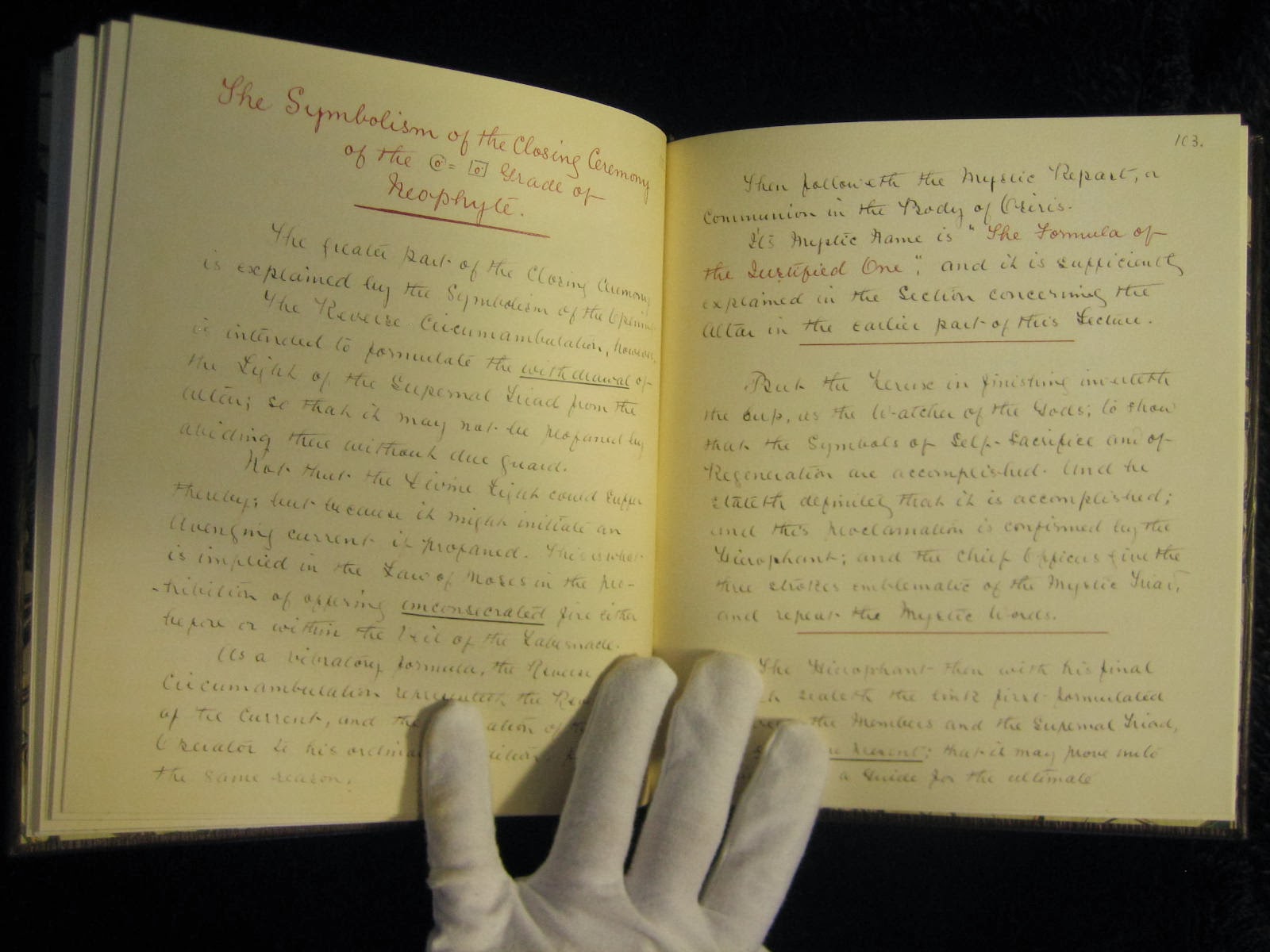
Z3 - The Enterer of the Threshold is like a window back in time. The book is a facsimile of a handwritten document linked to the most legendary occult group of the Victorian era, The Hermetic Order of the Golden Dawn. Long before days of xerox machines, scanners, and .pdf's members had to hand copy all documents concerning the order and its teachings. Magical documents, such as the 'Flying Rolls', were lent to Adepts on a temporary basis. While in their possession, Adepti had to make a personal copy within a specified amount of time before passing it along to the next member, usually through registered mail. This particular copy of the Z3 was copied on January 13th 1896, when the order was only six years old, by a female member known by her magical motto, Cogito Ergo Sum (I think, therefore I am) -- obviously a fan of Descartes.


The Z3 document is an explanation of the symbolism and meaning behind the Neophyte, or 0=0, Ritual of the Golden Dawn. The Neophyte Ritual is one of the most fundamental ceremonies within the Golden Dawn tradition. Paradoxically, it is one of their most basic rituals, yet at the same time it is also one of the most profound in the way it can be understood on multiple levels -- a microcosm of the macrocosm. One could draw a parallel to the LBRP ritual; it is one of the most basic of rituals, yet is also one of the most effective.


The Z3 begins by describing symbolism to be used in the ritual. I should add that this document is intended for Adepti, not the Neophyte candidate. This follows with notes about how the ceremony is to be structured and conducted. The reader is then told how to instruct the candidate in the meaning of some of the signs and symbolism used within the Golden Dawn. It also gives advice on how the Hierophant should conduct the ceremony. For example, "The Ritual should in all cases be said in a loud, stern, clear, and solemn voice, so as to impress the Candidate with the solemnity of the occasion; and in this there should be no foolishness, nervousness, or hesitation."  That's Victorian-speak for "No screwing around!" There are some other notation gems and interesting asides to be found within the text as well.


The text continues with instructions for teaching the candidate the basic Neophyte gestures, like the Step, Saluting Sign, Sign of Silence, and Grip. It also explains how the Grand Word and Equinoctial Password are to be imparted to the candidate. As many readers may know, a fair amount of the symbolism and ritual devices can be traced directly back to Freemasonry. As a good friend once told me, "The Golden Dawn is Freemasonry on steroids". The only caveat to that statement is the Golden Dawn allows women members; they were one of the first secret societies to do so. The Golden Dawn would not be what it is today without the contributions of female members like Florence Farr, Moina Mathers, Annie Horniman, Evelyn Underhill, and of course the copyist of this document. For those interested in learning more about the women of the order I highly recommend Mary K. Greer's book, The Women of the Golden Dawn: Rebels and Priestesses.


The text concludes with a discussion about the symbolism of the Closing Ceremony and the symbolism of the Equinox. The text reads more like an overview of the Neophyte ritual with tips and suggestions rather than a ritual script. The text assumes the reader already has advanced knowledge in the Golden Dawn tradition and Western esotericism in general, including text in Hebrew and Coptic, which is not surprising considering this was an Inner order document intended only for the eyes of Adepts. Unless one was very familiar with the Golden Dawn tradition, one would have a very hard time reproducing the Neophyte ceremony from this text alone. It presents the bare bones of the ritual only. Prior to Israel Regardie's published works, details of the Neophyte Ritual were mostly unknown outside the order. Those familiar with Regardie's version of the 0=0 will be intrigued by differences presented here.


Now for the book itself:

In this review I will be reviewing the Full Leather edition, one of the three 'Mother Letter" copies, of which this is 'Aleph' (א), meaning "breath'The book itself perfectly embodies the era in which it was originally written -- so much so that it almost feels like a relic. It is bound in full, rich, plum kidskin with vertical long grain. Inset into the cover is a piece of triangular, black, calfskin upon which the figure of Thoth is stamped in gilt. Each copy has one of 22 Hebrew letters in gilt at the apex of the triangle and "Z" & "3" at the lower points. The black triangle likely represents the Banner of the West. The spine has 5 double gilt lines representing the striped Nemyss worn during ritual. It also has striped black/gold head and tail bands.


The book opens to hand-marbled endpapers, a mesmerizing display of plum, gold, and emerald. The publisher states,
"Marbled papers by Ann Muir (traditionally made by hand with carrigheen moss and light-fast pigments derived from natural plant extracts, onto a good stock of archival paper), in a typical nineteenth century style whose coloration is chosen to harmonise with the colour scales relevant to the forces of the Grade Ritual of Neophyte under the activity of Thoth between the Pillars of Mercy and Severity."


 Each book also includes a replica of the original bookseller-stationer's label affixed to the top corner of the inner board. This is a real nice touch lending a real sense of history to the book. It is a detail that most publishers would not bother with. Bravo, Hell Fire Club Books.

Detail of  Cogito Ergo Sum's handwriting

The paper is quite nice and of a color and weight typical of the era. Again, to quote the publisher, the paper is, "100% cotton content produced by the prestigious mills of ‘Crane & Company’ who have been making paper since the 1850’s by time honoured methods and to the highest standards." It is printed in full color by offset lithography at the exact size of the original copy. Many of the passages were penned with red ink which comes though vibrantly in this edition. The strokes of the pen come though so clear that it is difficult to distinguish this from an original document. Some of the penmanship can be a bit difficult to read at spots, but overall it is very legible.

Z3 - The Enterer of the Threshold is a fascinating glimpse into the early workings of The Hermetic Order of the Golden Dawn. Experiencing a work like this in the actual hand of a member gives the reader a marked sense of intimacy and an appreciation for what serious magical practitioners were willing to do to obtain knowledge and enlightenment. How many magical practitioners today would be willing to copy nearly 120 pages by hand? Z3 is an insightful treasure for those interested in the Golden Dawn tradition and a fascinating reproduction for those enamored with Victorian era occultism.


Sunday, January 26, 2014

WINNER: 2013 Esoteric Book of the Year

*A note on how books are judged.

Books will be judged by the following criteria: binding, materials, design, talismanic intent & method of consecration (if applicable), artwork/layout, and editorial rigor. Books are chosen from those released and delivered (in full) within the year 2013 (even though they may have a 2012 publication date). This is because many books tend to encounter publishing delays. This is especially common in esoteric publishing for a number or reasons. For example, a 2012 book may not actually be available until 2013 in some cases. Books will not be judged by their topic, theme, or content (other than grammar). This may sound strange, but I feel it is unfair and pointless to compare or make value judgments between different magical paths or traditions (like comparing apples to oranges). While I do my best, I am not qualified to judge and assess every single magical system the world has to offer; I very much doubt such a person exists. Therefore, books will be judged by their craftsmanship, editorial competence, creativity, and beauty only.


Balkan's Arcane Bindings (BAB) is proud to announce its pick for the English language 2013 Esoteric Book of the Year.

*Note: A delayed entry: 
The Graveyard Wanderers (Copper clad version), published by The Society of Esoteric Endeavour was a likely candidate for an award this year. The sold-out book has been in the hands of readers for months. However, the deluxe copper slipcases for the 'Copper clad version' are still in production. Therefore the title must be pushed into 2014 and will be judged in the '14 awards.


The BAB Golden Talisman Award for 2013 Esoteric Book of the Year goes to....

Scarlet Imprint's Exu and the Quimbanda of Night and Fire by Nicholaj de Mattos Frisvold (Mor Edition).

This gigantic tome explores the origins of Exu, one of the most prominent spirits in the Quimbanda tradition. Exu is the Lord of Magic and represents masculine power, creation, and transformation. He can also be a trickster. Mr.Frisvold gives the reader instructions detailing how one is to work with Exu, including proper offerings, seals, magical powders, chants, and more. Within are ten illustrations and 120 pontos riscados/seals created by Enoque Zedro. His work is somewhat similar in style to decadent artist Aubrey Beardsley. This is a companion book to Mr. Frisvold's earlier work, Pomba Gira and the Quimbanda of Mbumba Nzila, 2011's Bronze Talisman winner. This is a tremendously important work, especially for those interested in ATR traditions and the grimoire tradition.

Exu (Mor Edition) is bound in full goatskin. The cover is decoratively blind stamped with a fiery design radiating from a goat skull device blocked in gold. This is a heavy book with sturdy construction -- 352 pages. Boards are thick to support the heavy textblock and are stylishly beveled. Exu has marbled endpapers, a black ribbon bookmark, and comes with a slipcase. Edges are gilt and have a dazzlingly bright sheen. The spine has four raised bands and sports the title, EXU, in large gilt letters. The publisher states, this edition is "reeking of cigar smoke and iron." When my copy arrived I noticed a faint yet distinct scent of cigar smoke. Either it was the power of suggestion, or Scarlet Imprint really did subject copies of the Mor Edition to a magical suffumigation. Observant readers may be aware that the Standard Edition of this book was released in 2012, however, the Mor Edition was not available until the first part of 2013 and is therefore judged among this year's releases. The Mor Edition of Exu and the Quimbanda of Night and Fire is limited to 70 copies. This is a magnificent production. Congratulations!


In second place, the BAB Silver Talisman Award goes to...


Ouroboros Press' Zoroaster's Telescope by André-Robert Andrea de Nercia and translated by Dr. Jennifer Zahrt (THE URN Edition).

Zoroaster's Telescope is a late 18th century work describing a fascinating divination system. The system utilizes 122 hexagonal tiles called "The Urn", each containing various planetary, zodiacal, and angelic associations. 37 tiles are drawn at random and formed into what the author calls "The Great Mirror". The diviner then studies the configuration and how the tiles relate to each other until answers begin to reveal themselves.

THE URN Edition of Zoroaster's telescope comes with 122 wooden tiles. Each tile has been engraved (laser engraved, I think) with various signs and attributions according to the book's instructions. The box in the photo is not included. I felt they needed a suitable container and happened to have a box that was the perfect size. This is one of the most unique divination systems I have ever used. It is somewhat complex, but it offers many layers of information. It is up to the diviner to decide how deeply they want to gaze into The Great Mirror. The only unfortunate drawback to the tile set is that a few tiles contain minor errors, mixing up Gemini/Pisces and Virgo/Scorpio signs (credit to V.H. Fra. Phaino for noticing this during our divination). At first I thought that perhaps the original diagram contained a blind (which the publisher faithfully reproduced), but the tiles to not reflect the way the tiles appear in the diagram. This minor oversight aside, Zoroaster's Telescope is an amazing system. Only 9 copies of THE URN edition (and 9 sets of tiles) were produced.

The book is bound in full vellum and contains a gilt lamp device on the cover. Vellum is hard to work with, but the result is stunning. The spine has seven raised bands, each outlined with a gilt line. It is finished with vellum head and tail bands, marbled endpapers, and a red ribbon bookmark. THE URN edition of Zoroaster's Telescope is easily one of the most unique books of 2013.


In third place, the BAB Bronze Talisman Award goes to...


IXAXAAR's FOSFOROS by Johannes Nefastos (Astra Matutina Edition)

No one could mistake the Astra Matutina Edition of FOSFOROS for anything but a magical book. The designer was able to successfully walk the thin line between 'tastefully ornamental' and 'gaudy'. The result is the diabolically beautiful and daring example of esoteric publishing you see below. FOSFOROS is a "Study on the being and essence of Satan". At its core it is a philosophical system seeking to understand the concept of total unity, or oneness, which it feels can only be done by paradoxically studying extreme opposites, in this case God/Satan. The book is illustrated by M. Räisänen, Fra V-A and Pietari Hanson. The artwork is quite good, perfectly complementing the book's content. It is translated by J. Nefastos and I Meinlander; edited by M. Wightman.

FOSFOROS (Astra Matutina Edition) is bound in full goatskin. The leather's scent is rich and earthy (no trace of brimstone). The cover is stamped in sliver and red foil with a vesica pattern and central pentacle emblem. Edges are silver gilt. FOSFOROS has leather head and tail bands, pentacle-patterned endpapers, and a silver ribbon bookmark. I must add I feel the book would have benefited from a title on the spine. Leaving it blank was a curious choice. Still, it is a marvelous and stunning work -- one of the year's best. Limited to 55 copies.


2013 Honorable Mentions:
  • The Keys of Ocat: A Grimoire of Daemonolatry Nygromancy by S. Connoly (Funerary Templar Edition), published by Nephilim Press.
  • Serpent Songs curated by Nicholaj De Mattos Frisvold (Serpentine Edition), published by Scarlet Imprint.
  • The Catechism of Lucifer by Johannes Nefastos (Leather Edition), published by IXAXAAR.
  • Arcanum Bestarium: Of the Subtil and Occult Virtues of Divers Beasts by Robert Fitzgerald (Deluxe Edition), published by Three Hands Press.
  • Occlith 0: Omniform by Joseph Uccello (Special Edition), published by Three Hands Press.
  • Rosicrucian Manifestos by Johann Valentin Andreae (NEQUAQUAM VACUUM Edition), published by Ouroboros Press.

2013 was an explosive year for esoteric publishing. The year saw the addition of a number of new esoteric publishers, but what stood out the most was the occult journals that have hit the market. See my earlier entry: A Brief Overview of Today's Esoteric Journals (only it wasn't quite so brief) for more details. I intend to post an update to this review in the near future to address some new and exciting journals, some of which are quite deluxe. 

I sincerely hope the dramatic growth within esoteric publishing is reflective of a growing readership. Are more people being drawn to the subject, or are current readers buying more books than previously? Perhaps what we are seeing is only a sign of an increasingly competitive market, one that I hope will remain driven by quality. In any case, it is encouraging to see new publishers arise, especially after so many claims that the days of "dead tree books" were numbered. The jury is still out on that one, but the e-book is certainly gaining ground. According to Pew Research, nearly half of Americans under 30 read an e-book in 2013.

Ever adaptable, much of the esoteric publishing world has developed the necessary shape-shifting skills to be whatever each individual reader desires. For some it is a convenient and space-saving e-book; for many it is a modestly priced hardback; for a few it is a magical operation performed via leather, ink, and gilt. All of these are the correct means of transmission. It is this sort of market-cunning that allows esoteric publishing to stay relevant in the 21st century.

There is a LOT to forward into 2014. A number of highly anticipated books have already been announced. Here are a few:
  • The long-awaited Ontological Graffitti by Michael Bertiaux, to be published by Fulgur Ltd. looks to be another fascinating exploration of the Voudon Gnostic current.
  • IXAXAAR's most deluxe publication to date: The Book of Achra Sitra: A Grimoire of the Dragons of the Other Side by N.A-A.218 (Deluxe Black Python Edition) will arrive in the first part of 2014. I hope interested readers have already secured a copy, as all copies (999 copies in total) have completely sold out prior to its release.
  • Scarlet Imprint's first release of 2014 will be the final volumes of Jake Stratton Kent's Encyclopedia Goetica series, The Testament of Cyprian the Mage (2 volumes). This marks the end of a truly monumental amount of research into the grimoire tradition.
  • Fans of David Chaim Smith will soon have his second volume of Qabalistic brilliance, A Blazing Dew of Stars, expected early in 2014 from Fulgur Ltd
  • 2014 will see the first volume of an ambitious series, THE MAGISTER, Volume 0: The Order of Revelation by Marcus Katz. It will be the first of 11 planned volumes (white quarter-leather), published by Salamander & Sons.
  • Ouroboros Press has recently announced a classic text from the late 16th century, Daemonologie. It will be printed in three editions, including the enticingly named "Hellmouth Edition", quarter-bound in snake skin and parchment.
  • Recently, fans of Mark Alan Smith received the standard edition (Blood-Pact Edition) of his newest work, The Altar of Sacrifice, and were stunned by its superb quality (myself included -- the standard edition is of the quality of most deluxe editions). However, early in the year a lucky few will receive the very limited Sacrificial Soul Edition, bound in black snake skin, published by Primal Craft.
  • Last but not least... perhaps the most anticipated book of the year (or even the decade for some) will be the legendary Dragon Book of Essex by the late Andrew Chumbley, made public for the first time by Xoanon Ltd.. It will be a mammoth tome at 882 pages. It has been a long wait for this one.

Have a great year, dear readers.

Sincerely,
B. Balkan


Sunday, December 29, 2013

The Future of Esoteric Publishing?

Image credit: pjmedia


In lieu of my usual book review I decided to open up a conversation with my readers about current trends and the future of esoteric publishing.

With 2013 drawing to a close, and a new year on the horizon, I began to wonder what possibilities the future may hold for esoteric publishing. Certainly we have seen a large increase in the number of independent esoteric publishers in recent years. I expect this trend to continue for a while for as much as the market will permit. However, what I'm most interested in is the form, format, and function that future publications may take. We live in a rapidly changing world where amazing new technologies are adopted quickly by society creating frequent paradigm shifts in how we digest information and how we communicate with one another.

With this in mind, how will new technology change esoteric publishing? E-books have certainly changed the landscape in ways both good and bad. Books are now available instantly, but at a cost, as book piracy has become a worrisome problem. Will digital media continue to expand and slowly overshadow the printed book? I see digital media becoming a stronger force in most time-sensitive (and relatively disposable) publications: newspapers, periodicals, mass-market paperbacks, etc. However, it may not take hold as much within esoteric publishing for the simple fact that many readers tend to see physical books as an iconic feature within esotericism. For some, books are simply a convenient vehicle for information (e-books being even more convenient); for others (myself included) they are a magical fetish, a residence of spirits, or an integral component of their practice.

One of the obvious benefits of digital books/documents is that one can store a massive amount of information on something as small as a flash drive. The website Sacred-Texts currently sells a flash drive containing 1700 esoteric books (books in public domain), stating, "Hold the world's wisdom in the palm of your hand!" It is really incredible when you think about it.

Photo credit: Sacred-Texts.com


Aesthetically there is a world difference between an ephemeral occult e-book and a gilded, goat-skin, grimoire. But what if there were a third option -- something in-between the two extremes? I see no reason why publishers cannot blend traditional bookbinding craftsmanship with a bit of ars technica.

Allow me to give you an example:

An old friend of mine recently brought a book to my attention. It is a hardback graphic novel titled, Shifter created by Skip Brittenham and Brian Haberlin and published by Anomaly Publishing. It is essentially an adventure involving characters shape-shifting into various animals. What really makes this book unique is that is utilizes modern technology in a rather novel way using what it calls "Ultimate Augmented Reality", or (UAR), an app one can download from the publisher's site. By using the app the reader is able to access additional information. The reader uses a smart phone and points it at "live" pages. This generates hidden 3D items (via augmented reality) that the reader can interact with by tapping/swiping their smart phone. Additional information and content is added periodically by the publisher extending the life the story by offering more possibilities for the reader. It sounds like something right out of William Gibson's Neuromancer, but it is today's reality.

Image credit: Anomaly Publishing


I believe technological features such as these offer tremendous potential for esoteric publishing. Consider the following possibilities:
  • An occult book with embedded/hidden digital content accessible via smart phone app, such as video footage of the author performing a ritual described in the book or demonstrating personal techniques.
  • A grimiore that has interactive tables and diagrams, or one that generates a virtual ritual space via augmented reality. 
  • An alchemical text allowing the reader to mix virtual chemicals safely as a chemical/spiritual model (no fulminate of mercury explosions for the Jack Parsons of our time!) or shop for labware directly through the book. 
  • A charm book that generates specific spells in real-time that are aligned to current conditions, such as appropriate planetary hours or specific calendar days; again, accessible via smart phone or something like Google Glass.
  • How about a book on Enochian magic that generates 3D elemental tablets and an audio pronunciation guide?  
Embedded content is a whole new way of hiding information in plain sight -- a long tradition in esotericism. Books could open up in ways previously unimaginable for those willing to look deep enough. I needn't remind anyone that the very word 'occult' means hidden. Thus, one could look at all this as a 21st century take on a very told tradition.

I should note that the possibilities described above should not be added as simple gimmicks or games, but rather used as serious tools intended to assist the reader. 

Granted, some of these ideas would require innovative software development. However, publishers/authors could still utilize modern technology by doing something as simple as including a printed QR code to take readers instantly to relevant internet links.
Image credit: Wikipedia

Technology aside, there are still other ways in which publishers and authors could creatively add layers of esoteric content to their works. For example, I have often wondered why it is that very few esoteric books experiment with layout and typesetting, that is, making the text itself a magical sigil of sorts. If one is interested in seeing a marvelous example of creative text I would suggest picking up a copy of Mark Z. Danielewski's novel, House of Leaves. The book has achieved cult status among fans. The book is a massive cypher, a modern classic of metafiction. Perceptive readers are still deciphering the text and finding new hidden content over 13 years after the book's publication. 

Photo credit: NPR.org


An example of HOS's eccentric text layout. Photo credit: The Dreadful Cafe

Current trends:

Some of my readers may have noticed an increase in hand-made accouterments accompanying deluxe editions: elaborate slipcases & chemises, decorative wood boxes, hand-made divination tools -- even small bags of animal bones. A couple decades ago we began to see books including talismans hand-drawn by the author, like the ones accompanying many of Andrew Chumbley's first limited editions. Many of these were roughly the size of a large bookmark. Today this tradition continues, exhibiting a wide array of materials, impressive craftsmanship, and notable originality.

Xoasis Publications recently announced a limited edition (Death Edition) of The Box of Pandora by Sheila Undi that actually comes inside an ornately carved ebony box. The box also has a lock, and considering the title, one should expect nothing less. The 'Devotee Special Edition' of Black Magic Evocation of the Shem ha Mephorash by G. de Laval, published by Aeon Sophia Press, also comes inside an intricately carved, custom, wooden box, as did the deluxe edition of David Beth's Voudon Gnosis, published by Fulgur Ltd.. Ouroboros Press recently released 'THE URN' edition of Zoroaster's Telescope. Besides the beautiful vellum-bound book, each copy includes 122 hexagonal etched wood tiles used for a divination system detailed in the book. It is a very small edition -- only 9 sets were made.

The examples given above represent a wonderful marriage of the bookbinder and woodworker's respective arts. I suspect we will see more of this in coming years, though it is easy to see how this sort of thing could get a bit carried away. For example, I doubt I would buy a special edition of anything that came with a 2 foot statue, or a vial of the author's blood. In my opinion, books should come with items people actually want and that serve a purpose. My suggestion to publishers is to keep such items relative to the work. Furthermore, extra items should be practical and either serve as protective housing for the book or compliment it in some way, like a tool. 'THE URN' edition of Zoroaster's Telescope is perhaps the best example of the latter; the wood tiles are a key component of what the book is all about.

Some of you may also have noticed rapidly climbing prices of some deluxe and "super-deluxe" editions. I refer to the original sale price, not the aftermarket price, which is often absurdly inflated to the point of being ridiculous (check out eBay for a good laugh). Just a few years ago $300 was generally considered the top of the high end for most deluxe editions (still an outlandish sum for most readers). Things have changed. This is because some books are becoming even more lavish. Recently I have seen new publications listing a pre-order price over $700. I think this nears the ceiling of what most customers are willing to spend on a new book, even the most rabid collectors, though I could be proven wrong.

Without a doubt the bar has been raised. In coming years I foresee books bound in more exotic leathers/hides and also the revival of old bookbinding techniques, like gauffered edges (see photo below). We haven't quite reached the 'bound in human skin' point, but publishers are getting far more inventive and willing to push the boundaries of bookbinding.  I am not sure if this is a result of increased competition in the market or not. Amazing publications that generate a lot of 'buzz' will certainly make a publisher stand out. It could also be that publishers realize there is less risk involved when investing in very expensive editions now that deluxe editions (even super-deluxe editions) have a proven track record of selling out.

Example of gauffered edges. Imagine a book like the one shown above with magical insignia along the edges.
Image credit: crouchrarebooks.com


Generally speaking my estimation for increasing prices is due to two common market traits:
  • Quality: Publishers have noticed that customers are willing to pay premium prices for high quality books, often made using hard-to-find and exotic materials (like python skin). A few recent books have been of startling quality and construction; last year's Esoteric Book of the Year winner, Devils and Spirits is a good example. Publishers are meeting the market demand and customers are getting what they pay for. 
  • Scarcity: Some books are priced very high, not because of their lavish construction, but simply because they are printed in extremely small editions and expected to sell out quickly. In such cases it is good practice to be a bit leery of high-priced small print-runs intended to create artificial scarcity. Ask yourself, Would the book be worth the price if there were thousands available? Reputable publishers sell books at a reasonable debut price regardless of how small the print run is. One can see a similar pricing model in the scotch whiskey market (I love using whiskey to illustrate a point). One cannot gauge the quality of scotch by the price alone. Some bottles are priced at astronomical prices due to extremely low supply. Thus, a rare $300 bottle of whiskey from a mothballed distillery may actually be of inferior quality when compared to a commonly available $50 bottle. It is priced high only because of its rarity. 
So, readers and collectors will have to decided what is most important to them: rarity, quality, content (at all costs?), or all of these. And as always, caveat emptor.

I invite my readers to share your thoughts and opinions about current trends in esoteric publishing, and also any ideas and prognostications about what the future may hold. What would you like to see?

In my next post will announce the 2013 awards for Esoteric Book of the Year.

Wishing everyone a Happy New Year,
B. Balkan