Showing posts with label Witchcraft. Show all posts

Wednesday, March 8, 2017

2016 Esoteric Book of the Year

My apologies for this late year-end review. I have been involved with a number of time consuming pursuits. Between projects and travel I have had little time to write book reviews as frequently as I would like.

*A note on how books are judged.

Books are judged by the following criteria: binding, materials, design, talismanic intent & method of consecration (if applicable), artwork/layout, and editorial rigor. Books are chosen from those released and delivered (in full) within the year 2016 (even though they may have a 2015 publication date). This is because books tend to encounter publishing delays. It is especially common in esoteric publishing for a number or reasons (including some of high strangeness). For example, a 2014 book may not actually be available until 2016 in some cases. Books will not be judged by their topic, theme, or content (other than grammar). This may sound strange, but I feel it is unfair and pointless to compare or make value judgments between different magical paths or traditions (like comparing apples to oranges). While I do my best, I am not qualified to judge and assess every magical system the world has to offer; I very much doubt such a person exists. Therefore, books will be judged by their craftsmanship, editorial competence, creativity, talismanic nature, and beauty only.

In recent years there has been a dramatic increase in the publication of deluxe esoteric books. This is certainly good news to publishers, readers, and collectors; however, it is becoming increasingly difficult to keep up with such high output. Frankly, there is not enough time for any individual to read and evaluate every deluxe esoteric book published in a given year. A few years ago it was possible, but no longer. This is a good "problem" to have. Consequently, some very important and noteworthy books may end up falling through the cracks.

Furthermore, with the sheer number of titles released annually I have to be more selective by choosing only topics I find personally interesting such as (but not limited to): witchcraft, folk-magic, Hermeticism, demonology, and reprints of historic grimoires. I am less interested in contemporary magical diaries, occult manifestos, and New Age cookbooks. Therefore I apologize in advance to publishers and authors of books I may have overlooked. To help remedy this, and give credit where credit is due, I invite my readers to post titles of deserving books (from 2016) that may have been overlooked in the comments section of this post.


And now, Balkan's Arcane Bindings' pick for the English language 2016 Esoteric Book of the Year.


The Golden Talisman Award for 2016 Esoteric Book of the Year goes to....


Ifá: A Forest of Mystery by Nicholaj de Mattos Frisvold (Fine Edition). Published by Scarlet Imprint. Black & white illustrations by Childerico.  Octavo. 400 pages. Limited to 64 copies.


Ifá: A Forest of Mystery is Nicholaj de Mattos Frisvold's fourth book of Afro-Caribbean magic published by Scarlet Imprint. It was preceded by Palo Mayombe: The Garden of Blood and Bones, Exu & the Quimbanda of Night and Fire, and Pomba Gira and the Quimbanda of Mbumba Nzila. The book explores the Yoruban Ifá tradition, and in particular, its primary divination practices. Prior to reading this book I had almost zero knowledge of the Ifá tradition, yet Mr. Frisvold made it easy for me to comprehend the basic tenets and cosmology of the system. The author strikes a welcome balance by making the work comprehensible for the novice (like me) and also providing enough depth and mystery to keep the interest of readers already familiar with the system. The dramatic artwork by Childerico (reminiscent of woodcuts, though far more detailed) creates a phantasmal atmosphere filled with primal power and laden with symbolic meaning -- 18 images virtually crackling with energy.
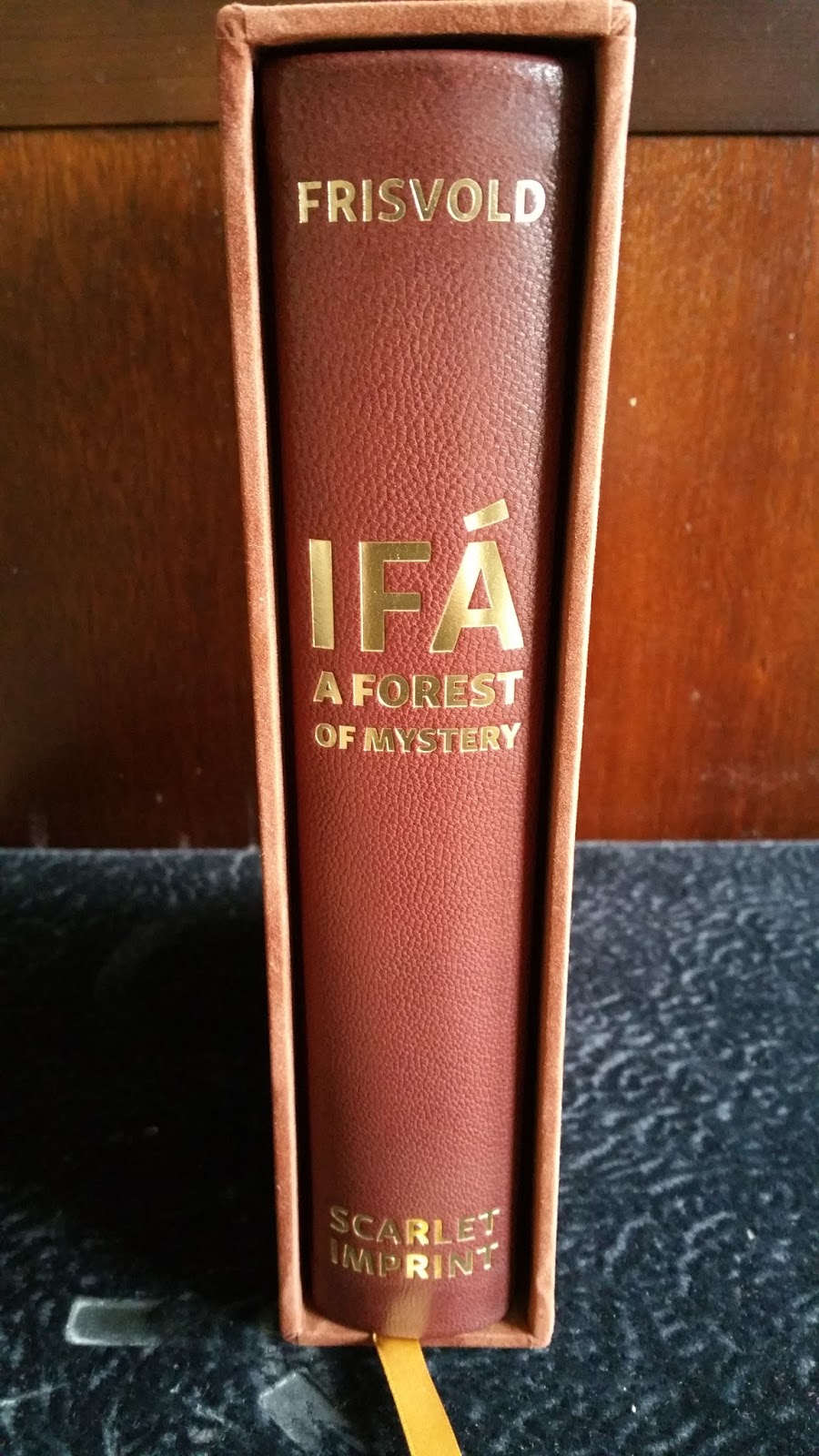


Like all the rest of the Frisvold/Scarlet Imprint collaborations, the fine edition of, Ifá: A Forest of Mystery is truly something to behold. Its luxurious binding is bound in full hand-grained morocco. The publisher (and probably the tannery) refers to the color as "rust", but I think chestnut would be more accurate. The leather is soft with a smooth tight grain and has a very pleasant scent -- what can only describe as malty.


This is a hefty book (2 inches thick) with very heavy beveled boards. As far as its construction goes, it is 'built like a tank'. Simply outstanding. I am sure it will outlast everyone reading this review. The cover is breathtaking -- an image of Orúnmila, the god of knowledge, blocked in gold. He holds the sacred palm tree nuts (ikin) used for divination. Custom endpapers from Victoria Hall are marbled with a striking weave pattern in shades of green and red. Quite unusual. The book's edges are gilded as well. There might be more gold in this book than some people's wedding rings. It is finished off with gold head/tail bands and a gold-colored silk ribbon bookmark. A brown suede slipcase is provided for protection. The work concludes with a glossary, bibliography, and index. Scarlet Imprint has shown once again why they are one of the leaders in fine bindings, and not just in esoterica, but among all publishers.


In second place the Silver Talisman Award goes too...

Azoëtia by Andrew Chumbley (Third Edition - Special Edition). Published by Xoanon Limited. Illustrated in black and white by the author. Octavo. 394 pages. Limited to 22 copies.


Azoëtia was ranked a very close second in my poll for the "Most Important Esoteric Book of the 20th Century" here. It was surpassed (by only 1%, mind you) by Crowley's Magick: Liber ABA (Book Four). Azoëtia is the foundation text of the Sabbatic Witchcraft tradition. A true modern grimoire, it contains a series of formulae, rites, conjurations, and instructions unique to the Sabbatic Witchcraft tradition. The work is illustrated throughout with Mr. Chumbley's own fascinating and complex pen/ink psychography. A glossary is included to familiarize the reader with potentially unfamiliar terms.

Azoëtia's impact on contemporary witchcraft traditions is considerable, but its influence extends far beyond witchcraft traditions in ways one might not expect. I believe Azoëtia's Second Edition (the "Sethos" Edition) was instrumental in making talismanic publishing what it is today. Prior to its publication, 20th century occult books rarely commanded high prices, with the exception of first edition or signed books by Crowley or A.O. Spare. That all changed with Mr. Chumbley and his publisher, Xoanon. Demand and buzz had been building after the first edition paperback of Azoëtia (1992) became scarce. In 2002 it was reprinted as a deluxe hardback. Not only was Azoëtia beautifully bound, but it was also very limited and in high demand. It sold out in a matter of months. Chumbley also created handmade talismans to accompany some of his works. This changed everything. Suddenly books were not simple vessels for magical material, they were themselves magical -- a very old idea reintroduced into the modern market. It was also a rejection of the disposable/paperback culture many of us had grown up with. Books began to look and feel magical again. Now, with the new 3rd Edition, the bar has been raised even higher.


The Special Edition of Azoëtia is bound in full cream-colored alum-tawed goat (whitened with alum salts). Alum-tawed skins are a time-honored material in bookbinding dating all the way back to the 12th century. I feel this is a perfect choice for binding material for Azoëtia, as the skin is both elegant and rustic -- understated and rugged -- perfectly reflecting the raw and direct nature of the work. The natural irregularities and blemishes of the goatskin echo the unique and variable challenges the reader will encounter within the Sabbatic current. Furthermore, the goatskin has a marvelous texture with a very fine "grip" -- semi-rough when stroked against the grain, like the tongue of a cat.

The cover is one of Mr. Chumbley's figurative pieces blocked in 22 karat gold. It is a component of an interior image, (Fig. 14 Erotocrasis: The Arch of Drewary O'er the Sigillick Tree of Earthen Albion). The book's title is emblazoned on the spine in matching gold and bordered by four raised bands, each outlined in gold. Head/tail bands, marbled endpapers, and ribbon bookmark are all scarlet red, a striking contrast against the pallid exterior. Opening the book is like opening up a living creature -- a marbled fleshy interior splashed with crimson.


Each copy of the Special Edition comes with a hand-written talisman, "bearing the sign of one of the twenty-two Sacred Letters of the Azoëtic continuum". For privacy reasons I have digitally removed the letter from the talisman in the photo. Each of the 22 "Holy Letters" found within Azoëtia has a specific energy signature and distinctive correspondences. Of all the 22 letters, the one I received was the most personal and appropriate for me. It was uncanny.

Later, in a conversation with the publisher, he explained to me that individual letters were specifically chosen for each of the 22 recipients. It impressed me beyond words that a publisher would take such care, time, and consideration to make sure that each copy arrived into the hands for which it was destined. This, ladies and gentlemen, was a truly magical process. It is this sort of personalized attention to detail that sets the small press (and specifically talismanic publishing) apart from mass-market publishers. This is not just a sales process; it is a magical working.


In third place, the Bronze Talisman Award goes to...


The Devil's Plantation: East Anglian Lore, Witchcraft & Folk-Magic
by Nigel Pearson (Fine Edition). Published by Troy Books. Illustrated in black & white by Gemma Gary. Black & white photographic plates. Octavo. 272 pages. Limited to 15 copies.


The Devil's Plantation is a fascinating collection of traditional witchcraft beliefs and lore from East Anglia. Mr. Pearson takes the reader on a journey covering a number of topics specific to the region: spirits of the landscape -- or genius loci (East Anglia's unique psychogeography), encounters with folkloric creatures, historic and notable witches and cunning-folk, flora/fauna/mineral lore, and witchcraft traditions (charms, cures, and curses). A bibliography and index are also included.

The title is an homage to an infamous "black book" of the same title written by a legendary Cambridgeshire witch, and also refers to cursed parcels of land believed to belong to the Devil, also known as a "Devil's Acre", "Devil's Hopyard", "Devil's Backbone" or "Devil's Den". Places ascribed with devil-names are of great interest to me. Poet J.G. Whittier wrote a poem about unhallowed grounds and accursed acreages titled, "The Devil's Den":
'Tis said that this cave is an evil place
The chosen haunt of a fallen race
That the midnight traveller oft hath seen
A red flame tremble its jaws between,
And lighten and quiver the boughs among,
Like the fiery play of a serpent's tongue;
That sounds of fear from its chambers swell
The ghostly gibber, the fiendish yell;
That bodiless hands at its entrance wave,
And hence they have named it The Demon's Cave.
* * *
Yet is there something to fancy dear
In this silent cave and its lingering fear,
Something which tells of another age,
Of the wizard's wand, and the Sybil's page,
Of the fairy ring and the haunted glen,
And the restless phantoms of murdered men:
The grandame's tale, and the nurse's song
The dreams of childhood remembered long;
And I love even now to list the tale
Of the Demon's Cave, and its haunted vale."


The Devil's Plantation is appropriately bound in full black goatskin. The goatskin has a medium grain with a faintly oily texture. Folklore speaks of certain books of maleficia that "sweat", indicating that the spirits bound within are in constant torment. Perhaps this is one. What makes this binding really stand out is an inlaid shield panel in deep blue leather with a blind embossed border. The shield is blocked in silver with a toad skeleton device and three crowns. The spine has five raised bands and a matching blue leather label, also blocked in silver. Head/tail bands and silk bookmark are in a matching shade of blue. Hand-marbled endpapers in grey, teal, and bronze are equally bewitching (pardon the pun), and look like the oily surface of a bubbling cauldron -- an amusing choice. The Devil's Plantation comes housed in a black buckram slipcase blind embossed with a shield device.


The book contains fifteen evocative pen/ink illustrations by Gemma Gary in her distinctive stipple-style (this has become a welcome trademark feature of Troy Books' titles), and twenty five black & white photographic plates. As somewhat of a companion book to The Devil's Plantation, Troy Books has recently released a new and revised edition of Nigel Pearson's earlier work, Treading the Mill: Workings in Traditional Witchcraft. Mr. Pearson's work is a tremendous contribution to the study of British folk magic.


2016 Honorable Mentions

  • The Triangular Book of St. Germain deciphered and translated by Nick Koss (Special Edition). Published by Ouroboros Press. Printed in full color. English and French text. Small triangular format (6 1/2" x  6"). 48 pages. Comes with a sterling silver talisman and marbled slipcase. Limited to 26 copies. 


  • Þursakyngi - Loki by Ekortu. (Deluxe Edition), published by IXAXAAR. Bound directly to goat leather creating a unique protective envelope with tied leather closures. Comes with a birch bark talisman created by the author. 270 pages. Octavo. Limited to 49 copies.


  • The British Book of Spells and Charms by Graham King (Fine Edition). Published by Troy Books. 296 pages. Blind embossed buckram slipcase. Duodecimo. Limited to 20 copies. 


  • Claves Regni by Nikolai Saunders. Published by Fall of Man. 542 pages. Octavo. Bound in Italian green moire silk and gold gilt. Faux-crocodile skin slipcase. Limited to 96 copies.


Moving into 2017:

My hope is to get back to writing semi-regular book reviews, that is, if life will ever calm down enough to permit it. I am also considering including a occasional interviews with authors and publishers to mix things up a bit. 

Have a great year, dear readers.

Sincerely,
B. Balkan

Read about past years' winners:

Thursday, January 28, 2016

2015 Esoteric Book of the Year

*First, a note on how books are judged.

Books are judged by the following criteria: binding, materials, design, talismanic intent & method of consecration (if applicable), artwork/layout, and editorial rigor. Books are chosen from those released and delivered (in full) within the year 2015 (even though they may have a 2014 publication date). This is because books tend to encounter publishing delays. It is especially common in esoteric publishing for a number or reasons (including some of high strangeness). For example, a 2014 book may not actually be available until 2015 in some cases. Books will not be judged by their topic, theme, or content (other than grammar). This may sound strange, but I feel it is unfair and pointless to compare or make value judgments between different magical paths or traditions (like comparing apples to oranges). While I do my best, I am not qualified to judge and assess every magical system the world has to offer; I very much doubt such a person exists. Therefore, books will be judged by their craftsmanship, editorial competence, creativity, talismanic nature, and beauty only.

In recent years there has been a dramatic increase in the publication of deluxe esoteric books. This is certainly good news to publishers, readers, and collectors; however, it is becoming increasingly difficult to keep up with such voluminous output. Frankly, there is not enough time for any individual to read and evaluate every deluxe esoteric book published in a given year. A few years ago it was possible, but no longer. This is a good "problem" to have, though some very important and noteworthy books may end up falling through the cracks as a consequence.

Furthermore, with the sheer number of titles released annually I have to be more selective by choosing only topics I find personally interesting such as (but not limited to): witchcraft, folk-magic, Hermeticism, demonology, and reprints of historic grimoires. I am less interested in contemporary magical diaries, occult manifestos, and New Age cookbooks. Therefore I apologize in advance to publishers and authors of books I may have overlooked. To help remedy this, and give credit where credit is due, I invite my readers to post titles of deserving books (from 2015) that may have been overlooked in the comments section of this post.


And now, Balkan's Arcane Bindings' pick for the English language 2015 Esoteric Book of the Year.


The Golden Talisman Award for 2015 Esoteric Book of the Year goes to....

The Society of Esoteric Endeavour's Book of Magic by Anon (Herbert Irwin). Three item set: Facsimile of Manuscript (octavo, 416 pages), Transcript (octavo, 408 pages), and Talisman Folder (octavo, inset with eight vellum talismans).


There are plenty of books o the market about magic, but very few are magical; that is, not just about magic, they are magic. The latter may result from a number of methods: consecration, binding materials with symbolic meaning or magical correspondences, intense personal connection, spirit binding (the book becomes a home to a spirit), making the book actually do something -- essentially turning it into magical device, or through a most repugnant method: sacrifice (destroying the book) *shudder*. 

Readers may scoff at the "personal connection" method, as everyone has a favorite book, or twenty, correct? What I mean by personal connection is a book that has an extremely deep connection. The kind of book one would run into a burning building to rescue; one that has made a profound impact on one's life and possibly even influenced the chapters of one's own life. I'll give you an example: This may not come as a surprise, but the first purchase I ever made as a child with my own money was a book. I was 6 years old. I had saved up pennies for quite some time doing odd chores for my parents (as much as a boy that age can do). The book I wanted was a children's book about monsters. Eventually I had saved enough to buy it. I have vivid memories of different monsters leaping off the page and (at least in the mind's eye of a small boy) becoming very real. That book was my Lesser Key of Solomon, a six-year-old's Goetia. I still have it. It is still one of my most magical books, and I still work with the monsters of the book. We've become old friends and have served each other well.

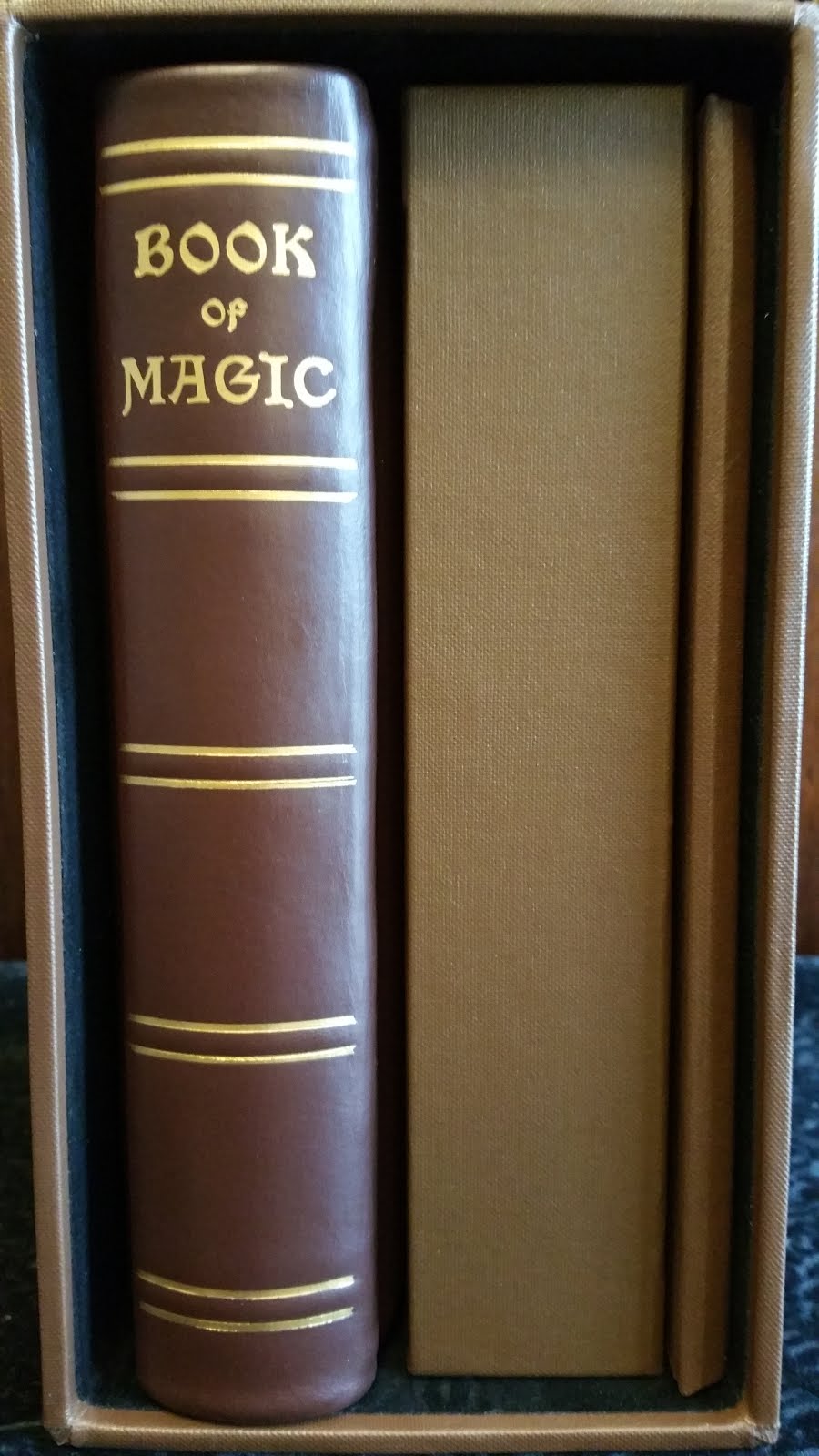
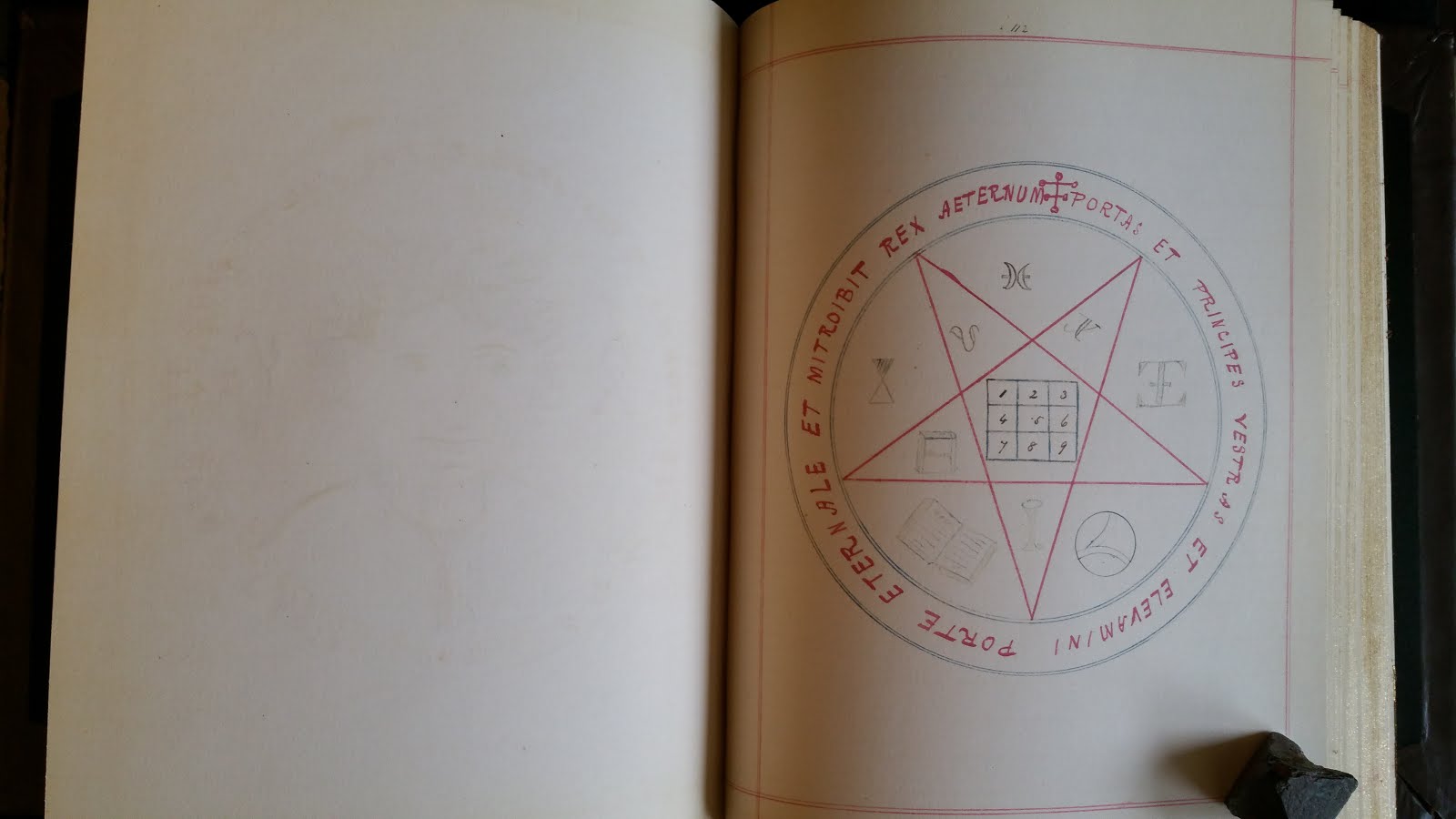
Book of Magic falls into to the "magical device" category. The original manuscript (from 1874) is an instruction manual about how to make a magical book, hence the title Book of Magic and not Book About Magic. Now, after over 140 years, the book has finally migrated from the astral and has physically manifest. The book is essentially a tool for doing magic, not just reading about it.

The set contains a number of magical devices. First, inside the cover is a diagram of an eye within concentric circles illustrating "The Harmony of the Universe". This can be used as a meditative tool to focus one's mind before an operation. It gets better: the eye is formed from a small piece of the original manuscript. This creates a magical link to the original text following the principles of Sympathetic Magic; specifically, the Law of Contact or Contagion which states that things that were once in contact continue to be connected after the connection is severed. Today scientists call this phenomena Quantum Non-locality, what Albert Einstein called “spooky actions at a distance”. Second, the hardback folder contains a set of 8 vellum talismans blocked in gold, created exactly as outlined in the text. These have a variety of uses. Third, (and this is perhaps the most astonishing feature) inset into the back cover of the book is a black convex scrying glass used for divination or spirit communication. Ben Fernee, the mastermind behind The Society for Esoteric Endeavour, elaborates by stating: 
Furthermore, with the eye in the motif set in the front cover being on paper from the original manuscript, it provides a magical link that is the basis for the magic mirror set in the rear board to act as the window by which the practitioner may access the same mind spaces that Herbert viewed to create the original manuscript.
The eye is set into the front cover directly opposite the rear mirror. So when the book is closed the eye is continuously gazing through the text block and into the darkness of the rear mirror, creating a magical circuit, if you will. So not only does the mirror provide an aperture to different states of mind, but also a window through time and into the head-space of the book's creator. Depending on the reader's beliefs, the eye -- ever watchful -- may also serve as a ward to make sure the mirror does not become an unintentional gateway when not in use, the Watcher at the Threshold.


For the most part, the content of Book of Magic is a collection of ceremonial magic techniques and Hermetic arts used later in the Golden Dawn tradition. There are also a few folk-magic inclusions like the magical use of a dozen drugs and herbs and how to make a dowsing rod. Interestingly, there is also a section on non-Euclidean geometry -- shades of H. P. Lovecraft's "impossible angles". It was the author's valiant attempt to graphically describe higher dimensions, with limited success. Occult architect Claude Bragdon did a much better job (visually) 56 years later in his book Four Dimensional Vistas (1930) and The Frozen Fountain (1932) through illustrations of hypercubes or tesseracts.


As previously stated, the set comes in 3 parts: book, transcript, and talisman folder. All are contained within a slipcase. The book is handsomely bound in full brown calf with gilt title and border. Edges are hand-gilded. Interior boards are inset with black silk doublure with scalloped corners. Endpapers are decorated with a black and red fylfot cross tessellation (the fylfot is also discussed in the text).

The text block is an exact full-color facsimile of the original manuscript (obviously penned by hand) which may present a challenge for modern readers. A second volume, a typed transcript, is provided for clarity. It is cloth-bound in a matching brown hue. The third item is the talisman folder, also bound in cloth. Inside are eight vellum talismans blocked in gold.


This book was offered for pre-order for one week. At the end of the week the number sold would be the total number produced for this edition. The final number was 196 copies. This is my preferred method of selling. It allows interested parties a reasonable chance to obtain a copy and avoids the mad dash and inevitable disappointment for those who are unable to get a copy due to slow emails, distant time zones, or because they couldn't immediately get financing in order.

Book of Magic is yet another stunning release from The Society of Esoteric Endeavour. It is a talismanic book par excellence.


In second place the Silver Talisman Award goes too...

Primal Craft's The Witchblood Grail by Mark Alan Smith (Devil's Crown Edition). Illustrated in black and white by Lorein. Octavo. 394 pages.


The second volume in the Way of Sacrifice Trilogy (preceded by The Altar of Sacrifice), the Witchblood Grail is, in a word, magnificent.  The book is revealed in four parts:
  • Book One -- The First Inner Book of the Flesh: The Book of the Initiated Blood
  • Book Two -- The Book of Forbidden Flesh
  • Book Three -- The Book of Malefic Blood
  • Book Four -- The Book of the Devil's Throne
One of the more interesting parts is found in Book One, a chapter tilted, "Toadstone Familiars", detailing the creation and consecration of the toadstone. It is a peculiar adjunct to toadbone ritual.

Like Mr. Smith's previous works, The Witchblood Grail contains full-page black and white illustrations (six of them) by an artist known only as "Lorien" along with countless sigils, seals, and other symbols used in magical operations.


The book continues a familiar pattern of Mr. Smith's other works with heavy focus on poetic incantations and affirmations. His works are devotionals rather than straight forward instruction manuals, which may not be everyone's cup of tea. But do not worry -- there is no groveling or mindless supplication involved; the chants and orations are meant to empower the practitioner. Sometimes verbalizing one's intent aloud can be just the key one needs to unlock doors. Our screen-filled world has become so visually dominated that it is easy to overlook or forget the auditory components of magical practice.

Like its preceding volume, The Witchblood Grail is fully bound python skin with five raised bands on the spine. This time it is black and white python instead of solid black. It has a mesmerizing quality about it and is a pleasure to hold. One could say the natural zig-zag pattern of the python skin reflects the "crooked path" taken by many practitioners, a path winding hither and thither like the snakes of the caduceus wand.

The cover is embossed with "The Devil's Crown and The Eye of The Dragon" in 24 carat gold. The symbol doesn't "pop" as much as the cover of the previous volume due to varied coloration of the snakeskin binding, but it does stand out sufficiently enough when light catches it, giving the impression of almost floating above the snakeskin. Black endpapers are embossed as well. To protect the book the publisher includes a black solander box lined with emerald green suede. The front of the box is embossed with "The Seal of The Dragon God".


The Devil's Crown Edition is signed and sigilized in ink mixed with the author's own blood and limited to 36 copies. It is also available in a high-quality standard edition (Dragon Flame Edition) is limited to 999 copies and is still available here. The Standard Edition is bound in a Red Lynnel Thermo Ibis, a luxurious suede-like material. Primal Craft's Standard Edition is what most publishers would consider "deluxe" (see image below).

One wonders if they will continue the snake-skin theme with the next volume in the series, and if so, what form that will take. Perhaps a series progression from dark to light culminating with solid white python and symbolic of the purification process? Primal Craft's fine editions are truly extraordinary objects of sinister beauty.


In third place, the Bronze Talisman Award goes to...


The Devil's Dozen: Thirteen Craft Rites of the Old one by Gemma Gary (Fine Edition), published by Troy Books. Illustrated in black & white by the author; photos by Jane Cox. Duodecimo (Twelvemo). 160 pages.


The Devil's Dozen is an fascinating attempt to create a modern "black book". The book is clearly modeled after 18th and 19th century folk-magic grimoires and includes thirteen original rites inspired by traditional (British) witchcraft rituals. Though the rites are contemporary they still have a wild and primal character in the spirit of early folk traditions. The author states,
"They are my own creations all; given in hope that they may provide usefulness or inspiration, and each a personal offering of devotion unto the starlit and smoking altar of the Old One."
One of my favorite examples is a rite titled, "A Rite of Turning" designed to summon hell hounds and send them after someone who harbors ill-will towards the practitioner, or perhaps just for sport -- this is a black book after all. Additionally, the rites generally require simple materials that are not too exotic or costly. One suggestion is using a simple large flat stone for an altar.

The book contains a handful of full-page, glossy, black & white photos (taken by Jane Cox) of practitioners performing rites described in the book. It also contains a number of spectacular full page black & white illustrations (untitled) by the author. Inclusion of a title page for the illustrations would have been a nice addition. One of my favorites is one found before the chapter, "The Light Betwixt" depicting a sabbatic goat standing in a thicket with a lit candle between its horns.

Rarely have I encountered a more delightfully diabolical-looking book than the Fine Edition of The Devil's Dozen (limited to 13 copies) The binder rides the fine line between tastefully dramatic and garishly over-the-top... and wins, creating something stylish, unique, and a thing of nightmares (in a good way). The book bound in full black goat with a gilt boarder (the leather has a faint scent of peat). The spine has 4 raised bands and is gilt-stamped with the title, author, and a golden stang. Heavy beveled boards give the book a little heft. At only 5 x 8 inches it is a nice portable size for carrying down to the crossroads. But it is the cover that is most memorable. The cover is blind embossed with a pentacle resting on a bed of thickets. Peering out from within the pentacle is a glass goat's eye cabochon. It is an unsettling addition that makes the book truly unique. I swear that if one stares at it long enough it will blink. A trick of the mind surely, but an interesting effect nonetheless.


The book is protected by a full goat leather solander box lined with black silk. The cover is embossed with a stylized Goat of Mendes with horns ending in twelve lit candles, a blazing six-rayed star between the horns, and the alchemical symbol for phosphorus upon its forehead. The box's spine repeats the six-rayed star pattern.

This is one of the most delightfully unusual books I have seen in a long time. The Fine Edition sold out long ago, but the paperback and an attractive standard hardcover are still available here.


*Note -- Some readers may notice the absence of the Special Edition of The Triangular Book of St. Germain, a spectacular recent release from Ouroboros Press. My copy was received during the second week of 2016. Therefore it will be a likely contender for the 2016 Esoteric Book of the year. As much as I'd like to include it in this year's review, I have to draw the cut-off point somewhere. It will be something to look forward to in the coming year.


2015 Honorable Mentions
  • Lucifer: Princeps by Peter Grey (Dawn Breaker Edition), published by Scarlet Imprint. The layout and design of this book is absolutely incredible. Scarlet Imprint continues to amaze with their consistently elegant designs. The Dawn Breaker Edition effectively uses simple ornament and color that is symbolically appropriate for the topic. This was a very close contender for third place and the Bronze Talisman Award -- a tough decision. A truly luminous work.
  • Witchcraft and Sorcery of the Balkans by Radomir Ristic (Special Edition), published by Three Hands Press. Bound in embossed boar skin. A great resource for anyone looking to study a witchcraft tradition outside the British Isles. Slim but filled with solid information. 
  • The Green Book by Heliophilus (Fine Edition), published by Scarlet Imprint. A fascinating book on plant alchemy (spagyrics). It is worth buying for the incredible full-color photography alone.
  • ÞURSAKYNGI - Volume I - The Essence of Thursian Sorcery by EKORTU (Leather-bound Talisman Edition), published by IXAXAAR. Bound directly to goat leather creating a unique protective envelope with tied leather closures. Includes a horn talisman hand-carved by the author.

Have a wonderful year, dear readers.

B. Balkan


Read about past years' winners:


Sunday, May 4, 2014

Daemonologie of King James


Ouroboros Press 2014. 120 pages. Duodecimo (Twelvemo). Black and white illustrations.

Available in three editions:

Standard Edition: Cloth and letterpress dust jacket. Limited to 600 copies.

Goat-Skin Edition: Full black goatskin. Limited to 45 copies.

Hellmouth Edition: Quarterbound in snakeskin and cloth with folding plate depicting the Hellmouth. Limited to 25 copies.

First published in 1597, Daemonologie of King James is a fascinating treatise on late 16th century attitudes regarding witchcraft, magic, sorcery, folkloric creatures, ghosts, and demons. The book is written in the form of a dialog between two gentlemen, Epistemon (Greek for sciences) and Philomathes (Greek for lover of knowledge). Epistemon presents a series of arguments (20 in all) on the nature of witchcraft, necromancy, magic, and sorcery. Philomathes plays the role of the doubter, or Devil's advocate, by questioning the validity of Epistemon's claims. Their dialog offers a curious glimpse into late 16th century rationality and logic. For example, Epistemon is portrayed as somewhat unsophisticated and naive, as he is ignorant of the powers of witches and sorcerers, even doubting their existence. Philomathes plays the part of a worldly scholar well-versed in witchlore and occult powers.

The irony is that while Philomanthes is supposed to be the uninformed common man (the "Joe Public" of today), he actually comes off as the more reasonable of the two. His skepticism, no doubt intended to be dangerously foolhardy and ignorant in his day, seems completely rational and levelheaded to the modern ear. In a reversal of roles, it is Epistemon who strikes the modern reader as sounding irrational, like a smug fundamentalist. Thus a work that was used as paranoia-inducing anti-witch propaganda in its day sounds rather quaint and jejune today.


The book is dived into three parts, each with a central argument followed a series of minor arguments and elaborations.


  • First Booke: The exord of the whole. The description of Magie in speciall.


  • Second Booke: The description of Sorcerie and Witchcraft in speciall.


  • Third Booke: The description of all these kindes of Spirites that troubles men or women. The conclusion of the whole Dialogue.

As you can see, the book is written in Elizabethan English. Those unfamiliar with it may find it challenging.


One observation that I found particularly interesting: the high value placed on information. It seems that no matter what the time period, knowledge is power. We like to say we live in an "Information Age" where information is everything. In reality it has always been everything; we just have more of it now. When describing the diabolic powers the Devil (or Deuill in Elizabethan English) grants his followers there is particular emphasis on the ability to know things beyond one's natural ability, such as the outcome of future battles, or whether a sick person will recover or die. For example:
"Sathan ... will oblish himselfe to teach them artes and sciences, which he may easelie doe, being so learned a knaue as he is: To carrie them newes from anie parte of the worlde, which the agilitie of a Spirite may easilie performe: to reueale to them secrets  of anie persons, so being they bee once spoken for the thought none knowes but GOD; ... Ye he will make his schollers to creepe in credite with Princes, by fore-telling them manie greate thinges; parte true, part false:"
As you can see, not only was information incredibly important and powerful, but also the speed at which it could be obtained -- something we take for grated today with Google at our fingertips. Those who had foreknowledge of what was to come, or advanced knowledge of something that has already occurred, had a significant strategic advantage over others. Speedy information was so powerful it was worth selling one's soul to get.


In one of Epistemon's arguments there is a passage that reminded me how little things have changed in 400 years.  Epistemon describes the sinful path of magicians and how simple curiosity can lead to far greater heresies.
"...they are so allured thereby, that finding their practize to prooue true in sundry things, they studie to know the cause thereof: and so mounting from degree to degree, vpon the slipperie and vncertaine scale of curiositie; they are at last entised, that where lawfull artes or sciences failes, to satisfie their restless minds, even to seeke to that black and vnlawfull science of Magie."
I seems that even back in 1597 people tried to use the "slippery slope" fallacy to win an argument. If Epistemon were around today he would probably be a pundit on FOX News.


Epistemon describes the differences between practitioners of the black arts. He lumps them into two groups, magician/necromancers and witches/sorcerers. The main difference between the two groups, according to Epistemon, is that magicians and necromancers generally mean no harm; they unknowingly fall into the trap of prideful lust for knowledge, including forbidden knowledge. In contrast, witches and sorcerers are out to do harm to others and lust for wealth. Magicians and Necromancers have high, yet sinful, aspirations while sorcerers and witches have lowly and base desires. Interestingly, later in the book Epistemon says that the sins of magicians and necromancers are actually far greater than those of witches and sorcerers because their sins come within closer proximity to God, that is, god-like understanding. My goodness, the arrogance...  Again, knowledge is power. If people learn too much they become a greater threat. This is why it was a burnable offense, according to those in power, unless the magician or necromancer worked for them of course.


In the latter part of the book Epistemon and Philomathes discuss the nature and existence of folkloric creatures. This amounts to a compendium of monsters and their respective natures and habits. Epistemon pontificates on the nature of lycanthropy and the existence of ghosts, dividing the latter into various subgroups: specters, wraiths, etc.. Additionally, fairies, brownies, incubi, succubi, and demonic possession are also addressed.  


Now on to the part you've been waiting for, the book itself:

For this review I will be reviewing the "Hellmouth Edition" of Demonologie of King James. Credit to Mr. William Kiesel of Ouroboros books for coming up with such a colorful edition title. I cannot say it without cracking a smile. I say, who wouldn't want a Hellmouth edition? The Hellmouth Edition is half-bound in white snakeskin and black cloth. I have no idea if the skin comes from an albino snake or if it has been bleached, though the former would be more appropriate. The magical properties of albinism is well known in witchcraft traditions throughout the world. (Unfortunately it has recently lead to savage butchery of albino people in Africa with the belief that albino limbs possess magical power.) The contrast between the white snakeskin and black cloth is striking and also appropriately symbolic. It represents how magic with good intentions can actually be something black underneath.


The snakeskin feels very smooth, has a remarkable shine, and begs to be touched. The black cloth is sturdy with a tight weave and is stamped front and back in gold with Ouroboros Press' colophon, the ouroboros circumscribing a Maltese cross. The spine has seven raised bands, each edged with gilding. Matching snakesking head/tail bands. The title, Daemonologie 1597 is stamped in gold on a black leather spine label. The book comes with a black ribbon bookmark. Opening the book reveals black and white hand-marbled endpapers. Paper is of medium-light weight and pale cream in color. The folding "Hellmouth" plate is lightly marbled parchment in color. The book begins with an spectacular period illustration of the Devil (see pic) and has several other equally attractive decorative ornaments and illustrations. This is a very elegant little book and one of the most unique to come from Ouroboros press. It marks a slight departure from their usual three-tiered business model (vellum, goatskin, and cloth). To further break with tradition, one of their newest releases, the Brazen Serpent Edition of Nicholas Flamel's Hieroglyphical Key, will feature a full Cambridge binding hand bound by Michael Atha of Restoration Books. The early pictures look incredible.


With Daemonologie of King James Ouroboros Press continues its wonderful service of providing high-quality editions of important long out-of-print works. They cater to a specific strata of the esoteric community that values source-works and is not put off or intimidated by archaic language. Like the Malleus Maleficarum, Glanvil's Saducismus Triumphatus and other anti-witchcraft treatises of the 16th-17th centuries, Daemonologie of King James provides a wealth of information about the practices and activities of magicians and witches, that is, if one is to believe testimonies given under torture. Many of the alleged diabolic acts are likely less a reality than they are a reflection of societal insecurities, namely, the rising power of the merchant class and its threat to the aristocracy, schisms within the church, and of course the ever-present fear of intelligent women with power. Fascinating and historically insightful as these books are, they were, sadly, used as tools -- even guidebooks -- for the persecution of countless people. As I alluded to earlier, books like these are valuable in that they can teach us something about the past, but they can also become an uncomfortable mirror reflecting society's age-old failings and highlighting fears that remain to this day.


Thursday, February 21, 2013

The Leaper Between by Andrew D. Chumbley


Three Hands Press  2012.  66 pages.  Duodecimo (Twelvemo).  Black and white toad device on title page, otherwise no illustrations.

Available in three editions:

Trade paperbound: unlimited
Deluxe hardcover: limited to 231 copies.  Sold out at publisher.
Special hardcover: full goat skin, limited to 77 copies.  Sold out at publisher.

Three Hands Press has printed yet another clever chapter from the corpus of Andrew D. Chumbley.  Recent publications of Chumbley's work always leave me with mixed feelings of exhilaration and melancholy.  On the one hand I find his keen observations and oftentimes oneiric prose utterly enchanting; however, the experience is always bittersweet, as I'm continually reminded of the great loss Chumbley's untimely passing has been for the occult world, particularly those interested in witchcraft.  We are all very fortunate that he was remarkably prolific during his brief time on this plane, with still a few more unpublished works planned for the future.

The Leaper Between: An Historical Study of the Toad-Bone Amulet; Its Forms, Functions, and Praxis in Popular Magic is Chumbley's treatise on the age-old 'toad-bone' rite.  It first appeared in an abridged form in The Cauldron back in 2001.  It is presented here in its unabridged form.


This is the second book to be released concerning the toad-bone rite in less than a year; the other being Nigel Pennick's The Toadman.  See my review here of Pennick's work for more details on the toad-bone rite itself.  Fortunately each book approaches the subject in a different way.  There is a small overlap of information, but readers can still greatly benefit by reading both studies.  Pennick's The Toadman is far more focused on history and the alchemical symbolism of the toad, especially as portrayed through artwork.  In contrast, Chumbley's research is far more localized, often drawing upon the lore of specific rural regions of southern England.  Like The Toadman, The Leaper Between provides a wealth of historical background information and cites many examples of how the toad-bone rite was used throughout history.  Chumbley does an impressive job illuminating the tradition, especially considering brevity of the work (only 66 pages).


The Leaper Between goes beyond ritualistic methods and procedures of the toad-bone rite itself by also providing a thoughtful and intuitive meditation of the nature, symbolism, and mystical function of toads within a larger magical context.  In essence, Chumbley is asking, What can they teach us?  I find it fascinating, and more than a little ironic, that toads (and frogs) are used by scientists today as prognosticators or 'early warning' devices for environmental damage.  Amphibians are the proverbial 'canary in a coalmine', as their permeable skin makes them highly susceptible to toxins within the environment.  Just as our cunning-folk ancestors divined animal signs for clues and answers concerning their world, modern scientists conduct their own batrachian auguries for much the same purpose.


The Leaper Between is a slim book, opening to reveal sage-colored endpapers.  The endpapers appear to be made of what could be hand-made paper -- they certainly have that look and texture -- lending it a pleasantly simple and rustic feel.  Three Hands Press always uses quality paper, and this volume is no exception.  Pages are bone-white; a nice tone, not to stark, not too cream.  Red ribbon bookmark.  The Special edition is bound in full black goat with a very fine pebbled texture.  Cover is stamped in silver with an amazingly creative toad-shaped device designed by James Dunk titled, 'Waters of the Moon' (also on title page).  The design is cleverly constructed out of a mixture of what appears to be Arabic and Chumbley's own magical alphabet.  Note Chumbley's 'Ninth Holy Letter' (according to Azoëtia) hidden within each shoulder of the toad, looking somewhat like the Hebrew letter 'shin' (click the cover photo above to enlarge and see detail).  Shin is also the symbol for Three Hands Press.  It's an interesting little cipher for readers to figure out.  The book concludes with an impressive bibliography.  A handsome little book befitting one of the most talented witches of our age.