Showing posts with label The Society of Esoteric Endeavour. Show all posts

Thursday, January 28, 2016

2015 Esoteric Book of the Year

*First, a note on how books are judged.

Books are judged by the following criteria: binding, materials, design, talismanic intent & method of consecration (if applicable), artwork/layout, and editorial rigor. Books are chosen from those released and delivered (in full) within the year 2015 (even though they may have a 2014 publication date). This is because books tend to encounter publishing delays. It is especially common in esoteric publishing for a number or reasons (including some of high strangeness). For example, a 2014 book may not actually be available until 2015 in some cases. Books will not be judged by their topic, theme, or content (other than grammar). This may sound strange, but I feel it is unfair and pointless to compare or make value judgments between different magical paths or traditions (like comparing apples to oranges). While I do my best, I am not qualified to judge and assess every magical system the world has to offer; I very much doubt such a person exists. Therefore, books will be judged by their craftsmanship, editorial competence, creativity, talismanic nature, and beauty only.

In recent years there has been a dramatic increase in the publication of deluxe esoteric books. This is certainly good news to publishers, readers, and collectors; however, it is becoming increasingly difficult to keep up with such voluminous output. Frankly, there is not enough time for any individual to read and evaluate every deluxe esoteric book published in a given year. A few years ago it was possible, but no longer. This is a good "problem" to have, though some very important and noteworthy books may end up falling through the cracks as a consequence.

Furthermore, with the sheer number of titles released annually I have to be more selective by choosing only topics I find personally interesting such as (but not limited to): witchcraft, folk-magic, Hermeticism, demonology, and reprints of historic grimoires. I am less interested in contemporary magical diaries, occult manifestos, and New Age cookbooks. Therefore I apologize in advance to publishers and authors of books I may have overlooked. To help remedy this, and give credit where credit is due, I invite my readers to post titles of deserving books (from 2015) that may have been overlooked in the comments section of this post.


And now, Balkan's Arcane Bindings' pick for the English language 2015 Esoteric Book of the Year.


The Golden Talisman Award for 2015 Esoteric Book of the Year goes to....

The Society of Esoteric Endeavour's Book of Magic by Anon (Herbert Irwin). Three item set: Facsimile of Manuscript (octavo, 416 pages), Transcript (octavo, 408 pages), and Talisman Folder (octavo, inset with eight vellum talismans).


There are plenty of books o the market about magic, but very few are magical; that is, not just about magic, they are magic. The latter may result from a number of methods: consecration, binding materials with symbolic meaning or magical correspondences, intense personal connection, spirit binding (the book becomes a home to a spirit), making the book actually do something -- essentially turning it into magical device, or through a most repugnant method: sacrifice (destroying the book) *shudder*. 

Readers may scoff at the "personal connection" method, as everyone has a favorite book, or twenty, correct? What I mean by personal connection is a book that has an extremely deep connection. The kind of book one would run into a burning building to rescue; one that has made a profound impact on one's life and possibly even influenced the chapters of one's own life. I'll give you an example: This may not come as a surprise, but the first purchase I ever made as a child with my own money was a book. I was 6 years old. I had saved up pennies for quite some time doing odd chores for my parents (as much as a boy that age can do). The book I wanted was a children's book about monsters. Eventually I had saved enough to buy it. I have vivid memories of different monsters leaping off the page and (at least in the mind's eye of a small boy) becoming very real. That book was my Lesser Key of Solomon, a six-year-old's Goetia. I still have it. It is still one of my most magical books, and I still work with the monsters of the book. We've become old friends and have served each other well.

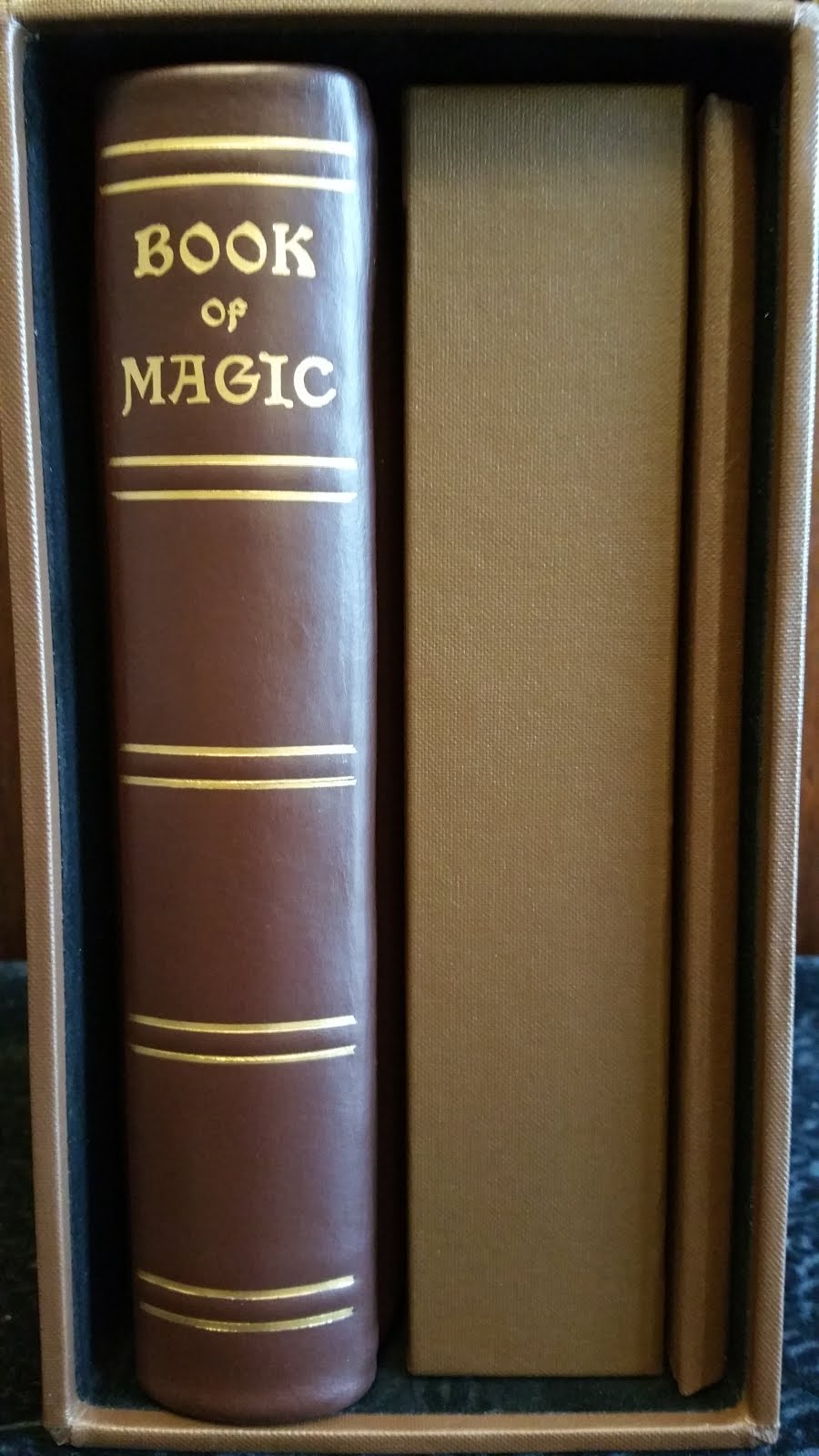
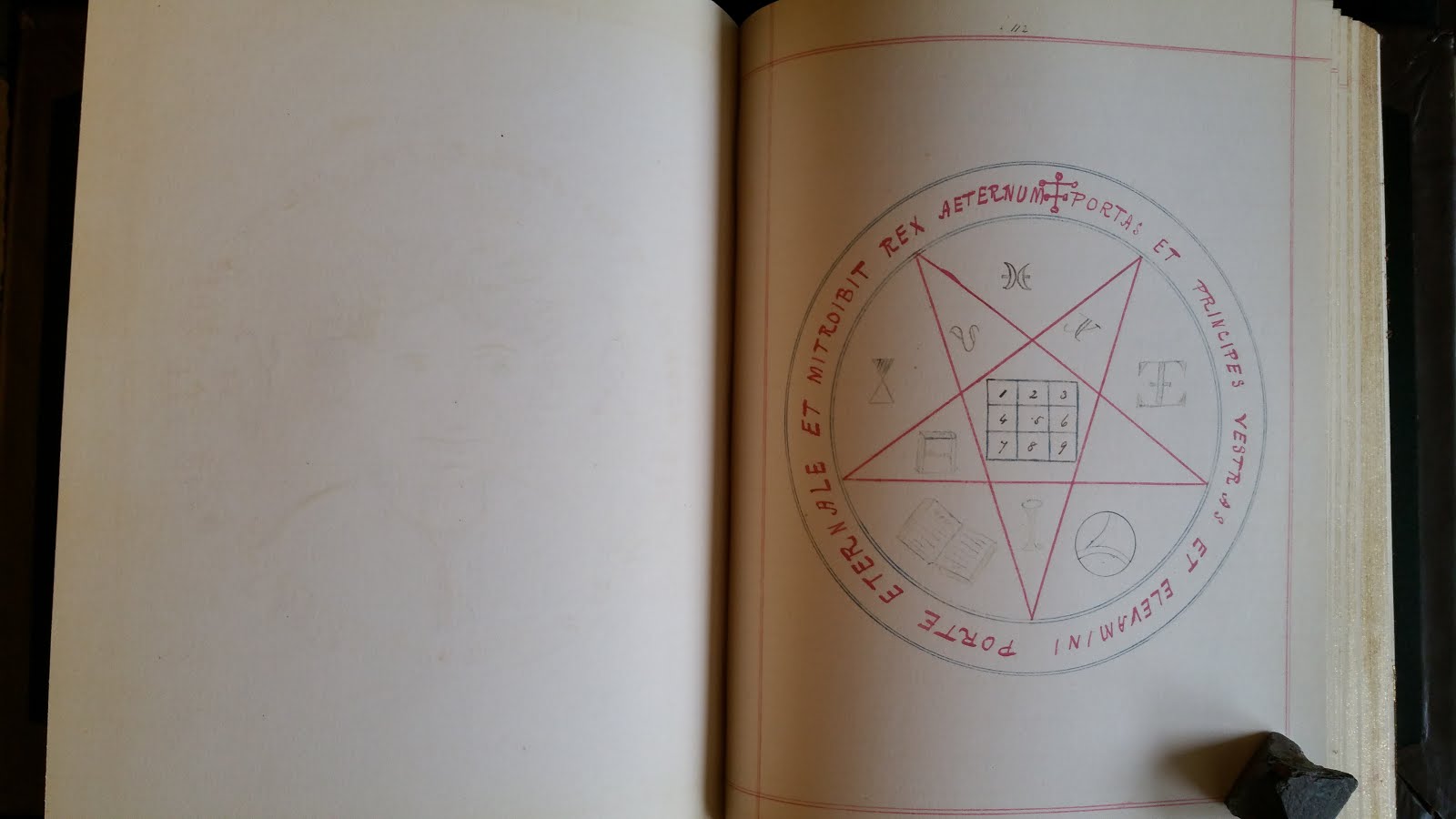
Book of Magic falls into to the "magical device" category. The original manuscript (from 1874) is an instruction manual about how to make a magical book, hence the title Book of Magic and not Book About Magic. Now, after over 140 years, the book has finally migrated from the astral and has physically manifest. The book is essentially a tool for doing magic, not just reading about it.

The set contains a number of magical devices. First, inside the cover is a diagram of an eye within concentric circles illustrating "The Harmony of the Universe". This can be used as a meditative tool to focus one's mind before an operation. It gets better: the eye is formed from a small piece of the original manuscript. This creates a magical link to the original text following the principles of Sympathetic Magic; specifically, the Law of Contact or Contagion which states that things that were once in contact continue to be connected after the connection is severed. Today scientists call this phenomena Quantum Non-locality, what Albert Einstein called “spooky actions at a distance”. Second, the hardback folder contains a set of 8 vellum talismans blocked in gold, created exactly as outlined in the text. These have a variety of uses. Third, (and this is perhaps the most astonishing feature) inset into the back cover of the book is a black convex scrying glass used for divination or spirit communication. Ben Fernee, the mastermind behind The Society for Esoteric Endeavour, elaborates by stating: 
Furthermore, with the eye in the motif set in the front cover being on paper from the original manuscript, it provides a magical link that is the basis for the magic mirror set in the rear board to act as the window by which the practitioner may access the same mind spaces that Herbert viewed to create the original manuscript.
The eye is set into the front cover directly opposite the rear mirror. So when the book is closed the eye is continuously gazing through the text block and into the darkness of the rear mirror, creating a magical circuit, if you will. So not only does the mirror provide an aperture to different states of mind, but also a window through time and into the head-space of the book's creator. Depending on the reader's beliefs, the eye -- ever watchful -- may also serve as a ward to make sure the mirror does not become an unintentional gateway when not in use, the Watcher at the Threshold.


For the most part, the content of Book of Magic is a collection of ceremonial magic techniques and Hermetic arts used later in the Golden Dawn tradition. There are also a few folk-magic inclusions like the magical use of a dozen drugs and herbs and how to make a dowsing rod. Interestingly, there is also a section on non-Euclidean geometry -- shades of H. P. Lovecraft's "impossible angles". It was the author's valiant attempt to graphically describe higher dimensions, with limited success. Occult architect Claude Bragdon did a much better job (visually) 56 years later in his book Four Dimensional Vistas (1930) and The Frozen Fountain (1932) through illustrations of hypercubes or tesseracts.


As previously stated, the set comes in 3 parts: book, transcript, and talisman folder. All are contained within a slipcase. The book is handsomely bound in full brown calf with gilt title and border. Edges are hand-gilded. Interior boards are inset with black silk doublure with scalloped corners. Endpapers are decorated with a black and red fylfot cross tessellation (the fylfot is also discussed in the text).

The text block is an exact full-color facsimile of the original manuscript (obviously penned by hand) which may present a challenge for modern readers. A second volume, a typed transcript, is provided for clarity. It is cloth-bound in a matching brown hue. The third item is the talisman folder, also bound in cloth. Inside are eight vellum talismans blocked in gold.


This book was offered for pre-order for one week. At the end of the week the number sold would be the total number produced for this edition. The final number was 196 copies. This is my preferred method of selling. It allows interested parties a reasonable chance to obtain a copy and avoids the mad dash and inevitable disappointment for those who are unable to get a copy due to slow emails, distant time zones, or because they couldn't immediately get financing in order.

Book of Magic is yet another stunning release from The Society of Esoteric Endeavour. It is a talismanic book par excellence.


In second place the Silver Talisman Award goes too...

Primal Craft's The Witchblood Grail by Mark Alan Smith (Devil's Crown Edition). Illustrated in black and white by Lorein. Octavo. 394 pages.


The second volume in the Way of Sacrifice Trilogy (preceded by The Altar of Sacrifice), the Witchblood Grail is, in a word, magnificent.  The book is revealed in four parts:
  • Book One -- The First Inner Book of the Flesh: The Book of the Initiated Blood
  • Book Two -- The Book of Forbidden Flesh
  • Book Three -- The Book of Malefic Blood
  • Book Four -- The Book of the Devil's Throne
One of the more interesting parts is found in Book One, a chapter tilted, "Toadstone Familiars", detailing the creation and consecration of the toadstone. It is a peculiar adjunct to toadbone ritual.

Like Mr. Smith's previous works, The Witchblood Grail contains full-page black and white illustrations (six of them) by an artist known only as "Lorien" along with countless sigils, seals, and other symbols used in magical operations.


The book continues a familiar pattern of Mr. Smith's other works with heavy focus on poetic incantations and affirmations. His works are devotionals rather than straight forward instruction manuals, which may not be everyone's cup of tea. But do not worry -- there is no groveling or mindless supplication involved; the chants and orations are meant to empower the practitioner. Sometimes verbalizing one's intent aloud can be just the key one needs to unlock doors. Our screen-filled world has become so visually dominated that it is easy to overlook or forget the auditory components of magical practice.

Like its preceding volume, The Witchblood Grail is fully bound python skin with five raised bands on the spine. This time it is black and white python instead of solid black. It has a mesmerizing quality about it and is a pleasure to hold. One could say the natural zig-zag pattern of the python skin reflects the "crooked path" taken by many practitioners, a path winding hither and thither like the snakes of the caduceus wand.

The cover is embossed with "The Devil's Crown and The Eye of The Dragon" in 24 carat gold. The symbol doesn't "pop" as much as the cover of the previous volume due to varied coloration of the snakeskin binding, but it does stand out sufficiently enough when light catches it, giving the impression of almost floating above the snakeskin. Black endpapers are embossed as well. To protect the book the publisher includes a black solander box lined with emerald green suede. The front of the box is embossed with "The Seal of The Dragon God".


The Devil's Crown Edition is signed and sigilized in ink mixed with the author's own blood and limited to 36 copies. It is also available in a high-quality standard edition (Dragon Flame Edition) is limited to 999 copies and is still available here. The Standard Edition is bound in a Red Lynnel Thermo Ibis, a luxurious suede-like material. Primal Craft's Standard Edition is what most publishers would consider "deluxe" (see image below).

One wonders if they will continue the snake-skin theme with the next volume in the series, and if so, what form that will take. Perhaps a series progression from dark to light culminating with solid white python and symbolic of the purification process? Primal Craft's fine editions are truly extraordinary objects of sinister beauty.


In third place, the Bronze Talisman Award goes to...


The Devil's Dozen: Thirteen Craft Rites of the Old one by Gemma Gary (Fine Edition), published by Troy Books. Illustrated in black & white by the author; photos by Jane Cox. Duodecimo (Twelvemo). 160 pages.


The Devil's Dozen is an fascinating attempt to create a modern "black book". The book is clearly modeled after 18th and 19th century folk-magic grimoires and includes thirteen original rites inspired by traditional (British) witchcraft rituals. Though the rites are contemporary they still have a wild and primal character in the spirit of early folk traditions. The author states,
"They are my own creations all; given in hope that they may provide usefulness or inspiration, and each a personal offering of devotion unto the starlit and smoking altar of the Old One."
One of my favorite examples is a rite titled, "A Rite of Turning" designed to summon hell hounds and send them after someone who harbors ill-will towards the practitioner, or perhaps just for sport -- this is a black book after all. Additionally, the rites generally require simple materials that are not too exotic or costly. One suggestion is using a simple large flat stone for an altar.

The book contains a handful of full-page, glossy, black & white photos (taken by Jane Cox) of practitioners performing rites described in the book. It also contains a number of spectacular full page black & white illustrations (untitled) by the author. Inclusion of a title page for the illustrations would have been a nice addition. One of my favorites is one found before the chapter, "The Light Betwixt" depicting a sabbatic goat standing in a thicket with a lit candle between its horns.

Rarely have I encountered a more delightfully diabolical-looking book than the Fine Edition of The Devil's Dozen (limited to 13 copies) The binder rides the fine line between tastefully dramatic and garishly over-the-top... and wins, creating something stylish, unique, and a thing of nightmares (in a good way). The book bound in full black goat with a gilt boarder (the leather has a faint scent of peat). The spine has 4 raised bands and is gilt-stamped with the title, author, and a golden stang. Heavy beveled boards give the book a little heft. At only 5 x 8 inches it is a nice portable size for carrying down to the crossroads. But it is the cover that is most memorable. The cover is blind embossed with a pentacle resting on a bed of thickets. Peering out from within the pentacle is a glass goat's eye cabochon. It is an unsettling addition that makes the book truly unique. I swear that if one stares at it long enough it will blink. A trick of the mind surely, but an interesting effect nonetheless.


The book is protected by a full goat leather solander box lined with black silk. The cover is embossed with a stylized Goat of Mendes with horns ending in twelve lit candles, a blazing six-rayed star between the horns, and the alchemical symbol for phosphorus upon its forehead. The box's spine repeats the six-rayed star pattern.

This is one of the most delightfully unusual books I have seen in a long time. The Fine Edition sold out long ago, but the paperback and an attractive standard hardcover are still available here.


*Note -- Some readers may notice the absence of the Special Edition of The Triangular Book of St. Germain, a spectacular recent release from Ouroboros Press. My copy was received during the second week of 2016. Therefore it will be a likely contender for the 2016 Esoteric Book of the year. As much as I'd like to include it in this year's review, I have to draw the cut-off point somewhere. It will be something to look forward to in the coming year.


2015 Honorable Mentions
  • Lucifer: Princeps by Peter Grey (Dawn Breaker Edition), published by Scarlet Imprint. The layout and design of this book is absolutely incredible. Scarlet Imprint continues to amaze with their consistently elegant designs. The Dawn Breaker Edition effectively uses simple ornament and color that is symbolically appropriate for the topic. This was a very close contender for third place and the Bronze Talisman Award -- a tough decision. A truly luminous work.
  • Witchcraft and Sorcery of the Balkans by Radomir Ristic (Special Edition), published by Three Hands Press. Bound in embossed boar skin. A great resource for anyone looking to study a witchcraft tradition outside the British Isles. Slim but filled with solid information. 
  • The Green Book by Heliophilus (Fine Edition), published by Scarlet Imprint. A fascinating book on plant alchemy (spagyrics). It is worth buying for the incredible full-color photography alone.
  • ÞURSAKYNGI - Volume I - The Essence of Thursian Sorcery by EKORTU (Leather-bound Talisman Edition), published by IXAXAAR. Bound directly to goat leather creating a unique protective envelope with tied leather closures. Includes a horn talisman hand-carved by the author.

Have a wonderful year, dear readers.

B. Balkan


Read about past years' winners:


Sunday, January 18, 2015

2014 Esoteric Book of the Year

*First, a note on how books are judged.

Books will be judged by the following criteria: binding, materials, design, talismanic intent & method of consecration (if applicable), artwork/layout, and editorial rigor. Books are chosen from those released and delivered (in full) within the year 2014 (even though they may have a 2013 publication date). This is because books tend to encounter publishing delays. It is especially common in esoteric publishing for a number or reasons (including some of high strangeness). For example, a 2013 book may not actually be available until 2014 in some cases. Books will not be judged by their topic, theme, or content (other than grammar). This may sound strange, but I feel it is unfair and pointless to compare or make value judgments between different magical paths or traditions (like comparing apples to oranges). While I do my best, I am not qualified to judge and assess every magical system the world has to offer; I very much doubt such a person exists. Therefore, books will be judged by their craftsmanship, editorial competence, creativity, and beauty only.

In recent years there has been a dramatic increase in the publication of deluxe esoteric books. This is certainly good news to publishers, readers, and collectors; however, it is becoming increasingly difficult to keep up with such voluminous output. Frankly, there is not enough time for any individual to read and assess every deluxe esoteric book published in a given year. A few years ago it was possible, but no longer. This is a good "problem" to have, though some very important and noteworthy books may end up falling through the cracks as a consequence. Therefore I apologize in advance to publishers and authors of books I may have overlooked. To help remedy this, and give credit where credit is due, I invite my readers to post titles of deserving books (from 2014) that may have been overlooked in the comments section of this post.


And now, Balkan's Arcane Bindings pick for the English language 2014 Esoteric Book of the Year.

The Golden Talisman Award for 2014 Esoteric Book of the Year goes to....


Troy Books' Cecil Williamson's Book of Witchcraft: A Grimoire of the Museum of Witchcraft by Cecil Williamson and  Steve Patterson (Special Fine Edition). Octavo. 304 pages.


There is a wonderful story behind this book: About twenty years ago, while helping with refurbishments at the Museum of Witchcraft in Boscastle, Steve Patterson discovered a curious manuscript written by the museum's founder, Cecil Williamson. Its title read simply, "Witchcraft". The manuscript contained a number of charms, instructions, and philosophy the author believed were authentic examples of traditional witchcraft as practiced in the West Country by the wayside witches, or "Aunty Mays", as they are sometimes called. Lastly, the author discussed his interactions with notable figures Gerald Gardner and Aleister Crowley. 

Now, a couple decades later, Cecil Williamson's Witchcraft book is finally available to the public. The book includes an annotated transcript of Williamson's Witchcraft manuscript plus historical background on Cecil Williamson and the Museum of Witchcraft. This is a very important work that will help historians and practitioners decipher which, if any, early witchcraft practices survived unbroken into the 20th century, and if so, are they still present in so-called "modern" witchcraft?


Interestingly a recent discovery in Cornwall may finally prove the existence of an unbroken witchcraft tradition reaching from the 1640 to as recent as the 1970s. Read the article here.

Steve Patterson's contributions are considerable, approximately two thirds of the book's 304 pages. Mr. Patterson's passion for the subject is clearly evident by his thorough annotations, copious notes, inclusion of historic photos, comprehensive history of The Witchcraft Museum, exhaustive appendices (nearly 100 pages!), and index. A remarkable feat.

Watch Mr. Patterson discuss the manuscript here. I'd like to buy the man a pint.

Mr. Patterson was recently interviewed by Karagan Griffith at On the Black Chair. Listen here.


The Special Fine Edition of Cecil Williamson's Book of Witchcraft resides within a stout oak box handmade by the author, Steve Patterson. Only 10 were produced. The box's hinges and clasp are made of hammered copper. Copper nails are also used in the box's construction. One can perhaps assume that copper, associated with Venus, was chosen for its historical use in witchcraft and for its conductive properties. The wood does not appear new, so I have the impression that the wood used for the boxes is "reclaimed" lumber of some variety. If so, I makes me wonder what its previous use may have been. It is immediately obvious the box is handmade, most notably from its charming irregularities. For example, the bottom of box is constructed with beautifully mismatched wood planks. Its rustic construction and hand-carved ornamentation, a central charm claiming, "Who so bears this sign about him, let him fear no one, but fear God", lends the box a hoary and arcane air. The inside is lined in black felt and contains a ribbon book lift to assist in removing the book from its oaken abode.
                                             

The book is bound in full, hand finished, terracotta goat. The leather has an almost candy-like scent, like cherry taffy. The cover is gilt blocked with a prosperity charm. Title and author are gilt blocked on black leather labels adhered to the spine. The spine has six raised bands with the publisher's colophon gilt stamped at the book's tail. Accents include a gold ribbon place marker and marbled endpapers in russet, green, and cream.

Cecil Williamson's Book of Witchcraft is as talismanic as they come. It is a phenomenal mixed-media expression of Steven Patterson's understanding of witchcraft and his reverence for the tradition. Astounding.

As of this writing, Standard and Fine Editions are still available here.


*This year there is a tie for second place and the Silver Talisman Award. The books are so similar that I feel they deserve equal ranking. 


In second place the Silver Talisman Award goes too...


IXAXAAR's The Book of Sitra Achra by N.A-A.218 (Deluxe Edition). Octavo. 309 pages.


When I opened the mysterious gilt and leather solander box I gave an audible gasp. Lurking inside upon blood-red suede was a creature unlike any I had ever seen. Golden snakes intertwined upon a surface of pitch black scales. At the center shined an eleven-angled gilt seal. This was The Book of Sitra Achra...

Author N.A-A.218 and IXAXAAR have succeeded in crafting one of the most fiendishly elegant books I have ever laid eyes upon. It exudes lethal doses of beauty and menace; an alluring cocktail of captivation and corruption.


The Deluxe Edition is bound in full black python. The scales are small and more pliant than one would expect. I often think of snakeskin as delicate, and sometimes rough or brittle when touched against the grain. However, the skin used for this binding has been softened to an almost rubber-like texture. It is an exquisite material yet tough enough to be used in ritual as intended. The cover is gilt stamped with braided snakes and a central open-ended pentagram representative of, "the breaking of the ten angles of the pentagram, bringing about the disruption of cosmic order and the intrusion of the powers of the Dragons of the Other Side." Page edges are gilt. The book's boards are surprisingly thick (nearly one quarter inch), giving the book a solid construction. Head and tail bands are black leather.

The book is just as beautiful on the inside: The reader is greeted with marbled endpapers that I liken to gilded cobwebs stretched across an abyss -- a symbolic representation for traversing a perilous path across the Abyss and through Daath. Pages are cream-colored, medium weight, and lightly textured with a vertical grain.

The Deluxe Edition also comes with an omitted chapter in booklet form, described as, "a ritual for the attainment of contact with the Guardian Angels of this Sacred Work of the Thoughtless God". It comes inside a large black envelope. Unfortunately it is too large to fit inside the solander box along side the book. It would have been convenient to store both works together.


The Book of Sitra Achra is essentially a compendium of Qliphotic forces, the "Dragons of the Other Side", listing their seal, attributes, number, Hebrew letter, zodiacal sign, tarot counterpart, and path on the nightside of the Tree where applicable. The book has eleven chapters:

  1. The Sitra Achra and the Serpents of the Thoughtless Light
  2. El Archer -- The Other God
  3. The Qliphoth of the Tree of Death
  4. The Eleven Heads of Azerate
  5. The 60 Emissaries of the Black Light
  6. The 22 Silencing Letters of the Other Side
  7. The 12 Princes of the Qliphotic Zodiac
  8. The Seven Hells and Seven Earths
  9. The Opening Ritual of the Seven Gates of Hell
  10. The Star of the Eleven -- The Qliphotic Magic of the Hendecagram
  11. Building Blocks of a Qliphothic Temple -- The Tools of Praxis

The book concludes (Chapter 11) with specific incense blends for each of the Qliphotic Rulers and recommendations of specific magical tools.

Each of the 61copies of the Deluxe Edition comes with a hand-sigilized python-skin bookmark talisman "dedicated to one of the 60 Emissaries of the Black Light, linking thus each book to one of those Standard-Bearers of the Qliphoth (with book 61 being the sole exception, bearing instead a separate Talisman and enlinkment)". What I find most interesting about these talismans is their stated purpose, "These talismans were added as additional gifts for those who know and understand to cherish them and as a concrete curse upon those who for more materialistic reasons have reached out for these Talismans of Sitra Achra". Could this perhaps be the author's way of fighting grimoire scalping? It appears so, a tactic for which I wholeheartedly approve. One may want to reconsider their actions before hastily placing their copy on Ebay at ridiculously inflated prices. For more on grimorie scalping see additional commentary here.


Primal Craft's The Altar of Sacrifice by Mark Alan Smith (Sacrificial Soul Edition). Illustrated in black and white by Lorein. Octavo. 400 pages.

There are a number of obvious similarities between The Altar of Sacrifice and The Book of Sitra Achra. Both are bound in full black snakeskin over heavy millboard covers, are gilt stamped, and include solander boxes for protection. In each case the solander box (also called a "clam-shell" box) was a wise decision. A slipcase would have likely caused wear or damage to the snakeskin scales through friction with the slipcase if the book was slid inside against the grain. That danger is avoided entirely by lifting out of the box -- no sliding necessary.

Deciding which book was better was like splitting hairs -- each has its own unique serpentine charms -- so, deserving it equally, I decided they should share second place.

The Altar of Sacrifice differs in a few significant ways. First, the snakeskin binding has much larger scales than The Book of Sitra Achra and has a high gloss (this may vary from copy to copy). Secondly, it is a much larger book -- nearly a third larger in thickness and significantly heavier. This is mainly due to the book's heavy weight paper (almost card stock). It also has nearly 100 more pages; 400 (including 10 pages for notes) compared to The Book of Sitra Achra's 309 pages.


The solander box is covered with fine black fabric. The spine is gilt stamped with the author's name, title, press, five bands, and a device described as the, "Seal of the Queen of Hell's Throne". Inside the books rests upon royal blue suede. The book's spine has five raised bands lined in gold and contains the same content as the spine of the box. It has a deadly beauty about it. The cover is gilt stamped in 24 carat gold with, "Sacred Seal of Flesh and Fur". The inside has solid bronze endpapers and includes a black ribbon place-marker. Page edges are gilt and off-white.

The book has six spectacular full-page illustrations by an artist known only as "Lorein". My favorite is titled, "The Formula for Soul Inversion" (found on page 51). It depicts a dragon-like demon holding a trident. He (Belial) is standing over a man that is shape-shifting into a wolf (or wolf into man). Other wolves watch from the forest's edge. The "Seal of the Queen of Hell's Throne" hangs in the night air. The level of detail is incredible -- a striking image of sorcery and lycanthropy. Lorein has also recreated all the interior designs found throughout the book: seals, sigils, gates, etc. from Mr. Smith's personal notes.

**Update -- Thanks to Mr. Smith for giving me permission to use the work mentioned above, "The Formula for Soul Inversion", for this review.

"The Formula for Soul Inversion" by Lorein. Used with permission from Primalcraft.com.


The Altar of Sacrifice's subject matter is certainly a controversial one. As the title implies, its primary theme is sacrifice, including animal sacrifice (One animal was clearly sacrificed for the book's elegant binding). Mr. Smith addresses the subject deftly and honestly. He also acknowledges is not the path for everyone, saying, "The way of the Bloodless Path is as valid and noble as the Way of Sacrifice when beheld by the Eyes of Gods." Mr. Smith's path of sacrifice is similar in some ways to Kosher methods of slaughter (Shechitah): ritualistic, respectful, and as painless as possible. Many readers are likely to object to this, though it would be a rather hypocritical stance if they are meat-eaters. Most Westerners prefer their meat to be a "product" that is as unrecognizable as possible from the animal of origin. Most could not look their food in the eye, nor wield the killing blade. Yet they order their Big Macs without a moment's pause -- out of sight, out of mind. Furthermore, large-scale factory slaughterhouses have very little respect for the animals they "process". That said, it is my personal belief that sacrificed animals should be consumed. I should be clear that I have strong feelings against killing or inflicting pain solely for the act of killing or torture. For more on this subject check out an earlier post here.

Like many of Mr. Smith's earlier works, The Altar of Sacrifice includes a large number of prayers and petitions. The book is divided up into three parts: The First Book of Sacrifice, The Book of the Temple of Four Pillars of Fire, and The Book of the Dragon God. The Sacrificial Soul Edition is signed and sigilized in ink mixed with the author's own blood.


In third place, the Bronze Talisman Award goes to...


The Society of Esoteric Endeavour's The Graveyard Wanderers: The Wise Ones and the Dead in Sweden by Dr. Tom Johnson. Wide Octavo. 106 pages.


This one was a delayed entry from last year. The book came out in 2013; however, the handmade copper slipcase did not arrive until 2014. Therefore the entire package will be counted as a 2014 entry.

There has been a small but significant resurgence in Scandinavian folk magic books recently. 2013 saw the printing of Fredrik Eytzinger's Salomonic Magical Arts. Shortly after, Dr. Tom Johnson translated 37 "Svartkonstbuchs" (black art books) and collected them together to create this wonderful book of Swedish necromancy titled, The Graveyard Wanderers: The Wise Ones and the Dead in Sweden. Later this year Johannes Gardback's Trolldom: Spells and Methods of the Norse Folk Magic Tradition will be also available.


The Graveyard Wanderers collects dozens of charms used primarily for controlling spirits of the dead, but also contains a number of near-universal folk charms for: winning at games of chance, becoming invisible, healing, detecting thieves, shape-shifting, bewitching firearms, and even for catching fish. The book concludes with a fascinating afterword, "The Wise & Their World", followed by a bibliography, and footnotes.

This is artisinal bookbinding at its most creative. The creator, Ben Fernee of The Society of Esoteric Endeavour, put a tremendous amount of thought and personal knowledge into this. The first thing that catches the reader's eye is the marvelous, hand-made, copper-clad, slipcase (offered optionally). The case has heavy, scalloped-cornered, and gray marbled boards on each side. Note the faint skeletal hands in the pattern. The book fits snugly  inside and is protected by a copper spine cap stamped with four skulls. When completely enclosed the book is thoroughly protected. Perhaps the copper case serves a secondary purpose by providing protective "shielding" around the book -- a bibliopegistical Faraday cage, if you will. The case and spine cap are lined with black felt.

The book is covered in leather cloth (85% leather). Presumably this was chosen over leather hide to pull off the book's extravagant and decorative inset with beveled board edges. Inside the open panel is a copper plate (front and back) with raised skeletal hands. When one holds the book one feels the cold metal of the skeletal hands as they partially intertwine with one's own fingers -- a chilling yet exhilarating effect. The book exudes the sharp metallic scent of copper. A few words from the binder about the use of metal,

"The Wise Ones would pay for the services of the Dead by leaving in place of the bone, a piece of metal in the form of a coin or a scraping from a church bell. Metal is an ideal vehicle for the transmission of deathliness ... the form of skeletal hands in the binding of this book, so the reader feels the shape of dead fingers interlaced with their own. Bones are the part of us that persist after decay, and here the copper that forms their shape has been patonised, whereby the natural oxidation process is accelerated and stabilised. The result are iridescent colours, an effect referred to as the "peacock's tail" in alchemy, where it is identified with the stage of decay in the Great Work. The patonised copper is then preserved with lacquer."
Fascinating. I am in awe, Mr. Fernee. Time will tell if the lacquer has completely halted the copper's oxidation process, or if over time the book will exhibit a slow and creeping green patina. One never knows: a leprous verdigris may enhance the book's aesthetic appeal.


The title is in white, a stark contrast against the black leather cloth, as are three skulls and the publisher's colophon on the spine. I must say the white skulls are a bit much, but it can be excused due to the fact that it is upholding a very old tradition. Again, Mr. Fernee,
"The black cloth is lettered in white as there is a tradition within the corpus that is how a black art book should look. ... The sense of this tradition is unclear, though an observation based on handling copies of this book is that white letters on a black background can be discerned more clearly in half-light, perhaps appropriate for night time rituals in churchyards."
There you have it; all for the benefit of nyctophiles such as we. The book's endpapers mirror the marbled skeletal hand panels of the slipcase. The paper is a real treat: "Printed on 180 gsm Fabriano Ingres, a real laid paper, whereby the textures are natural product of the pulp on wire mesh frames rather than being artificially embossed with a pretend texture." Text is printed in three colors: black, gray, and crimson. A must-have for any aspiring necromancer.

2014 Honorable Mentions:
  • Arbor de Magistro: An Advanced Study on Aethyric Evocation by Nikolai Saunders (Magister Edition), published by Fall of Man. Magister Edition comes with a handcrafted and sigilized oak box. For the advanced student.
  • Flamel's Heiroglyphical Key by Nicholas Flamel and translated by: Eirenaeus Orandus (Brazen Serpent Edition), expertly bound in Cambridge style binding by Michael Atha of Restoration Books, published by Ouroboros Press. A stunning little book.
  • Obeah: A Sorcerous Ossuary by Nicholaj de Mattos Frisvold (Limited Edition), published by Hadean Press. Limited Edition comes with a custom mojo bag.
  • The Dragon Book of Essex by Andrew D. Chumbley (Deluxe Edition), published by Xoanon Ltd. Easily the largest esoteric book of 2014. This is not a book for dabblers.
  • The Blazing Dew of Stars by David Chaim Smith (Deluxe Edition), published by Fulgur Ltd. What more can be said about David Chaim Smith's brilliance? This is one of 2014's must-haves.
  • The Testament of Cyprian the Mage by Jake Stratton Kent (Infernal Pact Edition, 2 volumes), published by Scarlet Imprint. Mr. Stratton-Kent's Encyclopaedia Goetica (5 volumes in all) is a resource of incalculable value to the Grimoire Tradition. Nothing short of astounding.
  • 36 Faces: The History, Astrology and Magic of the Decans (Special Edition) by Austin Coppock, published by Three Hands Press. Each copy of the Special Edition comes with a unique talisman depicting one of the geniuses for each of the 36 decans. An illuminating treatise by a talented young author.

Looking towards 2015

There is a much to look forward into 2015. A number of highly anticipated books have already been announced. Here are a few:
  • The long-awaited Ontological Graffiti by Michael Bertiaux, to be published by Fulgur Ltd. looks to be another fascinating exploration of the Voudon Gnostic current. This book has been in the works for a long time, but it appears its release is immanent. 
  • ÞURSAKYNGI - Volume I - The Essence of Thursian Sorcery by EKORTU will arrive in the first half of 2015. It looks to be a fascinating new take on pre-Christian Norse magical practices. Yet another exciting release from IXAXAAR
  • The next publication from The Society of Esoteric Endeavour, Book of Magic by Herbert Erwin. This will be a wonderfully talismanic text. Each copy will come with an embedded black scrying mirror and a set of 8 velum talismans. All 196 copies of Book of Magic have already sold out. 
  • The second book in Mark Alan Smith's The Way of Sacrifice trilogy, The Witchblood Grail, is slated for an early 2015 release. This is the fifth volume in Mr. Smith's Grimoire Trilogies series.
  • Will 2015 be the year we see the first volume (eleven volumes planned) in Marcus Katz' The Magister series?
  • And of course we mustn't forget the 2015 Esoteric Book Conference scheduled for next September. I was just in Seattle last November, but I am already yearning to return. Perhaps I will make it back next Fall. 


2014 Observations

Wooden Boxes

There has been a number of esoteric books released this year that are housed inside wooden boxes (stylish to rustic). It is an interesting development. Besides the Special Fine Edition of Cecil Williamson's Book of Witchcraft (reviewed above) there have been other examples including Aeon Sophia Press' Devotee Edition of Black Magic Evocation of the Shem Ha Mephorash by G. De Laval (Deluxe Edition reviewed here) and Fall of Man's Magister Edition of Arbor de Magistro: An Advanced Study on Aethyric Evocation by Nikolai Saunders.

In certain cases, like Troy Books' amazing example mentioned above, decorative wooden boxes can compliment a book's subject matter nicely without overshadowing the book contained therein or its content. However, in other cases they can be a needless accoutrement, or at worst, a bulky gimmick. They also present some storage issues, as they typically take up twice the space of a non-boxed book. It also begs the question, how many wood boxes does one want on their shelf? Will the wooden box trend continue? Do we want it to?


Balkan's Requests for the Future


Image credit: malwarwickbooks.com

  • Books with gauffered edges.
  • Wider use of exotic yet non-endangered skins/hides (Scarlet Imprint recently published the Fine Edition of Reasonances using Salmon skin. Bravo, SI!). How about a book bound in stingray (shagreen) or ostrich?
  •  More practical magic books and fewer that read like someone's dream diary.
  • Cross-traditional collaborations between strange bedfellows. Imagine a collaboration between Stephen Skinner and Orryelle Defenestrate-Bascule. Now that would be interesting. Lets move outside our comfort zones.


Have a wonderful year, dear readers.

B. Balkan


Read about past years' winners:


Friday, January 25, 2013

WINNER: 2012 Esoteric Book of the Year


*A note on how books are judged.

Books will be judged by the following criteria: binding, materials, design, talismanic intent & method of consecration (if applicable), layout, and editorial rigor.  Unlike last year, this year I have decided to pick from books actually released in 2012 rather than books with a 2012 copyright date.  This is because many books tend to encounter publishing delays.  This is especially common in esoteric publishing for a number or reasons.  For example, a 2011 book may not actually be available until 2012 in some cases.  Books will not be judged by their content.  This may sound strange, but I feel it is unfair and pointless to compare or make value judgments on different magical paths or traditions (like comparing apples to oranges). While I do my best, I am not qualified to judge and assess every single magical system the world has to offer; I very much doubt such a person exists.  Therefore, books will be judged by their craftsmanship,  creativity, and beauty only.  So without further ado Balkan's Arcane Bindings (BAB) is proud to announce its pick for the English language 2012 Esoteric Book of the Year.


The BAB 'Golden Talisman Award' for '2012 Esoteric Book of the Year' goes to....


The Society of Esoteric Endeavor & Treadwell's Books edition of Devils & Spirits by Anon.

When it comes to contemporary publications, I consider this book to be one of the crowning jewels of the entire Balkan collection.  Devils & Spirits absolutely epitomizes the concept of a magical grimoire.  It exudes an aura of hoary mystery, uncommon luxury, and implicit danger.  This is not some re-imagined compendium of spells, nor it is a post-modern attempt at redefining sorcery -- this is a text with historical merit.  Devils and Spirits is a reprint of 17th century spells, charms, and practices as recorded in two anonymous texts; one a grimoire of conjurations, and the other a discourse on the nature of devils and spirits.  Each originally appeared in the appendix of the 1665 edition of Reginald Scot's Discoverie of Witchcraft.    This edition includes an introduction by Christina Oakley-Harrington, proprietor of Treadwell's Books of London.

What makes this edition particularly important is that it was created through a collaboration between one of the finest esoteric publishers of our day (TSoEE) and a popular occult bookstore, Treadwell's Books of London.  This, in my opinion, gives Devils and Spirits unique historical significance.  The book is, in essence, an emblematic specimen of the fine occult publishing world at the dawn of the 21st century.  Limited to only 14 copies.

Devils and Spirits is bound in full Spanish leather displaying wonderful natural striations.  Hand tooled border and includes numerous gilt devices.  Decorative, two-tone, gilt-stamped title.  Marbled boards.  Comes with matching marbled paper bookmark.  Printed in two colors (black and red).  Includes felt-lined, lidded, slipcase with marbled lip.  Slipcase lid bound in matching leather.  The craftsmanship is astounding.  Bookbinding at its finest.  Congratulations!


In second place, the BAB 'Silver Talisman Award' goes to...


The Society of Esoteric Endeavor's Experimentum compiled by Frederick Hockely with translation and transcript by Dan Harms.

Yet another exciting release from The Society of Esoteric Endeavor.  Experimentum is made to look as close to the original manuscript as possible.  The pages are full-color giclée facsimiles of the original handwritten pages.  The quality is so good and deceptively realistic that a casual observer may mistake it for an original manuscript.  Dan Harms provides a translation of the text (the handwritten script can be difficult to read at times), a brief essay on the history of the text, provides thorough notes on the text, and includes a bibliography.

The book is half-bound in supple, blue, sheepskin with tooled accents.  Marbled boards are treated with beeswax, making the book water resistant and lending it a soft sheen.  Experimentum comes with a slipcase standard; however, an optional lidded slipcase and/or chemise can be custom ordered.  The chemise is blue cloth, blocked in gilt, and lined with blue suede.  Flaps on each side can be lifted to reveal tipped-in plates.  One is a fascinating full-page image from the book.  It is fully restored with screen-printed metallic inks (gold, silver & copper) to reveal how the original must have looked before the fine detail was obliterated by time.  The lidded slipcase has matching marbled paper on three sides.  The separate lid includes a leather label blocked in gilt.  The chemise and lidded case provide exceptional protection for the book.  Expermentum is limited to 100 copies.


In third place, the BAB 'Bronze Talisman Award' goes to...


Primal Craft's The Scorpion God: Forbidden Wisdom of Belial by Mark Alan Smith (Venom Edition).

I continue to be impressed with the work of Mark Alan Smith and his talented bookbinders.  His previous work, The Red King, won last year's Silver Talisman Award.  His dedication to his chosen path comes through clearly in is writing.  Mr. Smith's books are not simple manuals detailing his unique witchcraft current; they are an essential physical component and direct manifestation of his practice.  The books in the 'Trident of Witchcraft' series give the reader the impression that they are almost conscious.  Some talismanic books serve as homes for resident spirits, or 'bottle' for the genie.  In Mr. Smith's case, his books are the actual flesh.

Third volume in the 'Trident of Witchcraft' series, The Scorpion God is a hefty tribute to Belial.  Unlike the first two books (The Queen of Hell and The Red King published by Ixaxaar), The Scorpion God is published by Primal Craft, the author's own publishing house.  Size and format match the first two volumes for an attractive uniform set.  It is bound in a beautiful shade of full olive goat (close to the hue of very old vellum) and bears the gold seal of the scorpion.  A delight to touch.  Gilt edges and ribbon bookmark.  Evocative and dramatic interior artwork by Namtaru Creations.  Each copy (73 total) is consecrated, signed, and sigilized by the author using ink that was ritually infused with his own blood.  A truly talismanic work, one that the author claims will never be reprinted.


2012 Honorable Mentions:

  • Theatrum Chemicum Britanicum compiled by Alias Ashmole (Vellum Edition), published by Ouroboros Press.
  • Veneficium: Magic Witchcraft and the Poison Path by Daniel Schulke (Deluxe Edition), published by Three Hands Press 
  • The Psalter of Cain by Various (Deluxe Edition), published by Xoanon Ltd.
  • The Toadman: Lore and Legend, Rites and Ceremonies of Toadmanry and Related Traditional Magical Practices by Nigel Pennick, published by The Society of Esoteric Endeavour.
  • The Sacrificial Universe by David Chaim Smith (Deluxe Edition), published by Fulgur Ltd.
  • Mandragora by Various (Cthonia Fine Bound Edition), published by Scarlet Imprint.


2012 was a very exciting year for esoteric publishing.  A great number of wonderful texts saw publication, making this year's judging extremely difficult.  However, one publisher really stands out:  Ben Fernee of The Society of Esoteric Endeavour really had a spectacular year with a number of showstoppers, much like Scarlet Imprint did in 2011.  Mr. Fernee has really taken esoteric publishing to a new level (or one not seen in centuries) by offering optional lidded slipcases and chemises with his most recent publications, a feature rarely seen in the publishing world these days regardless of genre.  Many thanks, Mr. Fernee.

2012 saw the publication of a number of nicely bound and inspired magical texts and insightful essay collections; the The Book of Azazel by E.A. Koetting (Special Reserve Edition) from the new publishing house Nephilim Press and Scarlet Imprint's At the Crossroads (Compassed Edition) come to mind. The year also saw the release of a few books destined to become modern classics, such as Daniel Schulke's Veneficium: Magic Witchcraft and the Poison Path from Three Hands Press (the Deluxe Edition bound in snakeskin and Shantung silk is particularly beautiful -- see pic) and Liber Falxifer II: The Book of Anamlaqayin by N.A-A.218 and published by Ixaxaar.


While we didn't experience a Mayan apocalypse, we did see a significant number of classic magical texts that were discovered, reprinted, and saved from obscurity.  The 2012 Silver Talisman award recipient, Experimentum, is a perfect example.  2012 also saw the publication of another important classic work, Theatrum Chemicum Britanicum, thanks to Ouroboros Press.  Their sturdy vellum and leather editions will ensure this work sticks around for a few more centuries.  A dear friend remarked that the stunning white vellum edition (complete with white ribbon closures) looked like a wedding registry book (see pic).  Amused, I responded, "It is... a chymical wedding".  If I were to judge books by their esoteric content, Theatrum Chemicum Britanicum would likely take this year's gold.  There's a reason why Sir Isaac Newton owned a copy.  It is a masterpiece.


Lastly, another very noteworthy reprinted manuscript that may have flown under the radar of many of my readers in 2012 is Der Freund in der Noth - Or - The Friend In Need: An Annotated Translation of an Early Pennsylvania Folk-Healing Manual by Johann Georg Hohman, translated (for the first time in English) and annotated by Patrick J. Donmoyer.  It is published by The Pennsylvania German Cultural Heritage Center.  This is an extremely obscure and primary source work relating to the American folk-magic tradition know as Pow-wow, a.k.a. Braucherei.  It is now available for the first time since 1813.  Previously unknown or forgotten charms and practices can now be accessed and utilized by modern practitioners, further enriching the tradition.  It is a sturdy, albeit humble, book (much like the tradition).  The Friend is Need includes an impressive amount of scholarly research, facsimiles of the original text (with English translation on the opposite page), and commentary by Mr. Donmoyer who has a particularly keen understanding of this fascinating tradition.


As we look forward into 2013, there are already a number of highly anticipated books on the horizon:
  • The 'Mor Edition' of Exu and the Quimbanda of Night and Fire by Nicholaj de Mattos Frisvold (Scarlet Imprint) should arrive any day.  This massive goatskin tome is bound to make a deep and lasting impression within some circles.
  • Ixaxaar has plans to release a pair of diabolic texts penned by Johannes Nefastos, The Catechism of Lucifer and FOSFOROS.  
  • Three Hands Press shall release the long-awaited ARCANUM BESTIARUM by Robert Fitzgerlad.  This will include 55 original woodcut illustrations by Liv Rainey-Smith.  I am a great admirer of her work.
  • Salamander & Sons is rumored to release a new limited work in the Golden Dawn tradition within the near future.  
  • Also be on the lookout for The Book of St. Cyprian by Humberto Maggi from Nephilim Press.  
  • And of course we mustn't forget the 2013 Esoteric Book Conference scheduled for next September.  

Have a great year, dear readers.

Sincerely,

B. Balkan


Wednesday, April 25, 2012

The Toadman by Nigel Pennick


Society of Esoteric Endeavour  2012.  130 pages.  Illustrated (some full-color).
Duodecimo (Twelvemo) square/landscape (6.5" x 7.5").

Copies No. 1-33: Half-leather, coloured endpapers and a doublure panel of hand marbled paper.

Copies No. 34-150: Quarter-leather, standard marbled paper endpapers.

As of this writing all copies are SOLD OUT.

I've had numerous requests to review this title, so here it is, dear readers -- The Toadman.  Since its release The Toadman has garnered a fair amount of buzz among certain circles, all of it warranted.  The Toadman's author, Nigel Pennick, is no stranger to folk magic traditions.  He has written a impressive number of books with topics ranging from geomancy to runic languages, and from sacred geometry to animal guising.  The subject matter of The Toadman is a controversial one, particularly in modern times.  Pennick is quick to point out in the book's introduction that he is apposed to animal cruelty stating, "The author and publisher totally disapprove of any and all cruelty to animals and respectfully request the reader not perform any of the cruel activities described in this book."  He continues to add that that tile is for historical exploration only.


No, that's not a cigar...


On this point Mr. Pennick and I are in complete agreement.  Poor treatment of animals may have been an accepted norm in earlier times, but it is totally unacceptable now.  While it certainly makes for a fascinating study, it is nonetheless an outmoded practice that has no place in contemporary society.  Considering the wide variety of alternative practices available to folk magic practitioners today (not to mention virtually endless proxy devices) such practices are unjustifiable.  Animal cruelty is the tell-tale sign of dysfunctional children, not magicians.


This brings up the larger subject: sacrifice.  Please allow me a slight digression:  As a meat-eater, I would be a hypocrite were I to state opposition to the slaughter of animals for human use.  However, I believe this must be done in a humane way and one where the entire animal is used (as apposed to killing an animal solely for its dorsal fin or gallbladder).  Recently a conjure man in the American south became the subject of intense controversy after he burned a rooster alive as part of a Palo ceremony (or so he claimed) and cited religious freedom as a defense.  Other  traditions dealing with spirit veneration, like Santeria, Vodou, and Hmong ancestor worship are known to sacrifice chickens too.  However, it is done quickly and humanely (likely better and more respectfully than most chicken slaughterhouses).  After the ceremony the chicken is usually eaten.    This is entirely different than intentionally causing severe pain and suffering, as in the aforementioned conjure man's case.

This kind of thinking, that is, the ritualistic use of intense pain, is similar in many ways to the beliefs of the Kanaima witch-doctors of the Amazon.  For the Kanaima, pain and suffering is inflicted as an offering.  Those unfortunate people who become victims of the Kanaima experience an unimaginably painful death.  Their rites make the Toad Bone rite look like child's play.  My response is this: does the world really need more pain?  For more on this subject I would highly recommend the books Dark Shaman: Kanaima and the Poetics of Violent Death and In Darkness and Sorcery: The Anthropology of Assault Sorcery and Witchcraft in Amazonia, both by Neil L. Whitehead.  Sadly, Professor Whitehead passed away just last month.  He will be missed.


Back to the book...

The Toadman mentions various folkloric and medicinal uses for the toad bone and toad stone in Toadmanry.  The author also explains how Toadmanry had much in common with other rural fraternities, like the Society of the Horseman's Word.  However, the book deals with far more than just physical uses for toads; it also explains in-depth how toads were used symbolically, particularly in alchemy.  The toad was believed to symbolize the First Matter.  Toads were also meant to represent the black phase of purification, also know as Caput Corvi (Crow's Head).


Pennick also touches upon how toads played a part in shape-shifting lore. Witches were sometimes believed to have the ability to turn into toads or have toads that served as their 'familiars'.  The author examines a general belief associating toads with diabolical powers or representing sickness (warts) and impurity.


The book concludes with a number of appendices.  These include a discussion of the potential origin of the Toad Bone rite and the exploration of other toad rites from around the world including Obeah, Gypsy magic, and Hoodoo.  The Toadman is heavily footnoted throughout.  Pennick, ever the scholar, also provides an extensive bibliography.


The sections are as follows:


Introduction
Frog and Toad Symbolism in Alchemy
Shape-Shifting as a Toad, Toad as a Familiar
Traditional Medicine and Toadmanry
The Bone
Secret Uses of the Bone
Rural Fraternities: Toadmen and Horsemen
Horse Stopping
The Word, The Whisper and the Devil
"Have you seen the Devil"
The Travails of Toadmanry
Putting the Toad on Someone

Appendices
1. Bones in the Shoemakers Legendarium
2. The Miller's Word
3. Some Toadmanry in Obeah, Hoodoo and Conjur
4. Other Bone magic and English Horse Skull Performances
5. Speculation upon some Roots of Toadmanry
6. The Examination of John Walsh

Footnotes
Bibliography
Credits


The copy reviewed here is one of the 33 half-leather editions.  The publisher offered an optional slipcase or slipcase and chemise combo.  The latter is exhibited here.  The book is bound in half-toadskin.  Australian Cane toad was used, as it is a destructive and invasive species on that continent.  For those wondering what toad-leather feels like:  It is very pliant, soft, and far thinner and delicate than standard leather.  Its characteristic warty texture begs to be touched and understood, like some kind of witch-Braille.  It is relatively odorless -- just a hint of a leathery scent. Boards are covered in rich hunter green linen.  A burgundy goatskin label with title and author blocked in gold adorns the cover.  The spine has a similar goatskin label.  The goatskin provides a smoother surface for the title, as the toadskin is highly textured with warts.  Each book is blind blocked with a little toad device somewhere on the book (each copy is different).  This copy happens to have two (note one right above cover title in photo).


The book opens to fuchia endpapers and a doublure panel of hand marbled paper made by Anne Muir Marbling Ltd.  Incredible stuff.  The marbled coloring has an appropriately batrachian color scheme consisting of three shades of green, fuschia, and umber beautifully brought together in a pattern resembling pond scum or clusters of frog's eggs.  The paper is an ivory color with evident texture not unlike some watercolor paper.  The texture is nice; however, I feel the paper may be a bit too absorbent to handle heavy full-color images.  The ink tends to give these pages a slight ripple.  There is no bleeding evident, though the image resolution appears somewhat soft.  Still, the use of full-color is appreciated.  Ivory head and tail bands blend seamlessly with the pages and thus do not distract from the man attraction, the toadskin binding.


The slipcase (optional) is wrapped with matching hunter green linen and matching hand marbled paper.  The interior is fully lined with soft burgundy felt to lessen surface abrasion as the book is slid in and out.  The chemise (also optional) is an unusual but very welcome additional feature.  It is shaped somewhat like a clam shell.  Its construction is the inverse of the book.  Instead of sporting a toadskin binding and goatskin label, it has just the opposite, a goatskin binding and toadskin label.  The title is blind blocked upon the toadskin.  It's a bit hard to read due to the warty texture of the leather, but still a nice touch.  The chemise also includes a blind blocked toad device randomly stamped on its surface.  The inside of the chemise is lined with matching marbled paper and burgundy felt along the seam to protect the toadskin binding of the book.  When held inside the protective chemise and slipcase, The Toadman is completely protected from all sides.


The Toadman is an absolute treasure.  It is perhaps one of the most uniquely bound contemporary books I've had the pleasure to hold.  It is no wonder it has been met with such enthusiasm.  It is the most unusual presentation of Toadmanry lore since the extremely limited Grimoire of the Golden Toad by Andrew D. Chumbley.  The Toadman is both a stunning object d'art and the last word on toad magic.  Thanks to Nigel Pennick and Ben Furnee at The Society of Esoteric Endeavour for creating such a delightful oddity, a book fit for a cabinet of curiosities.