Showing posts with label Andrew Chumbley. Show all posts

Wednesday, March 8, 2017

2016 Esoteric Book of the Year

My apologies for this late year-end review. I have been involved with a number of time consuming pursuits. Between projects and travel I have had little time to write book reviews as frequently as I would like.

*A note on how books are judged.

Books are judged by the following criteria: binding, materials, design, talismanic intent & method of consecration (if applicable), artwork/layout, and editorial rigor. Books are chosen from those released and delivered (in full) within the year 2016 (even though they may have a 2015 publication date). This is because books tend to encounter publishing delays. It is especially common in esoteric publishing for a number or reasons (including some of high strangeness). For example, a 2014 book may not actually be available until 2016 in some cases. Books will not be judged by their topic, theme, or content (other than grammar). This may sound strange, but I feel it is unfair and pointless to compare or make value judgments between different magical paths or traditions (like comparing apples to oranges). While I do my best, I am not qualified to judge and assess every magical system the world has to offer; I very much doubt such a person exists. Therefore, books will be judged by their craftsmanship, editorial competence, creativity, talismanic nature, and beauty only.

In recent years there has been a dramatic increase in the publication of deluxe esoteric books. This is certainly good news to publishers, readers, and collectors; however, it is becoming increasingly difficult to keep up with such high output. Frankly, there is not enough time for any individual to read and evaluate every deluxe esoteric book published in a given year. A few years ago it was possible, but no longer. This is a good "problem" to have. Consequently, some very important and noteworthy books may end up falling through the cracks.

Furthermore, with the sheer number of titles released annually I have to be more selective by choosing only topics I find personally interesting such as (but not limited to): witchcraft, folk-magic, Hermeticism, demonology, and reprints of historic grimoires. I am less interested in contemporary magical diaries, occult manifestos, and New Age cookbooks. Therefore I apologize in advance to publishers and authors of books I may have overlooked. To help remedy this, and give credit where credit is due, I invite my readers to post titles of deserving books (from 2016) that may have been overlooked in the comments section of this post.


And now, Balkan's Arcane Bindings' pick for the English language 2016 Esoteric Book of the Year.


The Golden Talisman Award for 2016 Esoteric Book of the Year goes to....


Ifá: A Forest of Mystery by Nicholaj de Mattos Frisvold (Fine Edition). Published by Scarlet Imprint. Black & white illustrations by Childerico.  Octavo. 400 pages. Limited to 64 copies.


Ifá: A Forest of Mystery is Nicholaj de Mattos Frisvold's fourth book of Afro-Caribbean magic published by Scarlet Imprint. It was preceded by Palo Mayombe: The Garden of Blood and Bones, Exu & the Quimbanda of Night and Fire, and Pomba Gira and the Quimbanda of Mbumba Nzila. The book explores the Yoruban Ifá tradition, and in particular, its primary divination practices. Prior to reading this book I had almost zero knowledge of the Ifá tradition, yet Mr. Frisvold made it easy for me to comprehend the basic tenets and cosmology of the system. The author strikes a welcome balance by making the work comprehensible for the novice (like me) and also providing enough depth and mystery to keep the interest of readers already familiar with the system. The dramatic artwork by Childerico (reminiscent of woodcuts, though far more detailed) creates a phantasmal atmosphere filled with primal power and laden with symbolic meaning -- 18 images virtually crackling with energy.
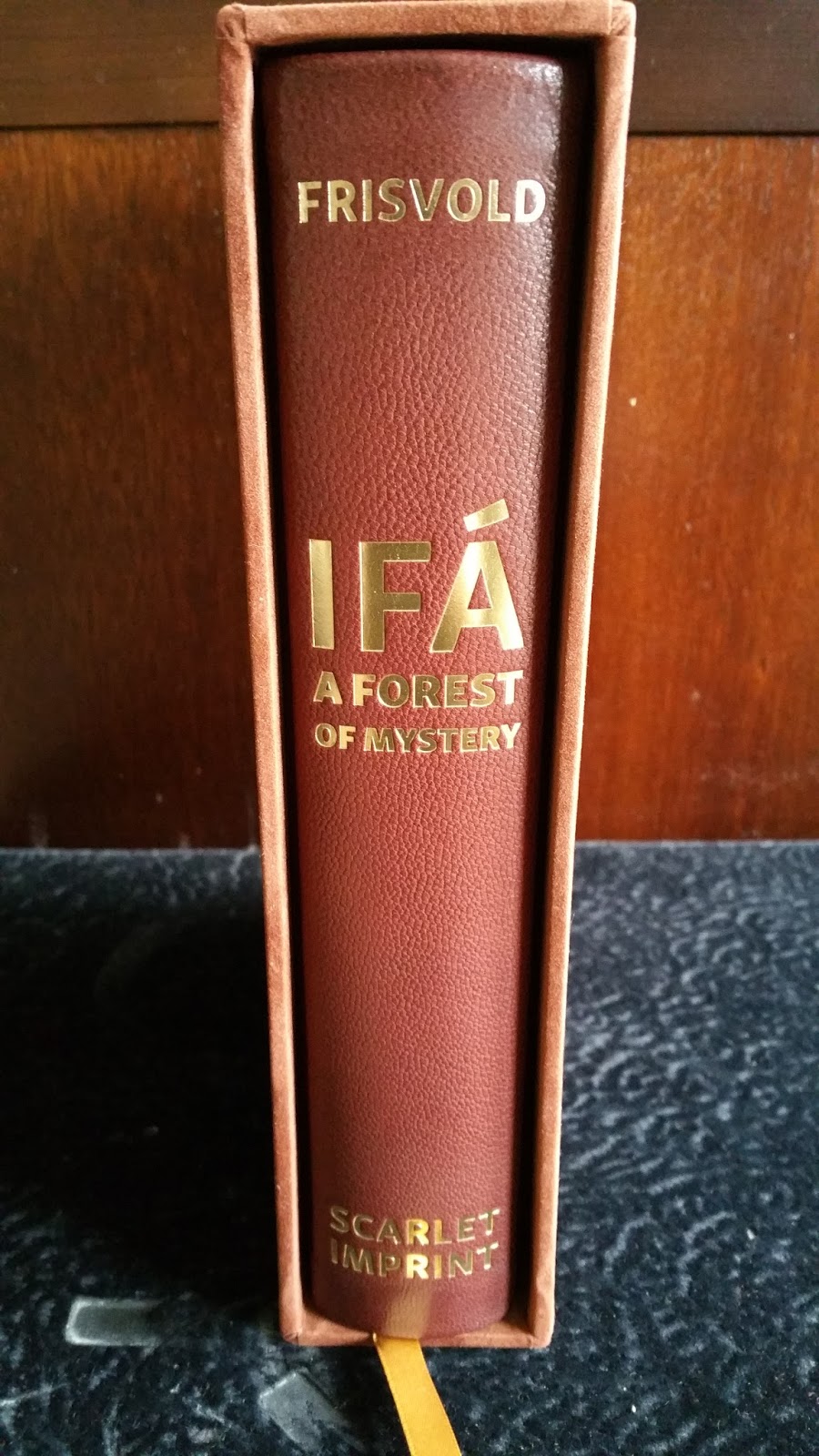


Like all the rest of the Frisvold/Scarlet Imprint collaborations, the fine edition of, Ifá: A Forest of Mystery is truly something to behold. Its luxurious binding is bound in full hand-grained morocco. The publisher (and probably the tannery) refers to the color as "rust", but I think chestnut would be more accurate. The leather is soft with a smooth tight grain and has a very pleasant scent -- what can only describe as malty.


This is a hefty book (2 inches thick) with very heavy beveled boards. As far as its construction goes, it is 'built like a tank'. Simply outstanding. I am sure it will outlast everyone reading this review. The cover is breathtaking -- an image of Orúnmila, the god of knowledge, blocked in gold. He holds the sacred palm tree nuts (ikin) used for divination. Custom endpapers from Victoria Hall are marbled with a striking weave pattern in shades of green and red. Quite unusual. The book's edges are gilded as well. There might be more gold in this book than some people's wedding rings. It is finished off with gold head/tail bands and a gold-colored silk ribbon bookmark. A brown suede slipcase is provided for protection. The work concludes with a glossary, bibliography, and index. Scarlet Imprint has shown once again why they are one of the leaders in fine bindings, and not just in esoterica, but among all publishers.


In second place the Silver Talisman Award goes too...

Azoëtia by Andrew Chumbley (Third Edition - Special Edition). Published by Xoanon Limited. Illustrated in black and white by the author. Octavo. 394 pages. Limited to 22 copies.


Azoëtia was ranked a very close second in my poll for the "Most Important Esoteric Book of the 20th Century" here. It was surpassed (by only 1%, mind you) by Crowley's Magick: Liber ABA (Book Four). Azoëtia is the foundation text of the Sabbatic Witchcraft tradition. A true modern grimoire, it contains a series of formulae, rites, conjurations, and instructions unique to the Sabbatic Witchcraft tradition. The work is illustrated throughout with Mr. Chumbley's own fascinating and complex pen/ink psychography. A glossary is included to familiarize the reader with potentially unfamiliar terms.

Azoëtia's impact on contemporary witchcraft traditions is considerable, but its influence extends far beyond witchcraft traditions in ways one might not expect. I believe Azoëtia's Second Edition (the "Sethos" Edition) was instrumental in making talismanic publishing what it is today. Prior to its publication, 20th century occult books rarely commanded high prices, with the exception of first edition or signed books by Crowley or A.O. Spare. That all changed with Mr. Chumbley and his publisher, Xoanon. Demand and buzz had been building after the first edition paperback of Azoëtia (1992) became scarce. In 2002 it was reprinted as a deluxe hardback. Not only was Azoëtia beautifully bound, but it was also very limited and in high demand. It sold out in a matter of months. Chumbley also created handmade talismans to accompany some of his works. This changed everything. Suddenly books were not simple vessels for magical material, they were themselves magical -- a very old idea reintroduced into the modern market. It was also a rejection of the disposable/paperback culture many of us had grown up with. Books began to look and feel magical again. Now, with the new 3rd Edition, the bar has been raised even higher.


The Special Edition of Azoëtia is bound in full cream-colored alum-tawed goat (whitened with alum salts). Alum-tawed skins are a time-honored material in bookbinding dating all the way back to the 12th century. I feel this is a perfect choice for binding material for Azoëtia, as the skin is both elegant and rustic -- understated and rugged -- perfectly reflecting the raw and direct nature of the work. The natural irregularities and blemishes of the goatskin echo the unique and variable challenges the reader will encounter within the Sabbatic current. Furthermore, the goatskin has a marvelous texture with a very fine "grip" -- semi-rough when stroked against the grain, like the tongue of a cat.

The cover is one of Mr. Chumbley's figurative pieces blocked in 22 karat gold. It is a component of an interior image, (Fig. 14 Erotocrasis: The Arch of Drewary O'er the Sigillick Tree of Earthen Albion). The book's title is emblazoned on the spine in matching gold and bordered by four raised bands, each outlined in gold. Head/tail bands, marbled endpapers, and ribbon bookmark are all scarlet red, a striking contrast against the pallid exterior. Opening the book is like opening up a living creature -- a marbled fleshy interior splashed with crimson.


Each copy of the Special Edition comes with a hand-written talisman, "bearing the sign of one of the twenty-two Sacred Letters of the Azoëtic continuum". For privacy reasons I have digitally removed the letter from the talisman in the photo. Each of the 22 "Holy Letters" found within Azoëtia has a specific energy signature and distinctive correspondences. Of all the 22 letters, the one I received was the most personal and appropriate for me. It was uncanny.

Later, in a conversation with the publisher, he explained to me that individual letters were specifically chosen for each of the 22 recipients. It impressed me beyond words that a publisher would take such care, time, and consideration to make sure that each copy arrived into the hands for which it was destined. This, ladies and gentlemen, was a truly magical process. It is this sort of personalized attention to detail that sets the small press (and specifically talismanic publishing) apart from mass-market publishers. This is not just a sales process; it is a magical working.


In third place, the Bronze Talisman Award goes to...


The Devil's Plantation: East Anglian Lore, Witchcraft & Folk-Magic
by Nigel Pearson (Fine Edition). Published by Troy Books. Illustrated in black & white by Gemma Gary. Black & white photographic plates. Octavo. 272 pages. Limited to 15 copies.


The Devil's Plantation is a fascinating collection of traditional witchcraft beliefs and lore from East Anglia. Mr. Pearson takes the reader on a journey covering a number of topics specific to the region: spirits of the landscape -- or genius loci (East Anglia's unique psychogeography), encounters with folkloric creatures, historic and notable witches and cunning-folk, flora/fauna/mineral lore, and witchcraft traditions (charms, cures, and curses). A bibliography and index are also included.

The title is an homage to an infamous "black book" of the same title written by a legendary Cambridgeshire witch, and also refers to cursed parcels of land believed to belong to the Devil, also known as a "Devil's Acre", "Devil's Hopyard", "Devil's Backbone" or "Devil's Den". Places ascribed with devil-names are of great interest to me. Poet J.G. Whittier wrote a poem about unhallowed grounds and accursed acreages titled, "The Devil's Den":
'Tis said that this cave is an evil place
The chosen haunt of a fallen race
That the midnight traveller oft hath seen
A red flame tremble its jaws between,
And lighten and quiver the boughs among,
Like the fiery play of a serpent's tongue;
That sounds of fear from its chambers swell
The ghostly gibber, the fiendish yell;
That bodiless hands at its entrance wave,
And hence they have named it The Demon's Cave.
* * *
Yet is there something to fancy dear
In this silent cave and its lingering fear,
Something which tells of another age,
Of the wizard's wand, and the Sybil's page,
Of the fairy ring and the haunted glen,
And the restless phantoms of murdered men:
The grandame's tale, and the nurse's song
The dreams of childhood remembered long;
And I love even now to list the tale
Of the Demon's Cave, and its haunted vale."


The Devil's Plantation is appropriately bound in full black goatskin. The goatskin has a medium grain with a faintly oily texture. Folklore speaks of certain books of maleficia that "sweat", indicating that the spirits bound within are in constant torment. Perhaps this is one. What makes this binding really stand out is an inlaid shield panel in deep blue leather with a blind embossed border. The shield is blocked in silver with a toad skeleton device and three crowns. The spine has five raised bands and a matching blue leather label, also blocked in silver. Head/tail bands and silk bookmark are in a matching shade of blue. Hand-marbled endpapers in grey, teal, and bronze are equally bewitching (pardon the pun), and look like the oily surface of a bubbling cauldron -- an amusing choice. The Devil's Plantation comes housed in a black buckram slipcase blind embossed with a shield device.


The book contains fifteen evocative pen/ink illustrations by Gemma Gary in her distinctive stipple-style (this has become a welcome trademark feature of Troy Books' titles), and twenty five black & white photographic plates. As somewhat of a companion book to The Devil's Plantation, Troy Books has recently released a new and revised edition of Nigel Pearson's earlier work, Treading the Mill: Workings in Traditional Witchcraft. Mr. Pearson's work is a tremendous contribution to the study of British folk magic.


2016 Honorable Mentions

  • The Triangular Book of St. Germain deciphered and translated by Nick Koss (Special Edition). Published by Ouroboros Press. Printed in full color. English and French text. Small triangular format (6 1/2" x  6"). 48 pages. Comes with a sterling silver talisman and marbled slipcase. Limited to 26 copies. 


  • Þursakyngi - Loki by Ekortu. (Deluxe Edition), published by IXAXAAR. Bound directly to goat leather creating a unique protective envelope with tied leather closures. Comes with a birch bark talisman created by the author. 270 pages. Octavo. Limited to 49 copies.


  • The British Book of Spells and Charms by Graham King (Fine Edition). Published by Troy Books. 296 pages. Blind embossed buckram slipcase. Duodecimo. Limited to 20 copies. 


  • Claves Regni by Nikolai Saunders. Published by Fall of Man. 542 pages. Octavo. Bound in Italian green moire silk and gold gilt. Faux-crocodile skin slipcase. Limited to 96 copies.


Moving into 2017:

My hope is to get back to writing semi-regular book reviews, that is, if life will ever calm down enough to permit it. I am also considering including a occasional interviews with authors and publishers to mix things up a bit. 

Have a great year, dear readers.

Sincerely,
B. Balkan

Read about past years' winners:

Wednesday, September 18, 2013

Serpent Songs curated by Nicholaj De Mattos Frisvold


Scarlet Imprint 2013. 224 pages. Large octavo. Black-and-white photos and illustrations.

Available in three editions:

Bibliotheque Rouge digital edition: (available as an epub and mobi files).

Sylvan edition: Cloth-bound hardcover. Limited to 750 copies.

Serpentine edition: Full leather with slipcase. Limited to 64 copies. Sold out at publisher.


Serpent Songs is Scarlet Imprint's newest anthology of unique voices from the occult underground. I am continually amazed by how SC is able to locate practitioners of extremely obscure traditions. This alone is a notable feat, but to find practitioners who are both sane and proficient writers is a miraculous accomplishment. The anthology is curated by Nicholaj De Mattos Frisvold (also a contributor). This book's theme is 'Traditional Witchcraft', however one happens to define the term.

 
The term 'Traditional Witchcraft' is regarded as a rather loaded term within certain circles. Argument often arises over what it really means, how accurate of a term it is, or if it is a useful descriptor at all. When this book was first announced I was afraid it would contain a series of ramblings and arguments over the definition of 'Trad Craft', or which group claims rightful ownership of the term. Thankfully neither was the case -- far from it. I should know by now to put more faith in SC's editorial acumen. Lesson learned.

Before I get into the full review, allow me to tell you an amusing story about my experience with some folks within "Trad Craft" and why it I was so apprehensive about the subject...  Some years ago, after reading inspiring works by Andrew Chumbley, Nigel Jackson, Daniel Schulke, Robert Cochrane, Michael Howard, Carlo Ginzburg, et al., I happened across a popular web forum dedicated to discussing 'Traditional Witchcraft'. However, unless one was a full-fledged member one had limited access. Without membership one could only read select threads and was unable to post or be part of discussions. I was curious to read what others' opinions were about so-called 'Traditional Witchcraft' and attempted to join the site. Only it wasn't that easy. I had to write an essay about what the term 'Traditional Witchcraft' meant to me. Fair enough. It figured it was their way to weed out teenagers and lunatics, and it might be a useful way to get some conversation going.

I actually enjoyed the exercise. What did 'Traditional Witchcraft' mean to me? After some deep consideration I wrote my thoughts out and submitted my summary. Unfortunately, (or not) my answer was not the 'correct' answer. My take on TW did not match theirs presumably. I was refused permission to join. This struck me as odd, as they specifically asked what 'Traditional Witchcraft' meant to me -- there should be no wrong answer to this. Maybe I didn't romanticize it enough. Maybe my avatar pic should have been spookier. Who knows. There's nothing wrong with having requirements, or even high standards, but one should always have room for new opinions to avoid the echo-chamber of 'group think'. In any case, it is the forum moderators' prerogative to decide who may join. I respect that. My interest in membership had withered. That single glimpse into their insular belief structure spoke volumes. I surmised I was dealing with yet another dogmatic group unwilling to have its beliefs questioned; a group with a high wall built to shelter fragile egos. 


So there you go. 


I should note that I have since encountered other groups that have far more acceptance of diverse ideas. For example, I recently requested permission to join a Facebook group about Traditional Witchcraft in the New World. I was allowed membership in less than a minute. Quite a contrast. Thanks again, Mr. Erwin.


Because of my past experiences I found the attitudes expressed in Serpent Songs to be a welcome breath of fresh air. The authors are lucid, erudite, sincere, and above all open-minded. The essays contain a rich diversity of regional European practices spanning from Norwegian Trolldom to Italian Stregoneria; from Basque folkways to Bogomilism in the Balkans. A few authors touch upon New World traditions such as Hoodoo and working with the spirits of indigenous animals.

Contents
  • Prelude: The Other Blood - Nicholaj De Mattos Frisvold
  • The Witch's Cross - Gemma Gary
  • The Spirit of True Blood - Shani Oates
  • Lezekoak - Arkaitz Urbeltz
  • A Gathering of Light and Shadows - Stuart Inman and Jane Sparkes
  • The Fall and Rise of an English Cunning One - Tony MacLeod
  • Stregoneria, A Roman Furnace - Nicholaj De Mattos Frisvold
  • But the House of my Father will stand - Xabier Bakaikoa Urbeltz
  • Bucca and the Cornish Cult of Pellar - Steve Patterson
  • Exorcists, Conjurors and Cunning Men in Post-Reformation England- Richard Parkinson
  • The Liturgy of Taboo - Francis Ashwood
  • Trolldom - Johannes Gardback
  • Bogomilian and Byzantine influences on Traditional Craft - Radomir Ristic
  • But to assist the Soul's Interior Revolution, the art of Andrew Chumbley and aspects of Sabbatic Craft - Anne Morris
  • Passersby: Potential, Crossroads & Wayfaring on the Serpent's Road- Jesse Hathaway Diaz
  • The Mysteries of Beast, Blood and Bone - Sarah Lawless


For the sake of brevity, I will not comment on every contribution, but I will share some thoughts and observations on a few:

 Gemma Gary's essay, The Witch's Cross, offers terrific insight into Cornish witchcraft. Her writing style is both elegant and informative. She is able to clearly convey the essence of her tradition, both from a practical and spiritual standpoint, without getting bogged down with minutiae or becoming too abstract. Her essay also includes one of her black and white illustrations.

Shani Oates' essay, The Spirit of True Blood, is stunning. The wisdom she presents to the reader is literary gold. Oates avoids the term 'Traditional Witchcraft' and prefers the simplified "Traditional Craft", believing it to have less baggage and negative associations. Early on, she and her clan felt that defining their practice as 'witchcraft' (and themselves as witches) would be self-limiting. She understands that no tradition exists within a vacuum and is keenly aware of significant influences within her tradition which can be traced back to other Western Mysteries; namely, Hermeticism and Gnosticism.

In direct contrast to the Trad Witchcraft forum mentioned above, Oates states:

The Craft is the thread that thrives as an underground stream. Its fierce abnegation of dogma offers succor that generates a mystical path, of hermitage and evolution. Its source honours the pagan path, yet seeks the transcendent infusion that ignites those animisms. It presents to every seeker an objective goal that allows their subjective need for a devotional path to overwhelm and elevate them as journeymen upon a road shared by others of similar vision ... it denies no-one, yet accepts only those who grasp the thorn. It is in fact the magic of the soul, a spiritual alchemy masterfully borne in the crafting of matter.

I enjoyed Johannes Gardback's exploration of Trolldom tremendously. His dry humor had me laughing out loud. The essay guides the reader step-by-step though a ritual he performed on a couple to remove a hex. Gardback's straightforward and non-apologetic style was a welcome contrast to a couple other essays that struck me as rather turgid and needlessly ornamented with esoteric abstractions. Some people enjoy essays on magic that twist and contort into verbal witches' knots. As for me, I have to be in the right mood to appreciate heady linguistic entanglements. Needlessly abstruse phrasing is occasionally used to veil secrets, but more often than not it is just fancy wrapping paper covering an empty box.


But to assist the Soul's Interior Revolution, the art of Andrew Chumbley and aspects of Sabbatic Craft by Anne Morris was very enjoyable. It was perhaps one of Serpent Song's most scholarly inclusions. Mrs. Morris has an uncanny understanding of Chumbley's artistic vision, what she calls "a metaphor for the divine". This essay stood out, as it does not aim to describe a particular tradition or its history per se, but instead details the way in which a tradition became manifest through the dreams and artistic vision of one individual. It's a wonderful essay; however, it would have benefited greatly by the inclusion of one of Chumbley's drawings. His drawings are highly symbolic, abstract, and difficult to put into words -- some were even created via automatic drawing. Thus, a visual reference would have been useful for those unfamiliar with his work. But of course there is always Google 'image search'. Perhaps it was due to a copyright issue.

As a side note: I first encountered Chumbley's art back in '99 within the pages of ESOTERRA: The Journal of Extreme Culture, issue #8. Inside was a short story titled "The Nightmare Network" and an interview with the author titled, "Triangulating the Demon: An Interview with Thomas Ligotti", one of my favorite fiction authors. Please, do yourself a favor: read him. Five black-and-white drawings accompanied the Ligotti pieces which seemed extremely appropriate considering Ligotti's usual themes of otherworldliness, deformity, nightmarish landscapes. In fact, I assumed they had been commissioned specifically for the story and interview. When presented together, Ligotti and Chumbley have a way of amplifying their work's dark message, like a phantasmagoric duet, and becomes something greater than the sum of its parts.

But I digress...


Steven Patterson's essay, Bucca and the Cornish Cult of Pellar, will be of great interest to both the practitioner and folklorist. His research into Cornish myth and the etymology of the word/name 'Bucca' is incredibly fascinating. I am greatly anticipating Patterson's next work concerning the life and works of Cecil Williamson, founder of the Museum of Witchcraft in Boscastle, Cornwall, who Patterson describes as, "one of the great unsung heroes of the twilight world of folklore and witchcraft". It will be titled, Cecil Williamson's Book of Witchcraft: A Grimoire of the Museum of Witchcraft and published by Troy Books.

Now on to the book itself...


In this review I will be reviewing the deluxe 'Serpentine Edition'. Bound in full green leather (roughly the color of a Green Tree Python) with black and gold accents, the Serpentine Edition is bound to entrance its owners. It was probably tempting to give this book a snakeskin binding, considering the title and theme. Snakeskin has recently become a popular material in esoteric publishing, including a number of Trident Books titles, the deluxe edition of Veneficium by Daniel Schulke, Transmutation Press' reissue of Ophiolatreia, and the forthcoming deluxe editions of Altar of Sacrifice by Mark Alan Smith, and The Book of Sitra Achra by N.A-A.218. As luxurious as snakeskin is, I believe leather was a wise choice for this particular book considering the practices described therein are practical, humble, and rural. A snakeskin binding may have been a bit too grandiose in this instance. The publisher does not indicate what type of leather was used (calf? goat?), though it feels buttery soft and is more yielding to the touch than some of their other leather editions. The scent of the leather is subtle with a faint hint of grassy sweetness.

The cover is ornamented in a two-tone design blocked in black and gold. The central device is a stylized vesica with a coiled serpent-- or is it an eye?  Perhaps it is a germinating seed, or all of these. Corners sport decorative serpent patterns creating a design reminiscent of Art Nouveau. The spine is also blocked in black and gold with twin serpents and gilt title. Page edges are gilded. Included is a black ribbon bookmark with matching black head/tail bands.


The book opens to amazing custom marbled endpapers. The design gives the illusion of snakes weaving vertically up and down the page -- a really nice touch and a sign that the designer put a lot of thought into this edition's presentation. The paper is high quality, light cream, and heavy weight, a type that has become a Scarlet Imprint standard.  The text block has nice generous margins, but the font size is a tad small for my taste. I much prefer the size SC used in Nicholaj De Mattos Frisvold's EXU. Having the type just a hair bigger seems to make a big difference. Like the cover, the text is printed in two colors, black & gold. Chapter headings are printed in gold, as are the decorative illuminated letters beginning each section. The Serpentine Edition comes with a slipcase covered in chartreuse cloth. It is lined with soft black felt to prevent wear to the cover design.

Serpent Songs is yet another powerful anthology by Scarlet Imprint that celebrates diversity in modern magic. SC's editors have developed and discerning eye for uncovering unique cultural and ethnic variances within specific subsets of larger traditions. Their anthologies are like magical photo albums documenting the hidden practices of our age. Each entry is a snapshot of a specific tradition, philosophy, or spiritual framework that gives us a sense of the past, a connection to the present, and a forecast of the future.


Thursday, February 21, 2013

The Leaper Between by Andrew D. Chumbley


Three Hands Press  2012.  66 pages.  Duodecimo (Twelvemo).  Black and white toad device on title page, otherwise no illustrations.

Available in three editions:

Trade paperbound: unlimited
Deluxe hardcover: limited to 231 copies.  Sold out at publisher.
Special hardcover: full goat skin, limited to 77 copies.  Sold out at publisher.

Three Hands Press has printed yet another clever chapter from the corpus of Andrew D. Chumbley.  Recent publications of Chumbley's work always leave me with mixed feelings of exhilaration and melancholy.  On the one hand I find his keen observations and oftentimes oneiric prose utterly enchanting; however, the experience is always bittersweet, as I'm continually reminded of the great loss Chumbley's untimely passing has been for the occult world, particularly those interested in witchcraft.  We are all very fortunate that he was remarkably prolific during his brief time on this plane, with still a few more unpublished works planned for the future.

The Leaper Between: An Historical Study of the Toad-Bone Amulet; Its Forms, Functions, and Praxis in Popular Magic is Chumbley's treatise on the age-old 'toad-bone' rite.  It first appeared in an abridged form in The Cauldron back in 2001.  It is presented here in its unabridged form.


This is the second book to be released concerning the toad-bone rite in less than a year; the other being Nigel Pennick's The Toadman.  See my review here of Pennick's work for more details on the toad-bone rite itself.  Fortunately each book approaches the subject in a different way.  There is a small overlap of information, but readers can still greatly benefit by reading both studies.  Pennick's The Toadman is far more focused on history and the alchemical symbolism of the toad, especially as portrayed through artwork.  In contrast, Chumbley's research is far more localized, often drawing upon the lore of specific rural regions of southern England.  Like The Toadman, The Leaper Between provides a wealth of historical background information and cites many examples of how the toad-bone rite was used throughout history.  Chumbley does an impressive job illuminating the tradition, especially considering brevity of the work (only 66 pages).


The Leaper Between goes beyond ritualistic methods and procedures of the toad-bone rite itself by also providing a thoughtful and intuitive meditation of the nature, symbolism, and mystical function of toads within a larger magical context.  In essence, Chumbley is asking, What can they teach us?  I find it fascinating, and more than a little ironic, that toads (and frogs) are used by scientists today as prognosticators or 'early warning' devices for environmental damage.  Amphibians are the proverbial 'canary in a coalmine', as their permeable skin makes them highly susceptible to toxins within the environment.  Just as our cunning-folk ancestors divined animal signs for clues and answers concerning their world, modern scientists conduct their own batrachian auguries for much the same purpose.


The Leaper Between is a slim book, opening to reveal sage-colored endpapers.  The endpapers appear to be made of what could be hand-made paper -- they certainly have that look and texture -- lending it a pleasantly simple and rustic feel.  Three Hands Press always uses quality paper, and this volume is no exception.  Pages are bone-white; a nice tone, not to stark, not too cream.  Red ribbon bookmark.  The Special edition is bound in full black goat with a very fine pebbled texture.  Cover is stamped in silver with an amazingly creative toad-shaped device designed by James Dunk titled, 'Waters of the Moon' (also on title page).  The design is cleverly constructed out of a mixture of what appears to be Arabic and Chumbley's own magical alphabet.  Note Chumbley's 'Ninth Holy Letter' (according to Azoëtia) hidden within each shoulder of the toad, looking somewhat like the Hebrew letter 'shin' (click the cover photo above to enlarge and see detail).  Shin is also the symbol for Three Hands Press.  It's an interesting little cipher for readers to figure out.  The book concludes with an impressive bibliography.  A handsome little book befitting one of the most talented witches of our age.


Sunday, June 12, 2011

Opuscula Magica Volume I: Essays on Witchcraft and the Sabbatic Tradition by Andrew D. Chumbley


Three Hands Press  152 pages.  Illustrated.  Octavo.

Standard Edition:  Cloth, limited to 726 copies
Deluxe Edition: Quarter black morocco with felt-lined slipcase, ribbon bookmarker, limited to 242 copies

 The current volume marks the first (of a planned 4) in the Opuscula Magica series by Andrew D. Chumbley.  Each volume is a collection of essays and artwork written and created by Chumbley over his tragically brief magical career.  Many previously appeared in occult journals from 1990 - 2003, such as The Cauldron.  The book also includes a few previously unpublished essays.

Table of Contents
Proem
A Short Critique and Comment upon Magic
The Heart of the Sorcerer
The Question of Sacrifice
The Hermit
Hekas
The Secret Nature of Ritual
What is Traditional Craft?
The Golden Chain and the Lonely Road
Initiation and Access to Magical Power within Early Modern Cunning-Craft and Modern Traditional Craft
An Interview with Andrew D. Chumbley
Notes on Texts:  Volume


Many of Chumbley’s magical treatises have a very poetic / stream-of-consciousness style. His works often strike me as having the flavor of ‘received’ books in the manner of Crowley’s Liber AL or James Merrill’s The Changing Light at Sandover. Chumbley’s insight, vision, and passion set his works apart from other contemporary texts on witchcraft. However, his essays are strikingly more concise, sacrificing poetic license for clarity and scholarly rigor. The reader gets the impression of having been granted a rare glimpse into a tradition that has little resemblance to popular modern witchcraft. Fluffy ‘harm none’ New Agers need not follow. The essays range in theme, are gathered chronologically, and have a moderately cohesive flow.


The Deluxe edition is a fitting tribute the late Magister of the Cultus Sabbati.  The book is a quarter bound in luxurious black morocco and charcoal gray cloth.  An emblem of a duel-headed Horus is embossed in black upon an otherwise somber gray cloth cover.  It’s a subtle yet stylish design somewhat reminiscent of Aubrey Beardsley's decadent illustrations.  The title is stamped on leather spine in gold leaf along with Three Hands Press’ iconic ‘shin’ logo.  The felt-lined slipcase is covered with matching gray cloth.  Upon opening, one encounters textured, jet black, art-paper endleaves embossed with a leather-like look.  The text is printed on very high-quality, crisp, satin white paper.  I might have preferred a shade of very light cream, as the pure white pages seem just a tad stark under good lighting.  Generous text margins are provided.  Within the text we are treated to a few of Chumbley’s pen & ink drawings and symbolically layered designs.  The book also comes with an attractive royal blue ribbon bookmark adding a vibrant splash of color to an otherwise darkly toned book.  Limitation hand-written at the rear.  Overall the quality of the binding is magnificent, as has become the standard of Three Hands Press.


Volume II of Opuscula Magica is scheduled to be released in just a few weeks.1