Wednesday, February 26, 2014

Z3 - The Enterer of the Threshold transcribed by Cogito Ergo Sum

Hell Fire Club Books - no date stated (original document dates to 1896). 119 pages. Small octavo. Printed in full color.


Available in two editions:

Half Leather: Limited to 56 copies.

Full Leather: Limited to 22 copies: 3 mother letters, 7 planetary letters, & 12 zodiacal letters. Sold out at publisher.

Z3 - The Enterer of the Threshold is like a window back in time. The book is a facsimile of a handwritten document linked to the most legendary occult group of the Victorian era, The Hermetic Order of the Golden Dawn. Long before days of xerox machines, scanners, and .pdf's members had to hand copy all documents concerning the order and its teachings. Magical documents, such as the 'Flying Rolls', were lent to Adepts on a temporary basis. While in their possession, Adepti had to make a personal copy within a specified amount of time before passing it along to the next member, usually through registered mail. This particular copy of the Z3 was copied on January 13th 1896, when the order was only six years old, by a female member known by her magical motto, Cogito Ergo Sum (I think, therefore I am) -- obviously a fan of Descartes.


The Z3 document is an explanation of the symbolism and meaning behind the Neophyte, or 0=0, Ritual of the Golden Dawn. The Neophyte Ritual is one of the most fundamental ceremonies within the Golden Dawn tradition. Paradoxically, it is one of their most basic rituals, yet at the same time it is also one of the most profound in the way it can be understood on multiple levels -- a microcosm of the macrocosm. One could draw a parallel to the LBRP ritual; it is one of the most basic of rituals, yet is also one of the most effective.


The Z3 begins by describing symbolism to be used in the ritual. I should add that this document is intended for Adepti, not the Neophyte candidate. This follows with notes about how the ceremony is to be structured and conducted. The reader is then told how to instruct the candidate in the meaning of some of the signs and symbolism used within the Golden Dawn. It also gives advice on how the Hierophant should conduct the ceremony. For example, "The Ritual should in all cases be said in a loud, stern, clear, and solemn voice, so as to impress the Candidate with the solemnity of the occasion; and in this there should be no foolishness, nervousness, or hesitation."  That's Victorian-speak for "No screwing around!" There are some other notation gems and interesting asides to be found within the text as well.

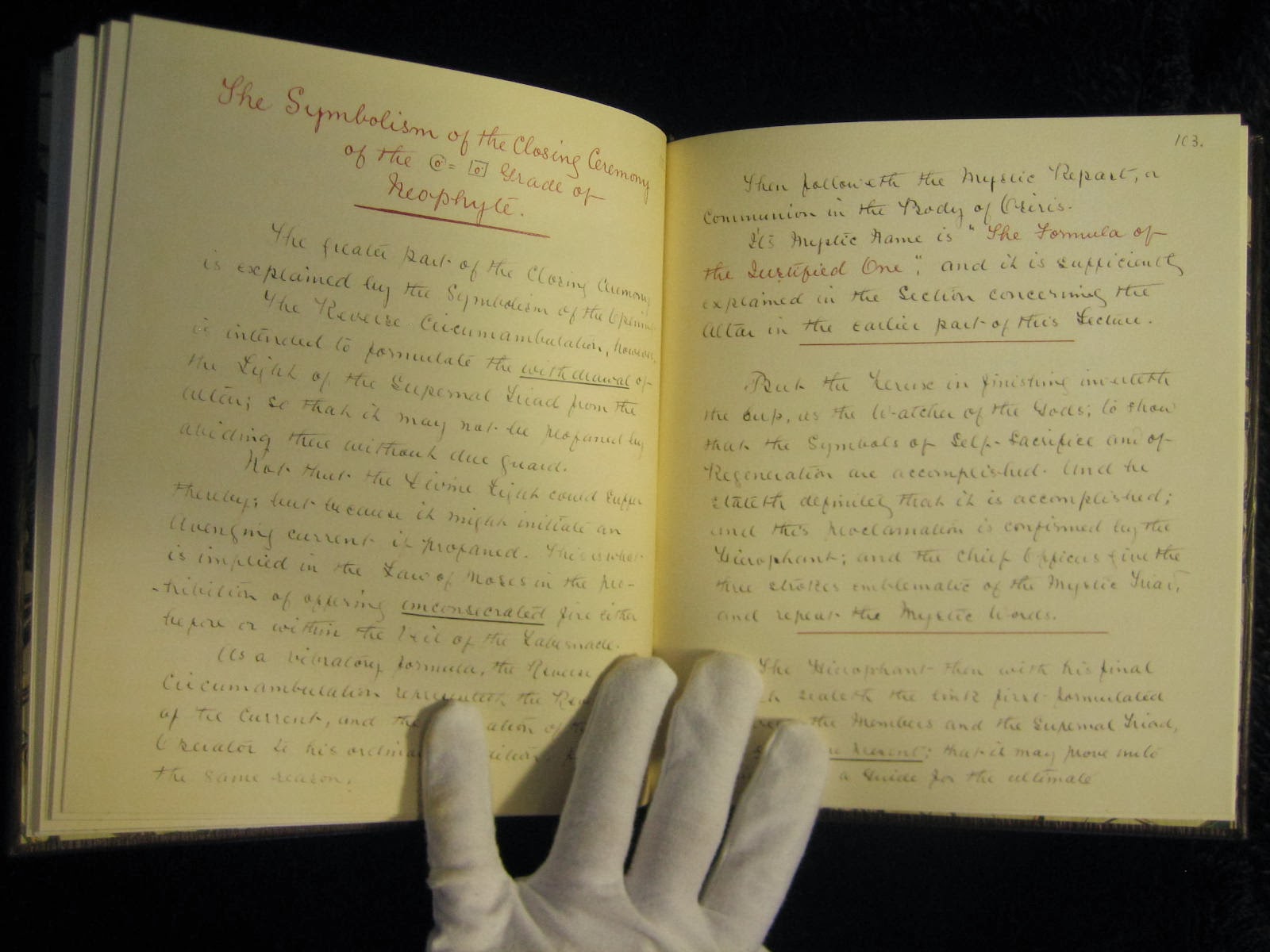


The text continues with instructions for teaching the candidate the basic Neophyte gestures, like the Step, Saluting Sign, Sign of Silence, and Grip. It also explains how the Grand Word and Equinoctial Password are to be imparted to the candidate. As many readers may know, a fair amount of the symbolism and ritual devices can be traced directly back to Freemasonry. As a good friend once told me, "The Golden Dawn is Freemasonry on steroids". The only caveat to that statement is the Golden Dawn allows women members; they were one of the first secret societies to do so. The Golden Dawn would not be what it is today without the contributions of female members like Florence Farr, Moina Mathers, Annie Horniman, Evelyn Underhill, and of course the copyist of this document. For those interested in learning more about the women of the order I highly recommend Mary K. Greer's book, The Women of the Golden Dawn: Rebels and Priestesses.


The text concludes with a discussion about the symbolism of the Closing Ceremony and the symbolism of the Equinox. The text reads more like an overview of the Neophyte ritual with tips and suggestions rather than a ritual script. The text assumes the reader already has advanced knowledge in the Golden Dawn tradition and Western esotericism in general, including text in Hebrew and Coptic, which is not surprising considering this was an Inner order document intended only for the eyes of Adepts. Unless one was very familiar with the Golden Dawn tradition, one would have a very hard time reproducing the Neophyte ceremony from this text alone. It presents the bare bones of the ritual only. Prior to Israel Regardie's published works, details of the Neophyte Ritual were mostly unknown outside the order. Those familiar with Regardie's version of the 0=0 will be intrigued by differences presented here.


Now for the book itself:

In this review I will be reviewing the Full Leather edition, one of the three 'Mother Letter" copies, of which this is 'Aleph' (א), meaning "breath'The book itself perfectly embodies the era in which it was originally written -- so much so that it almost feels like a relic. It is bound in full, rich, plum kidskin with vertical long grain. Inset into the cover is a piece of triangular, black, calfskin upon which the figure of Thoth is stamped in gilt. Each copy has one of 22 Hebrew letters in gilt at the apex of the triangle and "Z" & "3" at the lower points. The black triangle likely represents the Banner of the West. The spine has 5 double gilt lines representing the striped Nemyss worn during ritual. It also has striped black/gold head and tail bands.


The book opens to hand-marbled endpapers, a mesmerizing display of plum, gold, and emerald. The publisher states,
"Marbled papers by Ann Muir (traditionally made by hand with carrigheen moss and light-fast pigments derived from natural plant extracts, onto a good stock of archival paper), in a typical nineteenth century style whose coloration is chosen to harmonise with the colour scales relevant to the forces of the Grade Ritual of Neophyte under the activity of Thoth between the Pillars of Mercy and Severity."


 Each book also includes a replica of the original bookseller-stationer's label affixed to the top corner of the inner board. This is a real nice touch lending a real sense of history to the book. It is a detail that most publishers would not bother with. Bravo, Hell Fire Club Books.

Detail of  Cogito Ergo Sum's handwriting

The paper is quite nice and of a color and weight typical of the era. Again, to quote the publisher, the paper is, "100% cotton content produced by the prestigious mills of ‘Crane & Company’ who have been making paper since the 1850’s by time honoured methods and to the highest standards." It is printed in full color by offset lithography at the exact size of the original copy. Many of the passages were penned with red ink which comes though vibrantly in this edition. The strokes of the pen come though so clear that it is difficult to distinguish this from an original document. Some of the penmanship can be a bit difficult to read at spots, but overall it is very legible.

Z3 - The Enterer of the Threshold is a fascinating glimpse into the early workings of The Hermetic Order of the Golden Dawn. Experiencing a work like this in the actual hand of a member gives the reader a marked sense of intimacy and an appreciation for what serious magical practitioners were willing to do to obtain knowledge and enlightenment. How many magical practitioners today would be willing to copy nearly 120 pages by hand? Z3 is an insightful treasure for those interested in the Golden Dawn tradition and a fascinating reproduction for those enamored with Victorian era occultism.


Sunday, January 26, 2014

WINNER: 2013 Esoteric Book of the Year

*A note on how books are judged.

Books will be judged by the following criteria: binding, materials, design, talismanic intent & method of consecration (if applicable), artwork/layout, and editorial rigor. Books are chosen from those released and delivered (in full) within the year 2013 (even though they may have a 2012 publication date). This is because many books tend to encounter publishing delays. This is especially common in esoteric publishing for a number or reasons. For example, a 2012 book may not actually be available until 2013 in some cases. Books will not be judged by their topic, theme, or content (other than grammar). This may sound strange, but I feel it is unfair and pointless to compare or make value judgments between different magical paths or traditions (like comparing apples to oranges). While I do my best, I am not qualified to judge and assess every single magical system the world has to offer; I very much doubt such a person exists. Therefore, books will be judged by their craftsmanship, editorial competence, creativity, and beauty only.


Balkan's Arcane Bindings (BAB) is proud to announce its pick for the English language 2013 Esoteric Book of the Year.

*Note: A delayed entry: 
The Graveyard Wanderers (Copper clad version), published by The Society of Esoteric Endeavour was a likely candidate for an award this year. The sold-out book has been in the hands of readers for months. However, the deluxe copper slipcases for the 'Copper clad version' are still in production. Therefore the title must be pushed into 2014 and will be judged in the '14 awards.


The BAB Golden Talisman Award for 2013 Esoteric Book of the Year goes to....

Scarlet Imprint's Exu and the Quimbanda of Night and Fire by Nicholaj de Mattos Frisvold (Mor Edition).

This gigantic tome explores the origins of Exu, one of the most prominent spirits in the Quimbanda tradition. Exu is the Lord of Magic and represents masculine power, creation, and transformation. He can also be a trickster. Mr.Frisvold gives the reader instructions detailing how one is to work with Exu, including proper offerings, seals, magical powders, chants, and more. Within are ten illustrations and 120 pontos riscados/seals created by Enoque Zedro. His work is somewhat similar in style to decadent artist Aubrey Beardsley. This is a companion book to Mr. Frisvold's earlier work, Pomba Gira and the Quimbanda of Mbumba Nzila, 2011's Bronze Talisman winner. This is a tremendously important work, especially for those interested in ATR traditions and the grimoire tradition.

Exu (Mor Edition) is bound in full goatskin. The cover is decoratively blind stamped with a fiery design radiating from a goat skull device blocked in gold. This is a heavy book with sturdy construction -- 352 pages. Boards are thick to support the heavy textblock and are stylishly beveled. Exu has marbled endpapers, a black ribbon bookmark, and comes with a slipcase. Edges are gilt and have a dazzlingly bright sheen. The spine has four raised bands and sports the title, EXU, in large gilt letters. The publisher states, this edition is "reeking of cigar smoke and iron." When my copy arrived I noticed a faint yet distinct scent of cigar smoke. Either it was the power of suggestion, or Scarlet Imprint really did subject copies of the Mor Edition to a magical suffumigation. Observant readers may be aware that the Standard Edition of this book was released in 2012, however, the Mor Edition was not available until the first part of 2013 and is therefore judged among this year's releases. The Mor Edition of Exu and the Quimbanda of Night and Fire is limited to 70 copies. This is a magnificent production. Congratulations!


In second place, the BAB Silver Talisman Award goes to...


Ouroboros Press' Zoroaster's Telescope by André-Robert Andrea de Nercia and translated by Dr. Jennifer Zahrt (THE URN Edition).

Zoroaster's Telescope is a late 18th century work describing a fascinating divination system. The system utilizes 122 hexagonal tiles called "The Urn", each containing various planetary, zodiacal, and angelic associations. 37 tiles are drawn at random and formed into what the author calls "The Great Mirror". The diviner then studies the configuration and how the tiles relate to each other until answers begin to reveal themselves.

THE URN Edition of Zoroaster's telescope comes with 122 wooden tiles. Each tile has been engraved (laser engraved, I think) with various signs and attributions according to the book's instructions. The box in the photo is not included. I felt they needed a suitable container and happened to have a box that was the perfect size. This is one of the most unique divination systems I have ever used. It is somewhat complex, but it offers many layers of information. It is up to the diviner to decide how deeply they want to gaze into The Great Mirror. The only unfortunate drawback to the tile set is that a few tiles contain minor errors, mixing up Gemini/Pisces and Virgo/Scorpio signs (credit to V.H. Fra. Phaino for noticing this during our divination). At first I thought that perhaps the original diagram contained a blind (which the publisher faithfully reproduced), but the tiles to not reflect the way the tiles appear in the diagram. This minor oversight aside, Zoroaster's Telescope is an amazing system. Only 9 copies of THE URN edition (and 9 sets of tiles) were produced.

The book is bound in full vellum and contains a gilt lamp device on the cover. Vellum is hard to work with, but the result is stunning. The spine has seven raised bands, each outlined with a gilt line. It is finished with vellum head and tail bands, marbled endpapers, and a red ribbon bookmark. THE URN edition of Zoroaster's Telescope is easily one of the most unique books of 2013.


In third place, the BAB Bronze Talisman Award goes to...


IXAXAAR's FOSFOROS by Johannes Nefastos (Astra Matutina Edition)

No one could mistake the Astra Matutina Edition of FOSFOROS for anything but a magical book. The designer was able to successfully walk the thin line between 'tastefully ornamental' and 'gaudy'. The result is the diabolically beautiful and daring example of esoteric publishing you see below. FOSFOROS is a "Study on the being and essence of Satan". At its core it is a philosophical system seeking to understand the concept of total unity, or oneness, which it feels can only be done by paradoxically studying extreme opposites, in this case God/Satan. The book is illustrated by M. Räisänen, Fra V-A and Pietari Hanson. The artwork is quite good, perfectly complementing the book's content. It is translated by J. Nefastos and I Meinlander; edited by M. Wightman.

FOSFOROS (Astra Matutina Edition) is bound in full goatskin. The leather's scent is rich and earthy (no trace of brimstone). The cover is stamped in sliver and red foil with a vesica pattern and central pentacle emblem. Edges are silver gilt. FOSFOROS has leather head and tail bands, pentacle-patterned endpapers, and a silver ribbon bookmark. I must add I feel the book would have benefited from a title on the spine. Leaving it blank was a curious choice. Still, it is a marvelous and stunning work -- one of the year's best. Limited to 55 copies.


2013 Honorable Mentions:
  • The Keys of Ocat: A Grimoire of Daemonolatry Nygromancy by S. Connoly (Funerary Templar Edition), published by Nephilim Press.
  • Serpent Songs curated by Nicholaj De Mattos Frisvold (Serpentine Edition), published by Scarlet Imprint.
  • The Catechism of Lucifer by Johannes Nefastos (Leather Edition), published by IXAXAAR.
  • Arcanum Bestarium: Of the Subtil and Occult Virtues of Divers Beasts by Robert Fitzgerald (Deluxe Edition), published by Three Hands Press.
  • Occlith 0: Omniform by Joseph Uccello (Special Edition), published by Three Hands Press.
  • Rosicrucian Manifestos by Johann Valentin Andreae (NEQUAQUAM VACUUM Edition), published by Ouroboros Press.

2013 was an explosive year for esoteric publishing. The year saw the addition of a number of new esoteric publishers, but what stood out the most was the occult journals that have hit the market. See my earlier entry: A Brief Overview of Today's Esoteric Journals (only it wasn't quite so brief) for more details. I intend to post an update to this review in the near future to address some new and exciting journals, some of which are quite deluxe. 

I sincerely hope the dramatic growth within esoteric publishing is reflective of a growing readership. Are more people being drawn to the subject, or are current readers buying more books than previously? Perhaps what we are seeing is only a sign of an increasingly competitive market, one that I hope will remain driven by quality. In any case, it is encouraging to see new publishers arise, especially after so many claims that the days of "dead tree books" were numbered. The jury is still out on that one, but the e-book is certainly gaining ground. According to Pew Research, nearly half of Americans under 30 read an e-book in 2013.

Ever adaptable, much of the esoteric publishing world has developed the necessary shape-shifting skills to be whatever each individual reader desires. For some it is a convenient and space-saving e-book; for many it is a modestly priced hardback; for a few it is a magical operation performed via leather, ink, and gilt. All of these are the correct means of transmission. It is this sort of market-cunning that allows esoteric publishing to stay relevant in the 21st century.

There is a LOT to forward into 2014. A number of highly anticipated books have already been announced. Here are a few:
  • The long-awaited Ontological Graffitti by Michael Bertiaux, to be published by Fulgur Ltd. looks to be another fascinating exploration of the Voudon Gnostic current.
  • IXAXAAR's most deluxe publication to date: The Book of Achra Sitra: A Grimoire of the Dragons of the Other Side by N.A-A.218 (Deluxe Black Python Edition) will arrive in the first part of 2014. I hope interested readers have already secured a copy, as all copies (999 copies in total) have completely sold out prior to its release.
  • Scarlet Imprint's first release of 2014 will be the final volumes of Jake Stratton Kent's Encyclopedia Goetica series, The Testament of Cyprian the Mage (2 volumes). This marks the end of a truly monumental amount of research into the grimoire tradition.
  • Fans of David Chaim Smith will soon have his second volume of Qabalistic brilliance, A Blazing Dew of Stars, expected early in 2014 from Fulgur Ltd
  • 2014 will see the first volume of an ambitious series, THE MAGISTER, Volume 0: The Order of Revelation by Marcus Katz. It will be the first of 11 planned volumes (white quarter-leather), published by Salamander & Sons.
  • Ouroboros Press has recently announced a classic text from the late 16th century, Daemonologie. It will be printed in three editions, including the enticingly named "Hellmouth Edition", quarter-bound in snake skin and parchment.
  • Recently, fans of Mark Alan Smith received the standard edition (Blood-Pact Edition) of his newest work, The Altar of Sacrifice, and were stunned by its superb quality (myself included -- the standard edition is of the quality of most deluxe editions). However, early in the year a lucky few will receive the very limited Sacrificial Soul Edition, bound in black snake skin, published by Primal Craft.
  • Last but not least... perhaps the most anticipated book of the year (or even the decade for some) will be the legendary Dragon Book of Essex by the late Andrew Chumbley, made public for the first time by Xoanon Ltd.. It will be a mammoth tome at 882 pages. It has been a long wait for this one.

Have a great year, dear readers.

Sincerely,
B. Balkan


Sunday, December 29, 2013

The Future of Esoteric Publishing?

Image credit: pjmedia


In lieu of my usual book review I decided to open up a conversation with my readers about current trends and the future of esoteric publishing.

With 2013 drawing to a close, and a new year on the horizon, I began to wonder what possibilities the future may hold for esoteric publishing. Certainly we have seen a large increase in the number of independent esoteric publishers in recent years. I expect this trend to continue for a while for as much as the market will permit. However, what I'm most interested in is the form, format, and function that future publications may take. We live in a rapidly changing world where amazing new technologies are adopted quickly by society creating frequent paradigm shifts in how we digest information and how we communicate with one another.

With this in mind, how will new technology change esoteric publishing? E-books have certainly changed the landscape in ways both good and bad. Books are now available instantly, but at a cost, as book piracy has become a worrisome problem. Will digital media continue to expand and slowly overshadow the printed book? I see digital media becoming a stronger force in most time-sensitive (and relatively disposable) publications: newspapers, periodicals, mass-market paperbacks, etc. However, it may not take hold as much within esoteric publishing for the simple fact that many readers tend to see physical books as an iconic feature within esotericism. For some, books are simply a convenient vehicle for information (e-books being even more convenient); for others (myself included) they are a magical fetish, a residence of spirits, or an integral component of their practice.

One of the obvious benefits of digital books/documents is that one can store a massive amount of information on something as small as a flash drive. The website Sacred-Texts currently sells a flash drive containing 1700 esoteric books (books in public domain), stating, "Hold the world's wisdom in the palm of your hand!" It is really incredible when you think about it.

Photo credit: Sacred-Texts.com


Aesthetically there is a world difference between an ephemeral occult e-book and a gilded, goat-skin, grimoire. But what if there were a third option -- something in-between the two extremes? I see no reason why publishers cannot blend traditional bookbinding craftsmanship with a bit of ars technica.

Allow me to give you an example:

An old friend of mine recently brought a book to my attention. It is a hardback graphic novel titled, Shifter created by Skip Brittenham and Brian Haberlin and published by Anomaly Publishing. It is essentially an adventure involving characters shape-shifting into various animals. What really makes this book unique is that is utilizes modern technology in a rather novel way using what it calls "Ultimate Augmented Reality", or (UAR), an app one can download from the publisher's site. By using the app the reader is able to access additional information. The reader uses a smart phone and points it at "live" pages. This generates hidden 3D items (via augmented reality) that the reader can interact with by tapping/swiping their smart phone. Additional information and content is added periodically by the publisher extending the life the story by offering more possibilities for the reader. It sounds like something right out of William Gibson's Neuromancer, but it is today's reality.

Image credit: Anomaly Publishing


I believe technological features such as these offer tremendous potential for esoteric publishing. Consider the following possibilities:
  • An occult book with embedded/hidden digital content accessible via smart phone app, such as video footage of the author performing a ritual described in the book or demonstrating personal techniques.
  • A grimiore that has interactive tables and diagrams, or one that generates a virtual ritual space via augmented reality. 
  • An alchemical text allowing the reader to mix virtual chemicals safely as a chemical/spiritual model (no fulminate of mercury explosions for the Jack Parsons of our time!) or shop for labware directly through the book. 
  • A charm book that generates specific spells in real-time that are aligned to current conditions, such as appropriate planetary hours or specific calendar days; again, accessible via smart phone or something like Google Glass.
  • How about a book on Enochian magic that generates 3D elemental tablets and an audio pronunciation guide?  
Embedded content is a whole new way of hiding information in plain sight -- a long tradition in esotericism. Books could open up in ways previously unimaginable for those willing to look deep enough. I needn't remind anyone that the very word 'occult' means hidden. Thus, one could look at all this as a 21st century take on a very told tradition.

I should note that the possibilities described above should not be added as simple gimmicks or games, but rather used as serious tools intended to assist the reader. 

Granted, some of these ideas would require innovative software development. However, publishers/authors could still utilize modern technology by doing something as simple as including a printed QR code to take readers instantly to relevant internet links.
Image credit: Wikipedia

Technology aside, there are still other ways in which publishers and authors could creatively add layers of esoteric content to their works. For example, I have often wondered why it is that very few esoteric books experiment with layout and typesetting, that is, making the text itself a magical sigil of sorts. If one is interested in seeing a marvelous example of creative text I would suggest picking up a copy of Mark Z. Danielewski's novel, House of Leaves. The book has achieved cult status among fans. The book is a massive cypher, a modern classic of metafiction. Perceptive readers are still deciphering the text and finding new hidden content over 13 years after the book's publication. 

Photo credit: NPR.org


An example of HOS's eccentric text layout. Photo credit: The Dreadful Cafe

Current trends:

Some of my readers may have noticed an increase in hand-made accouterments accompanying deluxe editions: elaborate slipcases & chemises, decorative wood boxes, hand-made divination tools -- even small bags of animal bones. A couple decades ago we began to see books including talismans hand-drawn by the author, like the ones accompanying many of Andrew Chumbley's first limited editions. Many of these were roughly the size of a large bookmark. Today this tradition continues, exhibiting a wide array of materials, impressive craftsmanship, and notable originality.

Xoasis Publications recently announced a limited edition (Death Edition) of The Box of Pandora by Sheila Undi that actually comes inside an ornately carved ebony box. The box also has a lock, and considering the title, one should expect nothing less. The 'Devotee Special Edition' of Black Magic Evocation of the Shem ha Mephorash by G. de Laval, published by Aeon Sophia Press, also comes inside an intricately carved, custom, wooden box, as did the deluxe edition of David Beth's Voudon Gnosis, published by Fulgur Ltd.. Ouroboros Press recently released 'THE URN' edition of Zoroaster's Telescope. Besides the beautiful vellum-bound book, each copy includes 122 hexagonal etched wood tiles used for a divination system detailed in the book. It is a very small edition -- only 9 sets were made.

The examples given above represent a wonderful marriage of the bookbinder and woodworker's respective arts. I suspect we will see more of this in coming years, though it is easy to see how this sort of thing could get a bit carried away. For example, I doubt I would buy a special edition of anything that came with a 2 foot statue, or a vial of the author's blood. In my opinion, books should come with items people actually want and that serve a purpose. My suggestion to publishers is to keep such items relative to the work. Furthermore, extra items should be practical and either serve as protective housing for the book or compliment it in some way, like a tool. 'THE URN' edition of Zoroaster's Telescope is perhaps the best example of the latter; the wood tiles are a key component of what the book is all about.

Some of you may also have noticed rapidly climbing prices of some deluxe and "super-deluxe" editions. I refer to the original sale price, not the aftermarket price, which is often absurdly inflated to the point of being ridiculous (check out eBay for a good laugh). Just a few years ago $300 was generally considered the top of the high end for most deluxe editions (still an outlandish sum for most readers). Things have changed. This is because some books are becoming even more lavish. Recently I have seen new publications listing a pre-order price over $700. I think this nears the ceiling of what most customers are willing to spend on a new book, even the most rabid collectors, though I could be proven wrong.

Without a doubt the bar has been raised. In coming years I foresee books bound in more exotic leathers/hides and also the revival of old bookbinding techniques, like gauffered edges (see photo below). We haven't quite reached the 'bound in human skin' point, but publishers are getting far more inventive and willing to push the boundaries of bookbinding.  I am not sure if this is a result of increased competition in the market or not. Amazing publications that generate a lot of 'buzz' will certainly make a publisher stand out. It could also be that publishers realize there is less risk involved when investing in very expensive editions now that deluxe editions (even super-deluxe editions) have a proven track record of selling out.

Example of gauffered edges. Imagine a book like the one shown above with magical insignia along the edges.
Image credit: crouchrarebooks.com


Generally speaking my estimation for increasing prices is due to two common market traits:
  • Quality: Publishers have noticed that customers are willing to pay premium prices for high quality books, often made using hard-to-find and exotic materials (like python skin). A few recent books have been of startling quality and construction; last year's Esoteric Book of the Year winner, Devils and Spirits is a good example. Publishers are meeting the market demand and customers are getting what they pay for. 
  • Scarcity: Some books are priced very high, not because of their lavish construction, but simply because they are printed in extremely small editions and expected to sell out quickly. In such cases it is good practice to be a bit leery of high-priced small print-runs intended to create artificial scarcity. Ask yourself, Would the book be worth the price if there were thousands available? Reputable publishers sell books at a reasonable debut price regardless of how small the print run is. One can see a similar pricing model in the scotch whiskey market (I love using whiskey to illustrate a point). One cannot gauge the quality of scotch by the price alone. Some bottles are priced at astronomical prices due to extremely low supply. Thus, a rare $300 bottle of whiskey from a mothballed distillery may actually be of inferior quality when compared to a commonly available $50 bottle. It is priced high only because of its rarity. 
So, readers and collectors will have to decided what is most important to them: rarity, quality, content (at all costs?), or all of these. And as always, caveat emptor.

I invite my readers to share your thoughts and opinions about current trends in esoteric publishing, and also any ideas and prognostications about what the future may hold. What would you like to see?

In my next post will announce the 2013 awards for Esoteric Book of the Year.

Wishing everyone a Happy New Year,
B. Balkan


Tuesday, November 12, 2013

The Book of Azazel: The Grimoire of the Damned by E. A. Koetting


Nephilim Press 2012. 184 Pages. Octavo. Black and White Illustrations. Text in black & red.

Available in two editions:

Limited edition: Cloth-bound hardcover. Limited to 666 copies. Sold out at publisher.

Special Reserve edition: Full leather. Limited to 77 copies. Sold out at publisher.


The Book of Azazel is a quick but fascinating read. In some ways it reminds me of earlier grimoires in that it includes first-hand accounts from the author, including ritual preparation, magical results, and his relationship with spirits. Rather than being a simple laundry list of spells or tables of correspondences, the author includes a great deal of objective analysis of his workings. I found this to be remarkably refreshing. It is fairly common for occult authors to mention their magical successes and failures, and leave it at that -- like some kind of score card. Less commonly do authors dig deeper and analyze the mechanics behind their results to get a bigger picture of what is actually going on.


Mr. Koetting keeps a very open mind when discussing his relationship with spirits, particularly the spirit Azazel. I have found it is often temping for practitioners to become somewhat narrow-sighted when developing a relationship with a particular spirit. Some allow the spirit to become such a monumental part of their life that they slowly become slavish worshipers or begin to form unhealthy and parasitic bonds. The author comes close to the latter, but wisely steps away from the precipice before it is too late. This is most likely due to the authors experience and his overall philosophy regarding magic. Mr. Koetting appears to be from the "All is mind" school of thought. I believe this is a healthy perspective, as it allows the practitioner a clear and objective view of how he/she is linked to the cosmos; ergo, what seems to be outside phenomena may actually be a representation of an inner process. In contrast, those who believe in literal & external angels and demons are thereby forced to react to them within a literal framework. This can be somewhat limiting and problematic, to say the least.

The author wisely chooses to keep the concept of what is "real" very ambiguous. Mr. Koetting states, "The demon is given form by the ritual of evocation, and such a form is dictated by processes running as an undercurrent in the human consciousness." He believes, "there is no difference between the imaginal and the real, or the spiritual and the physical."


The Book of Azazel is in many ways a memoir detailing Mr. Koetting's dealings with the spirit Azazel, in particular the pact he made with said spirit. Like most memoirs, it includes a fair amount of personal details about the author's life and experiences. He presents his communication with Azazel in a particularly novel way: Throughout the book Azazel's words are printed in red. This lends a bit of a dramatic flair that seems perfectly suited for the tone and format of this work. Mr. Koetting describes the communication as being received telepathically, an almost instant impression on his mind of what the spirit is saying. I have heard numerous magicians describe spirit communication in a very similar way. Often words and images are flashed upon the mind in a brilliant instant, sometimes before the question is even finished, as if the spirit exists independent of time (which is likely the case). Some of Azazel's remarks are lengthy, so I can only assume the author is paraphrasing the spirit at times, unless he has a remarkable memory.


The midsection of the book, "The Grimoire of Legions", includes a list of demons along with their respective sigils. These are the spirits who work under Azazel and are divided between three houses: Anatel, Retzael, and Malkash. One part of the book that stands out in particular is the author's comment regarding how earlier grimoires seem to reflect the class structure of the times. For example, various demons have titles like 'Duke', 'Prince' or 'Knight'. Obviously this is an artifact of the Medieval mind, a hierarchical system that would have been familiar to them. The author postulates that said titles may not be very accurate -- more of a quaint relic -- as many believe that spirits operate within a dimension (or psyche) completely unlike our physical world. Thus societal constructs and terms like 'Archduke' seem ridiculous to the modern mind when applied to the realm of spirit. One can see similar hierarchies in Enochian magic. A modern practitioner may want to consider looking at spirits as being more fractal in nature -- each minor spirit containing all the information of the whole -- rather than a literal chain of command. The author, understanding this and seeking clarification, asks Azazel, "Explain the Infernal Hierarchy to me." 

Azazel responds, "The Infernal Hierarchy is as follows: The Operator; and everything else in existence."

This is a very post-modern perspective. It follows one of the main tenets behind Quantum Physics, that the observer is the key to decoding the universe so that it may be experienced or understood either intuitively or physically.


In the latter part of the work the author includes a number of ritual for working with demons listed and methods for preparing one's body for working with spirits. The author includes a number of personal accounts where he describes trying a number of mind-body exercise techniques. Some worked well for him, others not. He concludes that Ashtanga Yoga was the best method for him to prepare his body for direct spirit contact. 


The final section includes a series of evocation techniques designed to make spirits visible. By "visible" the author means in the 'mind's eye' or through the assistance of thick incense and imaginal thinking. As many reading this will know, this is an age-old technique. The theory is that entities can use the smoke to enshroud their forms (or energy fields) making them slightly visible. Parapsychologists use a similar technique using Van de Graff generators to super-charge a room with ambient energy to theoretically provide energy for an apparition to manifest -- ghost fuel, one might say. 

The other theory is that forms are seen via the brain's imaginative power, a process called 'matrixing' -- basically interpreting recognizable shapes in clouds. Either way, it is a valuable method for tapping into one's subconscious, or Jung's idea of collective unconsciousness.


Now for the book itself:

In this review I will be commenting on the 'Special Reserve Edition'. This edition is the first deluxe edition published by Nephilim Press. While is it a relatively modest production, it is nevertheless an impressive start for the publishing house. Subsequent deluxe editions from Nephilim Press have been even more impressive, such as the Funerary Templar edition of Keys of Ocat by S. Connolly, which is beautifully bound and includes a bag of bones for divination.  

The Book of Azazel is bound in full black leather (bonded leather, I believe). The leather is very smooth, with only the faintest grain, lending a very sleek and contemporary presentation. It has no noticeable scent. The cover is appropriately blocked in gold with the symbol known as "The Goetic Circle of Pacts", aka, "The Circle of Demonic Pacts" from The Grand Grimoire. Unfortunately, the spine is left blank and without title or publishers mark, a feature I feel would have benefited the book greatly. When one has a number of books on their shelf with blank spines it becomes difficult to locate particular works. It should be noted that subsequent deluxe editions from Nephilim Press have included titles on their spines. Endpapers are solid black, as are the head/tail bands. The book includes a red ribbon bookmark. Pages are light cream colored (a nice shade that is easy on the eye) and of moderate weight. Type is clear and sharp, including the aforementioned red text. Stamped limitation number.


Now for the most interesting and unique part of this book...  

From the publisher:


"The internals of the Special Reserve Edition are the same as the Limited edition but there is also something extra. Information has been distributed throughout the pages of the book that is invisible to the human eye. It can be seen, but the owners of the book will have to figure out how to view it. This was done for two reasons. The information is hidden to prevent those who would try to use it without truly understanding its power from causing harm to themselves and, as this book is talismanic, to prevent the book itself from being corrupted by “things” that would seek to use its inherent power against the owner."


Indeed there is hidden information within this book. Read below to find out how it can be accessed. Or if you prefer to discover the book's secrets on your own stop reading here.

*spoiler alert*


Additional information has been cleverly added to The Book of Azazel through the use of invisible ink that can only be seen under a black light. Each copy has a dozen or so pages spaced throughout the book containing hand-drawn astrological symbols, Hebrew letters, and various sigils. Some appear to be planetary hours for evocation. Others I will leave to the reader to decipher their meaning. I should note that because of the ghostly nature of the ink, some symbols can be a little difficult to read.


Black light box (short and long wave)
I used a black light box (see above photo), but any black light should do the trick. My apologies for the poor quality of the low-light images.


In conclusion, The Book of Azazel is a striking example of a post-modern grimoire. It is my hope that elements of this book will serve as a model for other contemporary works of magic, particularly the willingness to experiment and attempt something that has never been done within occult publishing. The use of invisible ink is truly a wonderful idea. It continues a long tradition of hiding knowledge in plain sight. In the past, secret knowledge was protected via intentional blinds or coded within symbolic imagery. Today we have invisible ink to hide it from the eyes of the profane. I hope this book inspires other writers and publishers to push boundaries and experiment with what the 21st century has to offer.


Wednesday, October 30, 2013

News update

Just a little news update:

De Occulta Philosophia has just published an interview with yours truly titled, "Reviewing the Modern Grimoire: Balkan's Arcane Bindings". The interviewer asks some really good questions, allowing me the opportunity to voice my opinions on a various aspects of contemporary occult publishing. The interview can be read at this link:

Reviewing the Modern Grimoire: Balkan's Arcane Bindings.


Also...


Manfred the Mandrake


After a prolonged dormancy, and just in time for Halloween, Manfred the mandrake has awakened from his slumber with a burst of new growth. Growing mandrakes can be extremely difficult, but for those willing to give it a try, I highly recommend contacting Harold Roth at Alchemy Works for purchasing seeds. 


C. J. S. Thompson's book, The Mystic Mandrake (1975) is well worth the read too.


Lastly, I will be spending the first part of November on a spiritual sojourn that will take me high up into the Rocky Mountains. Internet connection may be spotty at best. This may delay my next book review a little, though I hope to get it posted here soon.

Next book review:  The Book of Azazel: The Grimoire of the Damned by E. A. Koetting (Special Reserve edition), published by Nephilim Press.

Sincerely,

B. Balkan

Wednesday, September 18, 2013

Serpent Songs curated by Nicholaj De Mattos Frisvold


Scarlet Imprint 2013. 224 pages. Large octavo. Black-and-white photos and illustrations.

Available in three editions:

Bibliotheque Rouge digital edition: (available as an epub and mobi files).

Sylvan edition: Cloth-bound hardcover. Limited to 750 copies.

Serpentine edition: Full leather with slipcase. Limited to 64 copies. Sold out at publisher.


Serpent Songs is Scarlet Imprint's newest anthology of unique voices from the occult underground. I am continually amazed by how SC is able to locate practitioners of extremely obscure traditions. This alone is a notable feat, but to find practitioners who are both sane and proficient writers is a miraculous accomplishment. The anthology is curated by Nicholaj De Mattos Frisvold (also a contributor). This book's theme is 'Traditional Witchcraft', however one happens to define the term.

 
The term 'Traditional Witchcraft' is regarded as a rather loaded term within certain circles. Argument often arises over what it really means, how accurate of a term it is, or if it is a useful descriptor at all. When this book was first announced I was afraid it would contain a series of ramblings and arguments over the definition of 'Trad Craft', or which group claims rightful ownership of the term. Thankfully neither was the case -- far from it. I should know by now to put more faith in SC's editorial acumen. Lesson learned.

Before I get into the full review, allow me to tell you an amusing story about my experience with some folks within "Trad Craft" and why it I was so apprehensive about the subject...  Some years ago, after reading inspiring works by Andrew Chumbley, Nigel Jackson, Daniel Schulke, Robert Cochrane, Michael Howard, Carlo Ginzburg, et al., I happened across a popular web forum dedicated to discussing 'Traditional Witchcraft'. However, unless one was a full-fledged member one had limited access. Without membership one could only read select threads and was unable to post or be part of discussions. I was curious to read what others' opinions were about so-called 'Traditional Witchcraft' and attempted to join the site. Only it wasn't that easy. I had to write an essay about what the term 'Traditional Witchcraft' meant to me. Fair enough. It figured it was their way to weed out teenagers and lunatics, and it might be a useful way to get some conversation going.

I actually enjoyed the exercise. What did 'Traditional Witchcraft' mean to me? After some deep consideration I wrote my thoughts out and submitted my summary. Unfortunately, (or not) my answer was not the 'correct' answer. My take on TW did not match theirs presumably. I was refused permission to join. This struck me as odd, as they specifically asked what 'Traditional Witchcraft' meant to me -- there should be no wrong answer to this. Maybe I didn't romanticize it enough. Maybe my avatar pic should have been spookier. Who knows. There's nothing wrong with having requirements, or even high standards, but one should always have room for new opinions to avoid the echo-chamber of 'group think'. In any case, it is the forum moderators' prerogative to decide who may join. I respect that. My interest in membership had withered. That single glimpse into their insular belief structure spoke volumes. I surmised I was dealing with yet another dogmatic group unwilling to have its beliefs questioned; a group with a high wall built to shelter fragile egos. 


So there you go. 


I should note that I have since encountered other groups that have far more acceptance of diverse ideas. For example, I recently requested permission to join a Facebook group about Traditional Witchcraft in the New World. I was allowed membership in less than a minute. Quite a contrast. Thanks again, Mr. Erwin.


Because of my past experiences I found the attitudes expressed in Serpent Songs to be a welcome breath of fresh air. The authors are lucid, erudite, sincere, and above all open-minded. The essays contain a rich diversity of regional European practices spanning from Norwegian Trolldom to Italian Stregoneria; from Basque folkways to Bogomilism in the Balkans. A few authors touch upon New World traditions such as Hoodoo and working with the spirits of indigenous animals.

Contents
  • Prelude: The Other Blood - Nicholaj De Mattos Frisvold
  • The Witch's Cross - Gemma Gary
  • The Spirit of True Blood - Shani Oates
  • Lezekoak - Arkaitz Urbeltz
  • A Gathering of Light and Shadows - Stuart Inman and Jane Sparkes
  • The Fall and Rise of an English Cunning One - Tony MacLeod
  • Stregoneria, A Roman Furnace - Nicholaj De Mattos Frisvold
  • But the House of my Father will stand - Xabier Bakaikoa Urbeltz
  • Bucca and the Cornish Cult of Pellar - Steve Patterson
  • Exorcists, Conjurors and Cunning Men in Post-Reformation England- Richard Parkinson
  • The Liturgy of Taboo - Francis Ashwood
  • Trolldom - Johannes Gardback
  • Bogomilian and Byzantine influences on Traditional Craft - Radomir Ristic
  • But to assist the Soul's Interior Revolution, the art of Andrew Chumbley and aspects of Sabbatic Craft - Anne Morris
  • Passersby: Potential, Crossroads & Wayfaring on the Serpent's Road- Jesse Hathaway Diaz
  • The Mysteries of Beast, Blood and Bone - Sarah Lawless


For the sake of brevity, I will not comment on every contribution, but I will share some thoughts and observations on a few:

 Gemma Gary's essay, The Witch's Cross, offers terrific insight into Cornish witchcraft. Her writing style is both elegant and informative. She is able to clearly convey the essence of her tradition, both from a practical and spiritual standpoint, without getting bogged down with minutiae or becoming too abstract. Her essay also includes one of her black and white illustrations.

Shani Oates' essay, The Spirit of True Blood, is stunning. The wisdom she presents to the reader is literary gold. Oates avoids the term 'Traditional Witchcraft' and prefers the simplified "Traditional Craft", believing it to have less baggage and negative associations. Early on, she and her clan felt that defining their practice as 'witchcraft' (and themselves as witches) would be self-limiting. She understands that no tradition exists within a vacuum and is keenly aware of significant influences within her tradition which can be traced back to other Western Mysteries; namely, Hermeticism and Gnosticism.

In direct contrast to the Trad Witchcraft forum mentioned above, Oates states:

The Craft is the thread that thrives as an underground stream. Its fierce abnegation of dogma offers succor that generates a mystical path, of hermitage and evolution. Its source honours the pagan path, yet seeks the transcendent infusion that ignites those animisms. It presents to every seeker an objective goal that allows their subjective need for a devotional path to overwhelm and elevate them as journeymen upon a road shared by others of similar vision ... it denies no-one, yet accepts only those who grasp the thorn. It is in fact the magic of the soul, a spiritual alchemy masterfully borne in the crafting of matter.

I enjoyed Johannes Gardback's exploration of Trolldom tremendously. His dry humor had me laughing out loud. The essay guides the reader step-by-step though a ritual he performed on a couple to remove a hex. Gardback's straightforward and non-apologetic style was a welcome contrast to a couple other essays that struck me as rather turgid and needlessly ornamented with esoteric abstractions. Some people enjoy essays on magic that twist and contort into verbal witches' knots. As for me, I have to be in the right mood to appreciate heady linguistic entanglements. Needlessly abstruse phrasing is occasionally used to veil secrets, but more often than not it is just fancy wrapping paper covering an empty box.


But to assist the Soul's Interior Revolution, the art of Andrew Chumbley and aspects of Sabbatic Craft by Anne Morris was very enjoyable. It was perhaps one of Serpent Song's most scholarly inclusions. Mrs. Morris has an uncanny understanding of Chumbley's artistic vision, what she calls "a metaphor for the divine". This essay stood out, as it does not aim to describe a particular tradition or its history per se, but instead details the way in which a tradition became manifest through the dreams and artistic vision of one individual. It's a wonderful essay; however, it would have benefited greatly by the inclusion of one of Chumbley's drawings. His drawings are highly symbolic, abstract, and difficult to put into words -- some were even created via automatic drawing. Thus, a visual reference would have been useful for those unfamiliar with his work. But of course there is always Google 'image search'. Perhaps it was due to a copyright issue.

As a side note: I first encountered Chumbley's art back in '99 within the pages of ESOTERRA: The Journal of Extreme Culture, issue #8. Inside was a short story titled "The Nightmare Network" and an interview with the author titled, "Triangulating the Demon: An Interview with Thomas Ligotti", one of my favorite fiction authors. Please, do yourself a favor: read him. Five black-and-white drawings accompanied the Ligotti pieces which seemed extremely appropriate considering Ligotti's usual themes of otherworldliness, deformity, nightmarish landscapes. In fact, I assumed they had been commissioned specifically for the story and interview. When presented together, Ligotti and Chumbley have a way of amplifying their work's dark message, like a phantasmagoric duet, and becomes something greater than the sum of its parts.

But I digress...


Steven Patterson's essay, Bucca and the Cornish Cult of Pellar, will be of great interest to both the practitioner and folklorist. His research into Cornish myth and the etymology of the word/name 'Bucca' is incredibly fascinating. I am greatly anticipating Patterson's next work concerning the life and works of Cecil Williamson, founder of the Museum of Witchcraft in Boscastle, Cornwall, who Patterson describes as, "one of the great unsung heroes of the twilight world of folklore and witchcraft". It will be titled, Cecil Williamson's Book of Witchcraft: A Grimoire of the Museum of Witchcraft and published by Troy Books.

Now on to the book itself...


In this review I will be reviewing the deluxe 'Serpentine Edition'. Bound in full green leather (roughly the color of a Green Tree Python) with black and gold accents, the Serpentine Edition is bound to entrance its owners. It was probably tempting to give this book a snakeskin binding, considering the title and theme. Snakeskin has recently become a popular material in esoteric publishing, including a number of Trident Books titles, the deluxe edition of Veneficium by Daniel Schulke, Transmutation Press' reissue of Ophiolatreia, and the forthcoming deluxe editions of Altar of Sacrifice by Mark Alan Smith, and The Book of Sitra Achra by N.A-A.218. As luxurious as snakeskin is, I believe leather was a wise choice for this particular book considering the practices described therein are practical, humble, and rural. A snakeskin binding may have been a bit too grandiose in this instance. The publisher does not indicate what type of leather was used (calf? goat?), though it feels buttery soft and is more yielding to the touch than some of their other leather editions. The scent of the leather is subtle with a faint hint of grassy sweetness.

The cover is ornamented in a two-tone design blocked in black and gold. The central device is a stylized vesica with a coiled serpent-- or is it an eye?  Perhaps it is a germinating seed, or all of these. Corners sport decorative serpent patterns creating a design reminiscent of Art Nouveau. The spine is also blocked in black and gold with twin serpents and gilt title. Page edges are gilded. Included is a black ribbon bookmark with matching black head/tail bands.


The book opens to amazing custom marbled endpapers. The design gives the illusion of snakes weaving vertically up and down the page -- a really nice touch and a sign that the designer put a lot of thought into this edition's presentation. The paper is high quality, light cream, and heavy weight, a type that has become a Scarlet Imprint standard.  The text block has nice generous margins, but the font size is a tad small for my taste. I much prefer the size SC used in Nicholaj De Mattos Frisvold's EXU. Having the type just a hair bigger seems to make a big difference. Like the cover, the text is printed in two colors, black & gold. Chapter headings are printed in gold, as are the decorative illuminated letters beginning each section. The Serpentine Edition comes with a slipcase covered in chartreuse cloth. It is lined with soft black felt to prevent wear to the cover design.

Serpent Songs is yet another powerful anthology by Scarlet Imprint that celebrates diversity in modern magic. SC's editors have developed and discerning eye for uncovering unique cultural and ethnic variances within specific subsets of larger traditions. Their anthologies are like magical photo albums documenting the hidden practices of our age. Each entry is a snapshot of a specific tradition, philosophy, or spiritual framework that gives us a sense of the past, a connection to the present, and a forecast of the future.