De Occulta Philosophia has just published an interview with yours truly titled, "Reviewing the Modern Grimoire: Balkan's Arcane Bindings". The interviewer asks some really good questions, allowing me the opportunity to voice my opinions on a various aspects of contemporary occult publishing. The interview can be read at this link:
After a prolonged dormancy, and just in time for Halloween, Manfred the mandrake has awakened from his slumber with a burst of new growth. Growing mandrakes can be extremely difficult, but for those willing to give it a try, I highly recommend contacting Harold Roth at Alchemy Works for purchasing seeds.
C. J. S. Thompson's book, The Mystic Mandrake (1975) is well worth the read too.
Lastly, I will be spending the first part of November on a spiritual sojourn that will take me high up into the Rocky Mountains. Internet connection may be spotty at best. This may delay my next book review a little, though I hope to get it posted here soon.
Next book review: The Book of Azazel: The Grimoire of the Damned by E. A. Koetting (Special Reserve edition), published by Nephilim Press.
Scarlet Imprint 2013. 224 pages. Large octavo. Black-and-white photos and illustrations.
Available in three editions:
Bibliotheque Rouge digital edition: (available as an epub and mobi files).
Sylvan edition: Cloth-bound hardcover. Limited to 750 copies.
Serpentine edition: Full leather with slipcase. Limited to 64 copies. Sold out at publisher.
Serpent Songs is Scarlet Imprint's newest anthology of unique voices from the occult underground. I am continually amazed by how SC is able to locate practitioners of extremely obscure traditions. This alone is a notable feat, but to find practitioners who are both sane and proficient writers is a miraculous accomplishment. The anthology is curated by Nicholaj De Mattos Frisvold (also a contributor). This book's theme is 'Traditional Witchcraft', however one happens to define the term.
The term 'Traditional Witchcraft' is regarded as a rather loaded term within certain circles. Argument often arises over what it really means, how accurate of a term it is, or if it is a useful descriptor at all. When this book was first announced I was afraid it would contain a series of ramblings and arguments over the definition of 'Trad Craft', or which group claims rightful ownership of the term. Thankfully neither was the case -- far from it. I should know by now to put more faith in SC's editorial acumen. Lesson learned.
Before I get into the full review, allow me to tell you an amusing story about my experience with some folks within "Trad Craft" and why it I was so apprehensive about the subject... Some years ago, after reading inspiring works by Andrew Chumbley, Nigel Jackson, Daniel Schulke, Robert Cochrane, Michael Howard, Carlo Ginzburg, et al., I happened across a popular web forum dedicated to discussing 'Traditional Witchcraft'. However, unless one was a full-fledged member one had limited access. Without membership one could only read select threads and was unable to post or be part of discussions. I was curious to read what others' opinions were about so-called 'Traditional Witchcraft' and attempted to join the site. Only it wasn't that easy. I had to write an essay about what the term 'Traditional Witchcraft' meant to me. Fair enough. It figured it was their way to weed out teenagers and lunatics, and it might be a useful way to get some conversation going.
I actually enjoyed the exercise. What did 'Traditional Witchcraft' mean to me? After some deep consideration I wrote my thoughts out and submitted my summary. Unfortunately, (or not) my answer was not the 'correct' answer. My take on TW did not match theirs presumably. I was refused permission to join. This struck me as odd, as they specifically asked what 'Traditional Witchcraft' meant to me -- there should be no wrong answer to this. Maybe I didn't romanticize it enough. Maybe my avatar pic should have been spookier. Who knows. There's nothing wrong with having requirements, or even high standards, but one should always have room for new opinions to avoid the echo-chamber of 'group think'. In any case, it is the forum moderators' prerogative to decide who may join. I respect that. My interest in membership had withered. That single glimpse into their insular belief structure spoke volumes. I surmised I was dealing with yet another dogmatic group unwilling to have its beliefs questioned; a group with a high wall built to shelter fragile egos.
So there you go.
I should note that I have since encountered other groups that have far more acceptance of diverse ideas. For example, I recently requested permission to join a Facebook group about Traditional Witchcraft in the New World. I was allowed membership in less than a minute. Quite a contrast. Thanks again, Mr. Erwin.
Because of my past experiences I found the attitudes expressed in Serpent Songs to be a welcome breath of fresh air. The authors are lucid, erudite, sincere, and above all open-minded. The essays contain a rich diversity of regional European practices spanning from Norwegian Trolldom to Italian Stregoneria; from Basque folkways to Bogomilism in the Balkans. A few authors touch upon New World traditions such as Hoodoo and working with the spirits of indigenous animals.
Contents
Prelude: The Other Blood - Nicholaj De Mattos Frisvold
The Witch's Cross - Gemma Gary
The Spirit of True Blood - Shani Oates
Lezekoak - Arkaitz Urbeltz
A Gathering of Light and Shadows - Stuart Inman and Jane Sparkes
The Fall and Rise of an English Cunning One - Tony MacLeod
Stregoneria, A Roman Furnace - Nicholaj De Mattos Frisvold
But the House of my Father will stand - Xabier Bakaikoa Urbeltz
Bucca and the Cornish Cult of Pellar - Steve Patterson
Exorcists, Conjurors and Cunning Men in Post-Reformation England- Richard Parkinson
The Liturgy of Taboo - Francis Ashwood
Trolldom - Johannes Gardback
Bogomilian and Byzantine influences on Traditional Craft - Radomir Ristic
But to assist the Soul's Interior Revolution, the art of Andrew Chumbley and aspects of Sabbatic Craft - Anne Morris
Passersby: Potential, Crossroads & Wayfaring on the Serpent's Road- Jesse Hathaway Diaz
The Mysteries of Beast, Blood and Bone - Sarah Lawless
For the sake of brevity, I will not comment on every contribution, but I will share some thoughts and observations on a few:
Gemma Gary's essay, The Witch's Cross, offers terrific insight into Cornish witchcraft. Her writing style is both elegant and informative. She is able to clearly convey the essence of her tradition, both from a practical and spiritual standpoint, without getting bogged down with minutiae or becoming too abstract. Her essay also includes one of her black and white illustrations.
Shani Oates' essay, The Spirit of True Blood, is stunning. The wisdom she presents to the reader is literary gold. Oates avoids the term 'Traditional Witchcraft' and prefers the simplified "Traditional Craft", believing it to have less baggage and negative associations. Early on, she and her clan felt that defining their practice as 'witchcraft' (and themselves as witches) would be self-limiting. She understands that no tradition exists within a vacuum and is keenly aware of significant influences within her tradition which can be traced back to other Western Mysteries; namely, Hermeticism and Gnosticism.
In direct contrast to the Trad Witchcraft forum mentioned above, Oates states:
The Craft is the thread that thrives as an underground stream. Its fierce abnegation of dogma offers succor that generates a mystical path, of hermitage and evolution. Its source honours the pagan path, yet seeks the transcendent infusion that ignites those animisms. It presents to every seeker an objective goal that allows their subjective need for a devotional path to overwhelm and elevate them as journeymen upon a road shared by others of similar vision ... it denies no-one, yet accepts only those who grasp the thorn. It is in fact the magic of the soul, a spiritual alchemy masterfully borne in the crafting of matter.
I enjoyed Johannes Gardback's exploration of Trolldom tremendously. His dry humor had me laughing out loud. The essay guides the reader step-by-step though a ritual he performed on a couple to remove a hex. Gardback's straightforward and non-apologetic style was a welcome contrast to a couple other essays that struck me as rather turgid and needlessly ornamented with esoteric abstractions. Some people enjoy essays on magic that twist and contort into verbal witches' knots. As for me, I have to be in the right mood to appreciate heady linguistic entanglements. Needlessly abstruse phrasing is occasionally used to veil secrets, but more often than not it is just fancy wrapping paper covering an empty box.
But to assist the Soul's Interior Revolution, the art of Andrew Chumbley and aspects of Sabbatic Craft by Anne Morris was very enjoyable. It was perhaps one of Serpent Song's most scholarly inclusions. Mrs. Morris has an uncanny understanding of Chumbley's artistic vision, what she calls "a metaphor for the divine". This essay stood out, as it does not aim to describe a particular tradition or its history per se, but instead details the way in which a tradition became manifest through the dreams and artistic vision of one individual. It's a wonderful essay; however, it would have benefited greatly by the inclusion of one of Chumbley's drawings. His drawings are highly symbolic, abstract, and difficult to put into words -- some were even created via automatic drawing. Thus, a visual reference would have been useful for those unfamiliar with his work. But of course there is always Google 'image search'. Perhaps it was due to a copyright issue.
As a side note: I first encountered Chumbley's art back in '99 within the pages of ESOTERRA: The Journal of Extreme Culture, issue #8. Inside was a short story titled "The Nightmare Network" and an interview with the author titled, "Triangulating the Demon: An Interview with Thomas Ligotti", one of my favorite fiction authors. Please, do yourself a favor: read him. Five black-and-white drawings accompanied the Ligotti pieces which seemed extremely appropriate considering Ligotti's usual themes of otherworldliness, deformity, nightmarish landscapes. In fact, I assumed they had been commissioned specifically for the story and interview. When presented together, Ligotti and Chumbley have a way of amplifying their work's dark message, like a phantasmagoric duet, and becomes something greater than the sum of its parts.
But I digress...
Steven Patterson's essay, Bucca and the Cornish Cult of Pellar, will be of great interest to both the practitioner and folklorist. His research into Cornish myth and the etymology of the word/name 'Bucca' is incredibly fascinating. I am greatly anticipating Patterson's next work concerning the life and works of Cecil Williamson, founder of the Museum of Witchcraft in Boscastle, Cornwall, who Patterson describes as, "one of the great unsung heroes of the twilight world of folklore and witchcraft". It will be titled, Cecil Williamson's Book of Witchcraft: A Grimoire of the Museum of Witchcraft and published by Troy Books.
Now on to the book itself...
In this review I will be reviewing the deluxe 'Serpentine Edition'. Bound in full green leather (roughly the color of a Green Tree Python) with black and gold accents, the Serpentine Edition is bound to entrance its owners. It was probably tempting to give this book a snakeskin binding, considering the title and theme. Snakeskin has recently become a popular material in esoteric publishing, including a number of Trident Books titles, the deluxe edition of Veneficium by Daniel Schulke, Transmutation Press' reissue of Ophiolatreia, and the forthcoming deluxe editions of Altar of Sacrifice by Mark Alan Smith, and The Book of Sitra Achra by N.A-A.218. As luxurious as snakeskin is, I believe leather was a wise choice for this particular book considering the practices described therein are practical, humble, and rural. A snakeskin binding may have been a bit too grandiose in this instance. The publisher does not indicate what type of leather was used (calf? goat?), though it feels buttery soft and is more yielding to the touch than some of their other leather editions. The scent of the leather is subtle with a faint hint of grassy sweetness.
The cover is ornamented in a two-tone design blocked in black and gold. The central device is a stylized vesica with a coiled serpent-- or is it an eye? Perhaps it is a germinating seed, or all of these. Corners sport decorative serpent patterns creating a design reminiscent of Art Nouveau. The spine is also blocked in black and gold with twin serpents and gilt title. Page edges are gilded. Included is a black ribbon bookmark with matching black head/tail bands.
The book opens to amazing custom marbled endpapers. The design gives the illusion of snakes weaving vertically up and down the page -- a really nice touch and a sign that the designer put a lot of thought into this edition's presentation. The paper is high quality, light cream, and heavy weight, a type that has become a Scarlet Imprint standard. The text block has nice generous margins, but the font size is a tad small for my taste. I much prefer the size SC used in Nicholaj De Mattos Frisvold's EXU. Having the type just a hair bigger seems to make a big difference. Like the cover, the text is printed in two colors, black & gold. Chapter headings are printed in gold, as are the decorative illuminated letters beginning each section. The Serpentine Edition comes with a slipcase covered in chartreuse cloth. It is lined with soft black felt to prevent wear to the cover design.
Serpent Songs is yet another powerful anthology by Scarlet Imprint that celebrates diversity in modern magic. SC's editors have developed and discerning eye for uncovering unique cultural and ethnic variances within specific subsets of larger traditions. Their anthologies are like magical photo albums documenting the hidden practices of our age. Each entry is a snapshot of a specific tradition, philosophy, or spiritual framework that gives us a sense of the past, a connection to the present, and a forecast of the future.
Fulgur Ltd. 2012. 120 pages. Small folio. Black and white illustrations.
Available in two editions:
Standard edition: Cloth-bound hardcover with dust-jacket. Limited to 800 copies.
Deluxe edition: Quarter-bound leather hardcover with dust-jacket and slipcase. Limited to 88 copies. Sold out at publisher.
"The entire lower world was created in the likeness of the higher world. All that exists in the higher world appears like an image in this lower world; yet all this is but One." -- The Book of Zohar
Fulgur Ltd. has a unique (and crucial) role in the occult publishing industry. While most esoteric publishers focus primarily on beliefs, techniques, formulae, and philosophies of various traditions (from ancient and contemporary) -- essentially creating 'how to' books -- Fulgur Ltd. takes a far more abstract approach to the way it presents magical practice. To date, the publisher's primary focus is publishing works which explore and celebrate the esoteric in art (primarily visual art). They have published books featuring esoteric artists such as Orryelle Defenestrate-Bascule, Barry William Hale, and of course, Austin Osman Spare. This approach has recently blossomed into a full esoteric art exhibition titled "I:MAGE" held last May in London.
In 2012, Fulgur Ltd. added David Chaim Smith to their talented lineup and published The Sacrificial Universe. It is an utterly fascinating book containing artwork reminiscent of symbolic alchemical illustrations. Smith's work also appears to pay homage to the celestial, and often cryptic, artwork of Dionysus Andreas Freher (1649-1728) which accompanies the mystical texts of Jakob Boehme. Each image is like a window into the inner mechanisms of the universe, revealing how all things are possibly interconnected.
The book contains 30 full-page plates, five folding triptychs, and a quadriptych. The artwork contained within The Sacrificial Universe is stunningly unique, yet I think it is fair to compare it to Smith's style a few artists in particular. It has biomorphic/biomechanic aspects reminiscent of H.R. Giger, the structure and spiritual depth of Dionysus Andreas Freher's works (as aforementioned), and has the textual elements and diagrammatical presentation and function of the "magical machines" of Paul Laffoley. One of the most curious and paradoxical aspects of Smith's art is that he uses physical matter: organs, Alchemist's flasks, roots, horns, and other amorphous and organic forms to illustrate highly spiritual non-material principles.
The Sacrificial Universe is not written for the beginner. The book presents a highly complex Kabbalistic philosophy (or an exceedingly simple one depending on one's understanding). Those with little understanding of Qabalah (however one chooses to spell it) may have difficulty following his logic and conclusions -- but that is part of the beauty of art; even with little understanding of Qabalah one may still be able to intuitively glean esoteric understanding by Smith's remarkable artwork. Various elements and form may resonate with some readers on an instinctual or unconscious level. That said, readers will benefit greatly by having a basic understanding of Hebrew, as nearly all of Smith's works incorporate Hebrew letters into their design and structure. Thus, each piece is essentially a coded cipher loaded with many potential layers of meaning.
The book is divided into three parts:
Part One
The Birth of the Sacrificial Language
The Heart of the Matter
Sacred Geometry of the Serpent's Crown
An Ocean of Copulating Reflections
Mysteries of the Double Hexagram
The Nine Keys
Part Two
Penetration of the Dream Membrane
The Magical Language of Biomorphism
The All-Burning Prayer of Cognizance
Part Three
The Gnosimic Verses
Three Seals
Three Aspects of Gnosis in Six Manners of Investigation
The Heart Adorned with the Serpent's Crown
A Blazing Mirror of Itself
Commentary on the Stages of Ideational Contemplation
Funeral for the Empire of Witness
This is not 'New Age' Qabalism. Smith has stated that his primary influences are Medieval Qabalistic (Kabbalistic) sources such as The Book of Zohar, The Book of Contemplation, and The Fountain of Wisdom. This makes for some heavy reading. I'll be honest and admit that a few parts were a bit beyond my understanding. I do not fault the author; he does his best to explain highly complex concepts as best he can, rather, Smith helped me discover the gaps I have in my understanding of advanced Qabalistic thought. This is not a book to be hastily devoured. I suspect it will require a great deal of study, pondering, and revisiting from serious readers as the book slowly reveals its secrets over time. Each image is worthy of hours of contemplation.
Fulgur Ltd. has built a solid reputation for printing very high-quality books; The Sacrificial Universe exemplifies their high standards. The Deluxe version of the book is quarter-bound in beautiful, dark gray, morocco with gray cloth boards. It includes a hand-written limitation number and is signed by the author. The title is blocked in red on the spine. The cover contains a Qabalistic device (also blocked in red -- one of Smith's diagrams) which stands out nicely against the dark gray background. The book includes custom endpapers and red head/tail bands. Artwork and text is printed on heavy paper with a matte finish. Page ends are finished in silver foil lending the book a lavish look. A sturdy slipcase in matching gray cloth is also provided.
Like the standard edition, the Deluxe edition comes with a dust-jacket which has a very interesting and unusual texture -- almost rubbery. The cover sports one of Smith's illustrations. I have always found it perplexing why Fulgur includes dust jackets on their Deluxe and slip-cased books. Why cover up a beautifully bound leather book with a paper dust-jacket? A slip-case provides ample protection making a dust-jacket superfluous. Of course one can always remove the jacket, but most collectors prefer to keep their books 100% intact. Furthermore, dust-jackets can become easily worn or torn by sliding the book in and out of slipcases. In my opinion, clam-shell cases work much better for books with dust-jackets, as one lifts the book directly up and out rather than sliding and creating friction. To minimize wear, I have chosen to cover my dust-jacket with an archival jacket protector. I prefer Brodart's Just-A-Fold III jacket protectors. They are polyester, very durable, and are 100% acid free -- see photo directly below.
The Sacrificial Universe is a must-have for anyone who appreciates esoteric art regardless of one's path or area of study. Smith's art transcends cultural barriers through the use of sacred geometry, universal forms, and natural symbolism. His works are visual journeys that take the viewer on a kaleidoscopic and labyrinthine path of inner discovery and alchemical transformation. I am in awe of his talent and greatly look forward to his next book, The Blazing Dew of Stars, to be published soon by Fulgur Ltd.
Fall of Man 2011. 207 pages total. Duodecimo (Twelvemo). Black and white illustrations by Namtaru Creations. Four volume set.
Available in a single edition:
Standard edition: Four softback booklets with black suede slipcase, limited to 338 copies. As of this writing, the publisher has noted they are down to their last copies.
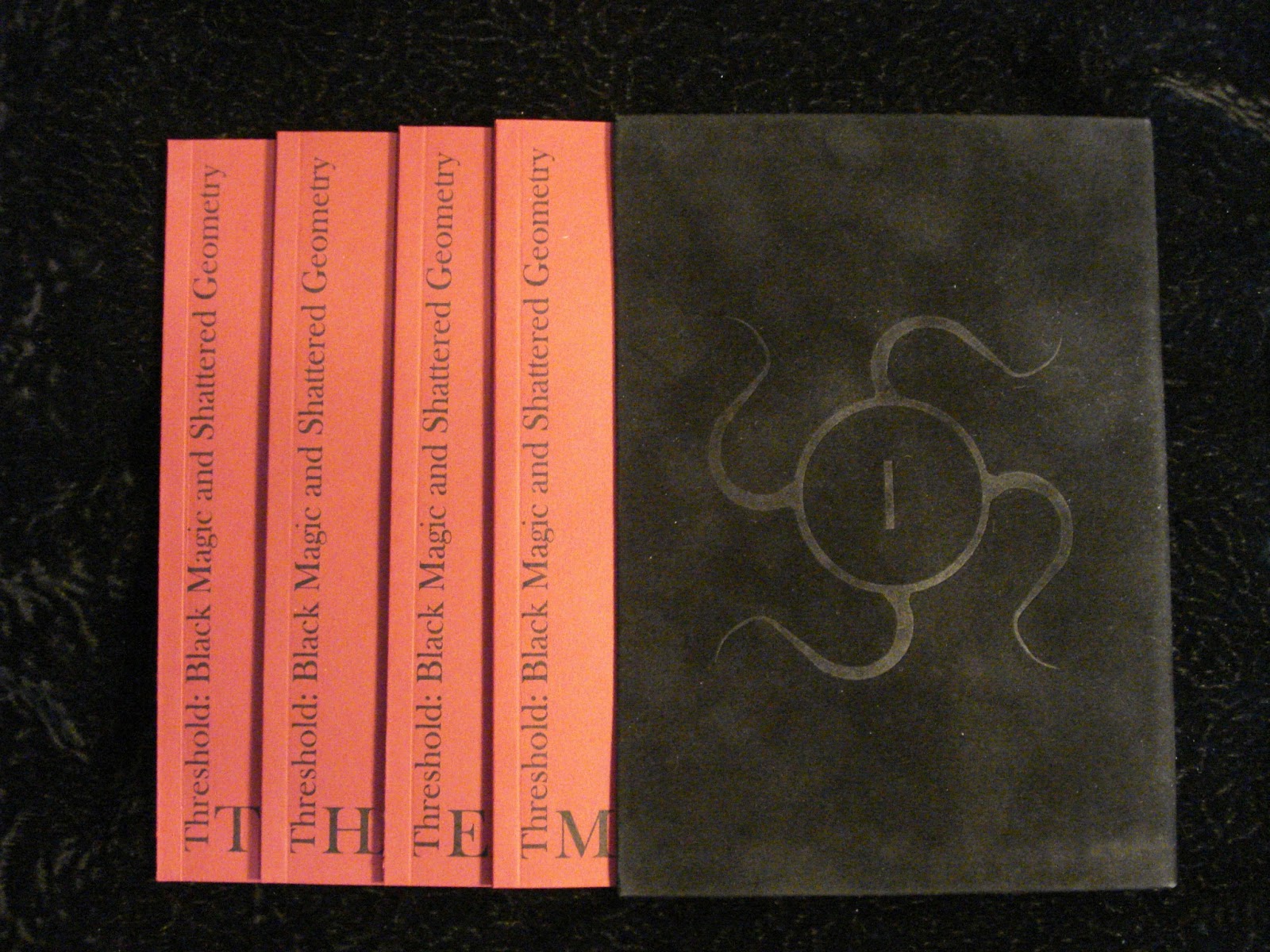
I do not normally review paperback editions, but this set had such a unique presentation that I felt it deserved a brief mention and review. Threshold: Black Magic and Shattered Geometry is a four volume set containing commentary on various aspects of the darker side of post-modern magic. The individual book titles are as follows:
TERATO (60 pages)
HARUSPEX (54 pages)
ENGRAM (43 pages)
MALEFICIA (50 pages)
One will immediately notice that the first letters of the titles create the word, "THEM", referring to the magical body "The Temple of THEM". The first volume, TERATO establishes a baseline for the group's belief system, which appears to be a mixture of post-modern currents such as Satanism (the authors' own take on the term), Chaos-Magic, and psychological concepts of "Ego","Self", and the "Id". The author presents a duelistic world view of two apposing forces, the "Magian" representing the status quo, control systems, and obfuscation, and the "Satanist", representing individuality, rebellion, and liberation.
The second volume, HARUSPEX, contains the authors' general philosophy, and some personal experiences, It's heavy on opinion, including a few rants about Man's laziness, reliance upon superstition, and the need for women to play a larger role in occultism. It also touches upon techniques for readers to govern and channel their emotions to work for them rather than against them. Lastly, the booklet discusses elements of sigil magic, sympathetic magic, and visualizations.
The third volume, ENGRAM includes what The Temple of THEM consider the "Fundamentals of Magic". It also contains a number of invocations, rituals and alchemical distillations of planetary intelligences. It concludes with a inspired ritual for "Rain Magic*k" that is rather unique. Of the four booklets, this one contains the most practical and instructive information for readers.
The fourth volume, MALEFICIA, deals primarily with sex magic, "Narrative Magick", and psychic vampirism. It includes rituals on how to attract members of the opposite sex. The section on psychic vampirism, includes a number of rituals for both protecting/shielding oneself and methods of energy exchange. It ends with a Glossary of terms unique to The Temple of THEM. This is a welcome addition, as magical groups tend to develop their own internal phrases and terminology that may not translate well outside the group.
The booklets themselves are made of simple red card stock with printing in black. The pages are white with a satin texture. Numerous illustrations by Namtaru Creations are found throughout all four volumes. Booklets come with a black suede slipcase blind stamped with one of The Temple of THEM's symbols, a circle with four tendrils turning widdershins about vertical mark (perhaps an "I", or a Roman numeral 1). I found that the slipcase was a bit too tight for the booklets. The books fit exact with no wiggle room. One has to uncomfortably force the fourth book in to make it fit. This could be a problem with my particular slipcase and may not reflect other copies.
Overall Threshold: Black Magic and Shattered Geometry is an interesting body of work. At times it reads like a manifesto of the Temple of THEM's particular beliefs and magical outlook. The authors' have strong opinions on a number of subjects. Readers are unlikely to agree with all of them, but they will likely find some value in the discussion, and perhaps be struck by a few flashes of insight that they can apply to their own practice. I'm going to assume that Ryan Anschauung is the primary author: His writing is very clear and concise and not overburdened with black magic mumbo-jumbo, which plagues so many occult books these days. His writing also reveals significant experience within a diverse range of occult topics. I hope to see more from him. Lastly, Fall of Man should be applauded for trying something new and publishing Threshold: Black Magic and Shattered Geometry in such an interesting (and affordable) format. Also look for their newest release, Lemulgeton - Goetia and the Stellar Tradition by Leo Holmes. Available in two affordable editions HERE.
Ixaxaar 2013. 80 pages. Decimo-sexto (Sixteenmo). Black and white illustrations.
Available in two editions:
Regular edition: Bound in black fauxleather, limited to 1200 copies. Leather edition: Bound in full black goatskin, limited to 100 copies. Sold out at publisher.
"Whoever has come to understand the world has found (only) a corpse, and whoever has found a corpse is superior to the world." -- The Gospel of Thomas
The Catechism of Lucifer first appeared in 2003. It was originally printed in Finnish and limited to 100 copies. Now, ten years later, Johannes Nefastos and Ixaxaar have published this devotional work of Gnostic Luciferiansim in English. The work is presented in the same format as The Catechism of the Catholic Church Luther's Catechism, being slim, small (pocket-sized), and with a similar text structure and layout, as can be seen by the book's major sections:
For the Reader
Sources
Preface to the English Version
The Ten Commandments (Commandments I-X)
The Commandments - A Path of Wisdom
Credo (Creeds I-III)
Magister Noster (Articles I-VI)
Of Lucifer's Sacraments
Of Demons
Of Magic
Of the Responsibility of the Individual
Of Satan
I must confess: I had my doubts about this book when it first became available. I was a bit dubious, for I was afraid it would be a simple inversion of Luther's Catechism and presented as a mocking satire, much in the way the infamous Black Mass is a satire of the Catholic Mass through heretical inversion. While such acts do have some historical basis, and breaking cultural taboos can be used as a powerful psychological technique for triggering altered states of consciousness, I was concerned that its approach would amount to a trite and polemic gimmick via the reversal of a few key words or themes. However, my concerns were put at ease immediately after reading the author's introduction. The main element differentiating this work from Luther's Catechism is its lack of dogma. In the introduction the author states,
"It should be remembered that this particular book is about theosophical Luciferianism, and that there are other true aspects of Luciferian gnosis of ascension. Let us not get imprisoned by these tenets of faith, brothers & sisters, but let us be liberated by them, by the spirit of devotion they try to represent."
This statement makes The Catechism of Lucifer an entirely different animal than the book it is modeled after, the latter being a compendium of strict laws and "truths" that are to be followed to the letter. The titles of some of Nefastos' Ten Commandments appear on the surface to be the standard ten turned on their head; however, instead they are actually a series of deep Gnostic meditations quite removed from the standard Catholic Catechism. He further deviates from the Catholic structure by offering a number of deeper philosophic questions and arguments. In fact, even Christians may find these new Commandments useful, as they may gain a different perspective of their own beliefs by momentarily contemplating their opposites. Other commandments are not oppositional at all to the originals, but are instead a redirection of the concept, such as his Sixth Commandment, "Purify the lust, abandon form-breeding sexuality", which appears to be a refashioning of the original "Thou shall not commit adultery". This commandment also reveals the Gnostic undercurrent of the entire work, which is also revealed in the title of Article VI, "Lead us not into Vanity but Deliver us from the Flesh".
A common belief among Gnostics is that the physical word is imperfect and tainted -- a shabby facade masking higher realms of being. This generally fosters a non-attachment attitude to the physical word, often exemplified in the Gnostic statement, "being in the world, but not of the world". This somewhat mirrors Buddhist beliefs regarding unnecessary attachment to material things and base impulses. Interestingly, the Gnostic Luciferian approach is 100% opposite of many consider "Satanism" to be, at least that of the LaVey school, which promotes hedonism and indulgence in worldly pleasures.
It is tempting for a lot of so-called "Left Hand Path" writers (a term and distinction I find rather asinine) to completely disregard or criticize all Christian practices in an attempt to expunge all traces of Christian influence, even symbolically powerful mystical elements that Christianity appropriated from earlier sources. Thankfully, Nefastos doesn't throw the baby out with the bathwater, as the saying goes. He is astute enough to recognize valuable (and somewhat universal) ritual practices, and is able to re-calibrate them to fit his ethos. Why reinvent the wheel indeed.
Some of the wording in The Catechism of Lucifer is a little over-the-top, such as references to the "Holy Darkness", but it is a forgivable indulgence as it sets a darkly majestic tone and is not out of place for a devotional work. The text includes 24 footnotes throughout the work. The book also includes a number of intriguing quotes from Nefastos' forthcoming work FOSFOROS. FOSFOROS has been bedeviled by production delays, but should be available soon.
The Leather edition is magnificent. Truth be told, I was speechless upon first receiving it. Its rich black goatskin feels incredible. The leather has a fine "pin morocco" grain and is blissfully redolent of the tannery. The cover design, a inverted cross set within a gothic vesica, is deeply stamped in gold. The depth of the stamp will help protect the gilding from wear over the years. The deep stamping in the leather also gives it a high-relief texture, or an intaglio effect. The spine includes 5 raised bands (one for each point of the pentagram?). There is no title on the spine (though the book description on Ixaxaar's site says otherwise). Head and tail bands are of matching black leather, lending a very uniform and classy presentation. Page edges are black and have a sheen similar to a raven's feather. Two ribbon bookmarks are provided, one gold and one black. This feature is especially handy for devotional works, as the reader may want to mark multiple passages for reflection.
Upon first opening the book one will notice the passage (John 12:25 -- "He that loveth his live shall lose it; he that hateth his life in this world shall keep it unto life eternal.") printed in gold along the edge of the inside cover -- a very Gnostic sentiment. It's a nice touch. Endpapers are solid black with a slightly pebbled texture. Interior paper is perfectly suited for the work. Paper is deep cream color, of moderate weight, and has a wonderful linen texture giving it a very antique look and feel. This is further continued by the books font, Blackletter. The choice of Blackletter was certainly a gamble for the author and publisher. I feel it is a wise choice for this work. Reading archaic fonts can be arduous and difficult for some readers, but most should be able to make it through 80 pages without too much trouble, especially since this book is intended to be read in brief contemplative readings. I feel the font's classic look lends an atmosphere of antiquity that far outweighs any difficulty it may present to readers. A number of detailed illustrations by Johannes Nefastos and M. Rautianen are included throughout the work.
Like all devotionals, The Catechism of Lucifer is something that can be read again and again, or read in small inspirational bites. The book's solid construction and layout reveals a lot of thought was put into its design. The Catechism of Lucifer is starkly elegant without excessive flamboyance. Its beauty would make even the most zealous and fanatical "black book" burner reconsider before consigning it to the flames.
Allan Oxford Longprimer Ref Ed. (KJV) 2009. 1264 pages, plus concordance and full-color maps. Octavo. Highland Goatskin.
Available in three colors: Black, Brown, and Dark Blue.
Also available in Black French Morocco.
Stay calm, dear readers. Before many of you go fleeing into the shadows like exorcised demons at the sight of a Bible on this blog, I'd like to include a quick reminder about the book's very long history in the Western Esoteric Tradition. Its ubiquity, and questionable interpretations, should not overshadow its importance, for it is without question one of the most influential books in all of Western magic and a keystone of the Western Esoteric Tradition. It is the talismanic book par excellence. The Book of Psalms in particular is an ancient magical formulary, as David Rankin expertly points out his his book The Book of Gold - the Magic and Spells of the Book of Psalms. I also urge my readers to check out David Chaim Smith's book, The Kabbalistic Mirror of Genesis: Commentary on Geneis1-3 for a deeper exploration of Kabbalistic meaning in the Book of Genesis.
All magical traditions in Europe (and many beyond) were in some way impacted by Christianity, even the Sami shamans of the remote boreal forests of northern Scandinavia did not escape the influence (and tyranny) of Christianity. This fact cannot be avoided, regardless of ones distaste for Christianity's theology and its followers. Many of its tenets, beliefs, and symbolism are written into the very DNA of the Western Esoteric Tradition.
It should also be noted that for the last thousand years the vast majority of European magicians, sorcerers, conjurers and cunning folk where Christian. The same holds true in America. Alchemists, root-workers, pow-wows, and mystics have been overwhelmingly Christian since the days of the Puritans. In Grimoires - A History of Magic Books, author Owen Davies writes, "American treasure seekers seem to have relied mostly on the Bible and the psalms rather than magical conjurations,...". Regarding the Bible, Davies also states:
Some books were also used as protective talismans. The most obvious example is the Bible, which people placed under their pillow to protect them from witches and evil spirits, or touched when swearing oaths. It was also used in popular divination. By placing a key at certain passages in the Bible, binding and then suspending it, the divine power enshrined in the 'good book' would make it turn in response to the name of a thief. The Bible was obviously not a grimoire, but the power of the words, stories, psalms, and prayers it contained, as well as its holiness as an object, made it the most widely used magical resource across the social and cultural spectrum over the past thousand years. ... in the Christian world, the Bible has always been thought a necessary companion of the grimoire, and both were required to make magic.
It is for these reasons that I feel the Bible is an essential book in any esoteric library.
The book also happens to feature one of my favorite protagonists in a prominent role.
Unlike most of my reviews, I will not be commenting on the written content of the Bible. That shouldn't be difficult to find elsewhere. Instead I intend to help my readers navigate through the ocean of Bibles available on the market and choose a quality edition that is right for them. I do not approach this from a belief standpoint, but rather one of functionality.
There are countless Bibles on the market, so deciding on which one is right for you can be a daunting task. The options are virtually endless. However, there were a few traits and features I was looking for which aided me in narrowing down my choices. These are as follows:
Fine binding and quality construction (preferably leather).
English language for ease of use. (Unfamiliar languages can be useful too. More on this later)
A traditional translation, yet not too removed from modern English. The King James Version is the best fit for me.
Not too small - not too large. I didn't want to squint to read fine print. I also wanted something that didn't require a lectern.
A traditional look and feel
After a considerable amount of research I decided the Bible best suited to my needs was the Allan Oxford Longprimer Ref Ed. (KJV). It met all of the criteria above. But don't just take my word for it: It is also a favorite among many Bible enthusiasts. One of my favorite reviews comes from this gentleman below. Book lovers come in all varieties. I admire his obsessive enthusiasm -- it's almost infectious. One wasn't enough; he had to get allthree colors and a stack of variations:
Like the gentleman in the video review above, it is not uncommon for people to own multiple copies/editions of the Bible. In some cases it can prove useful to have a copy printed in a language one is unfamiliar with, such as the Latin Vulgate Bible (if one doesn't know Latin). Finding one is easy, as the Bible is the most widely translated book in the world. Why own a copy one can't understand? The reason for this is simple: when one reads passages in an unfamiliar language it amounts to a "barbarous tongue" to one's ear and bypasses normal logic circuits of the brain. Meaning is experienced abstractly through auditory channels, much like listening to instrumental music, rather than via normal verbal cognition. Passages are felt rather than understood, at least on a rational level. Speaking in alien tongues is also an effective tool for putting the reader into a totally different 'head-space' outside the norm. For example, I have bi-lingual Bible printed in Pennsylvania Dutch, an obscure dialect of German, for just this purpose. I am totally unfamiliar with this dialect, yet when I read passages I feel as if I am invoking a distinct magical aesthetic that is highly appropriate for some workings.
The R L Allan Longprimer is bound in full Highland goatskin with a limp binding. This is a traditional style for Bibles, making them very flexible, easy to carry, and use. The limp binding is extremely pliant and soft. One can even roll the book up and bend it into all sorts of configurations without harming the binding. This is a practice Bible aficionados amusingly call "Bible yoga".
Normally a photo like this would make me cringe, but the limp binding
of the R L Allan Longprimer is intended for this sort of "Bible yoga".
The Highland goatskin has a luxurious, heavily gained texture, and has a full 1/2 inch overlapping yapp. The yapp is the part of the book's cover that extends beyond the text block on top, bottom, and side. With a limp binding the yapp can bend around on the sides of the text block to help protect it. The title is gilt stamped on the cover and spine. The spine also includes five bands.
A close-up of the book's yapp.
The inside covers are accented with two gilt lines. Cover page and end page are navy blue with a linen texture and are reinforced with leather to add strength to the binding. Other indications of quality are readily apparent. The publisher states,
This Bible has the distinctive 'overcasting' feature which used to be standard on quality binding. Basically you will find a extra line of stitching about 1/8 of an inch from the middle stitch, usually in Genesis and Revelation. This feature adds to durability and a feature of old school craftsmanship.
Head and tail bands are white. Page edges are colored red and gold gilt. This creates a lavish effect, as the page edges change color depending on how they are held to the light. Three royal blue silk bookmarks are included to mark multiple passages. I find this extremely handy.
As with most Bibles, the pages are thinner than most books, hence the paper phrase "Bible thin". This is a necessity due to the page-length of Bibles. However, the R L Allan Longprimer has far better pages than most. They are solid without feeling like "onion skin" and have minimal ghosting. Text is clear and sharp in 10 point bold, divided into dual columns, and includes center column references.
The book includes presentation pages for family history such as births, marriages, and deaths. This is a common inclusion in Bibles, as many become family heirlooms. The book concludes with a full concordance, full color maps, and over thirty lined pages for personal notes.
Overall the R L Allan Longprimer Bible is an impressive and handsome book. Its solid construction and practical design make it a great choice for both Christians AND magicians. When open it will lay completely flat, freeing one's hands for other ritual tools. It is an essential companion to most traditional grimoires and a primary talismanic tool in many charming traditions.